
Travel Medical IDs — Multilingual Bands for Travellers
A medical ID is only useful if the person who finds you can read it. For Australians travelling overseas — a Camino pilgrim in Spain, a family on a Tokyo holiday, a business traveller in Seoul, a cruise passenger calling at Marseille — that means a band engraved in the local language of the country you're in. This page covers the multilingual Mediband range, what to engrave for each destination, and how to set yourself up so the first stranger to find you understands the brief in five seconds.
Custom-engrave a travel band — in your destination's language →
Designed in Australia
Since 2004
Engraved in 30+ languages
Spanish, Japanese, Korean, French & more
NDIS-registered
Provider 4050021192
10–14 business days
Expedited available on request
Why language matters at the destination
An English-language medical ID works at home because the people most likely to read it — paramedics, ED clinicians, friends, family — all read English. Step off a plane in Madrid, Tokyo or Seoul and the people most likely to read your band are a Spanish guardia civil, a Japanese police officer, a Korean ambulance crew. Most of them read their own language fluently and English partially. A band engraved in the local language closes that gap and gets the right intervention started in seconds rather than minutes.
The five conditions where the language gap matters most: anticoagulant therapy (the trauma protocol changes), severe allergy (the receiving ED needs the trigger named), insulin-dependent diabetes (low blood sugar looks like a thousand other things), epilepsy on a specific antiseizure medication (the rescue medication may differ between jurisdictions), and pacemaker / ICD recipients (AED pad placement depends on knowing the device is there). All five are common Mediband custom-engraving requests for travellers.
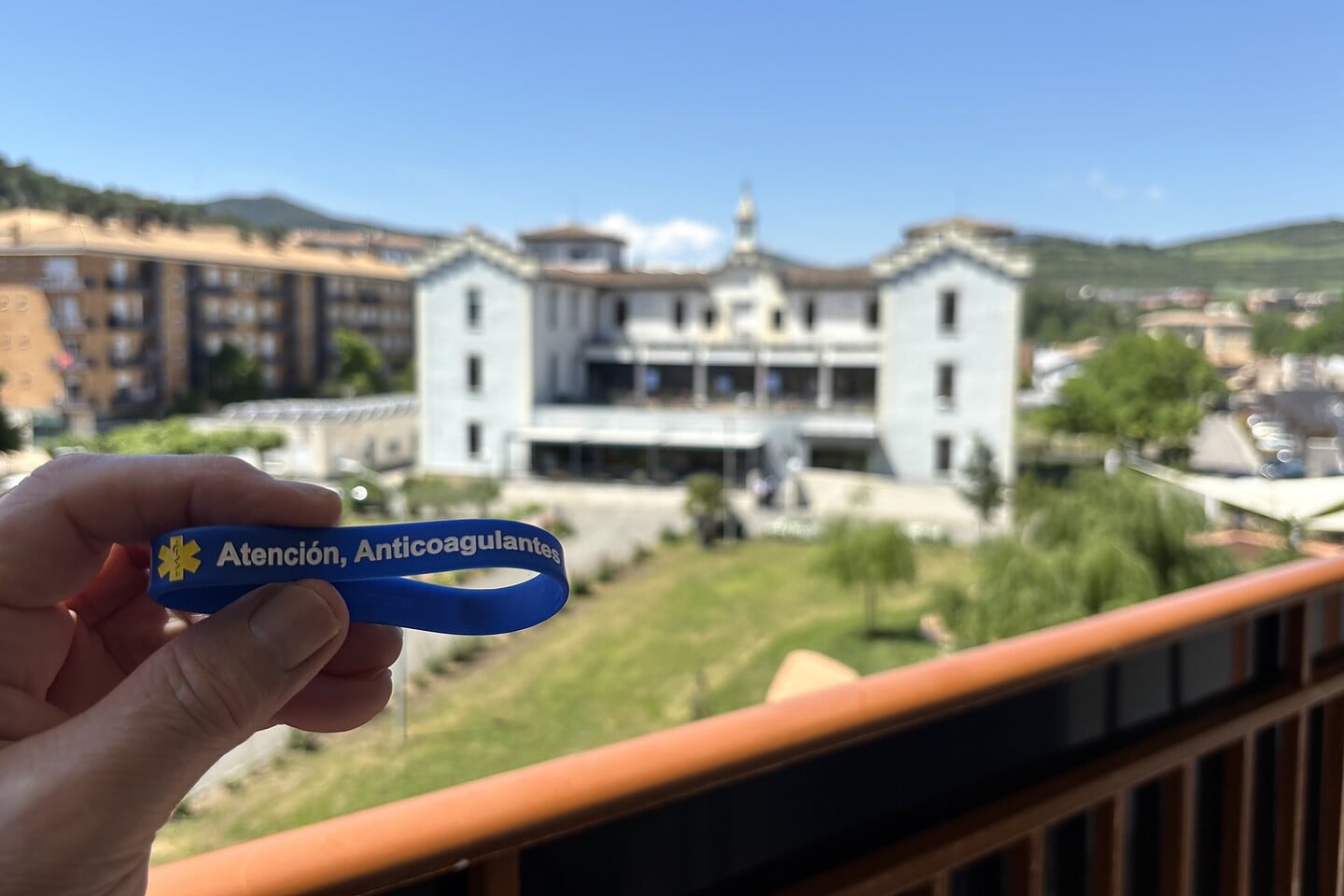
“I keep my band on all the time I’m in Spain. Presently in Estella, bike riding 850km for six weeks.”
Mediband customer, Spain — June 2026. Riding the Camino de Santiago with a Spanish-engraved “Atención, Anticoagulantes” band.
The Mediband multilingual range
Mediband has engraved bands in 30+ languages over the last 20 years. The five most common travel destinations for Australian customers — Spain / Latin America, Japan, Korea, France, Italy / German-speaking Europe — have well-trodden engraving conventions for each major medical condition. Custom-engraved silicone bands carry up to three lines per face, in the script of your destination. Below: examples from real Mediband custom orders.
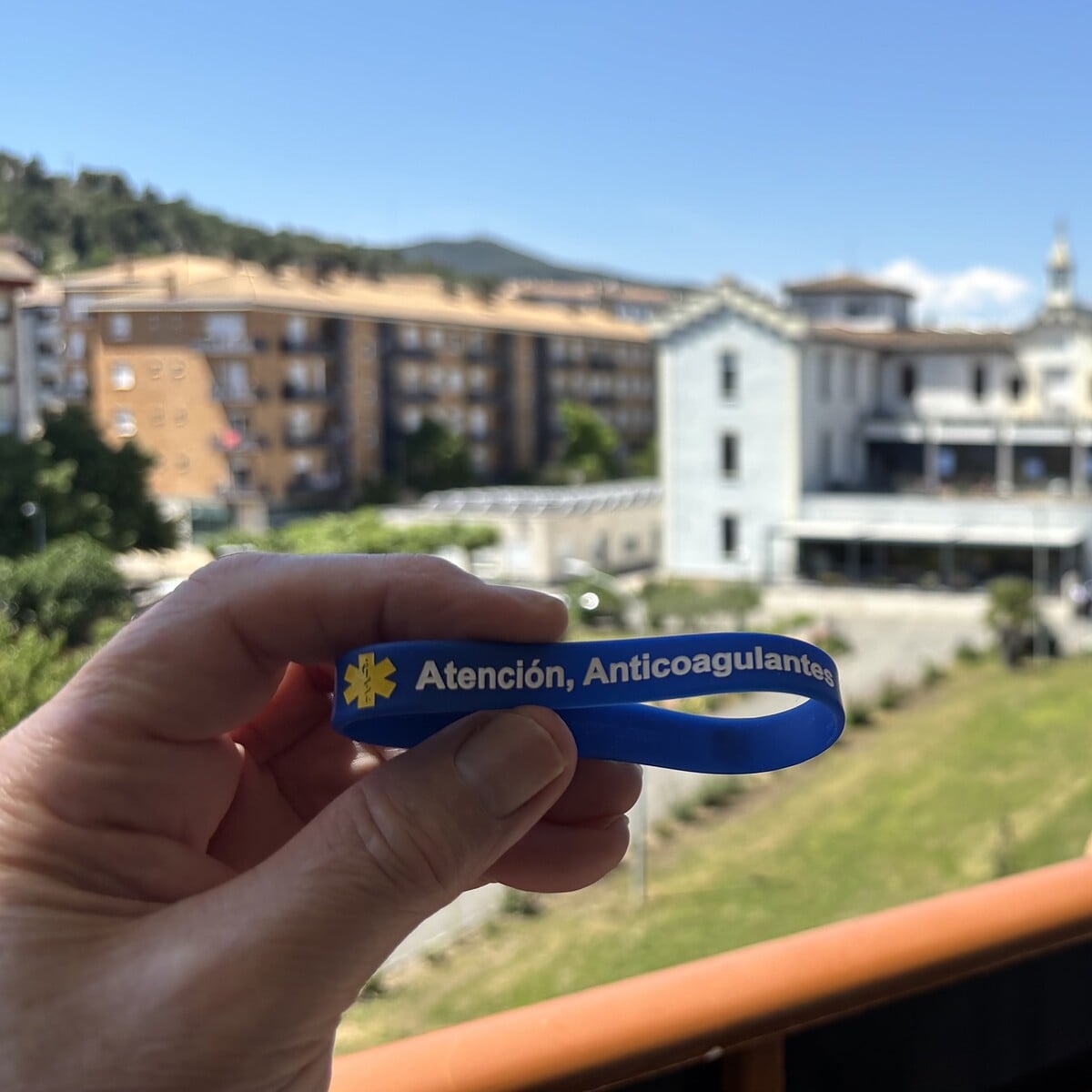
Spanish — Atención, Anticoagulantes
Blue silicone band engraved in Spanish for travellers in Spain, Mexico, Argentina, Chile, Peru and the wider Spanish-speaking world. The medical alert star plus the Spanish phrase identifies an anticoagulant patient to a guardia civil, a paramedic or an ED clinician in seconds. Pair with a wallet card carrying the drug name (warfarin, apixaban, rivaroxaban, dabigatran) and the dosing schedule in Spanish.
Common requests: Atención Anticoagulantes, Diabético Tipo 1, Alergia Cacahuetes, Marcapasos.
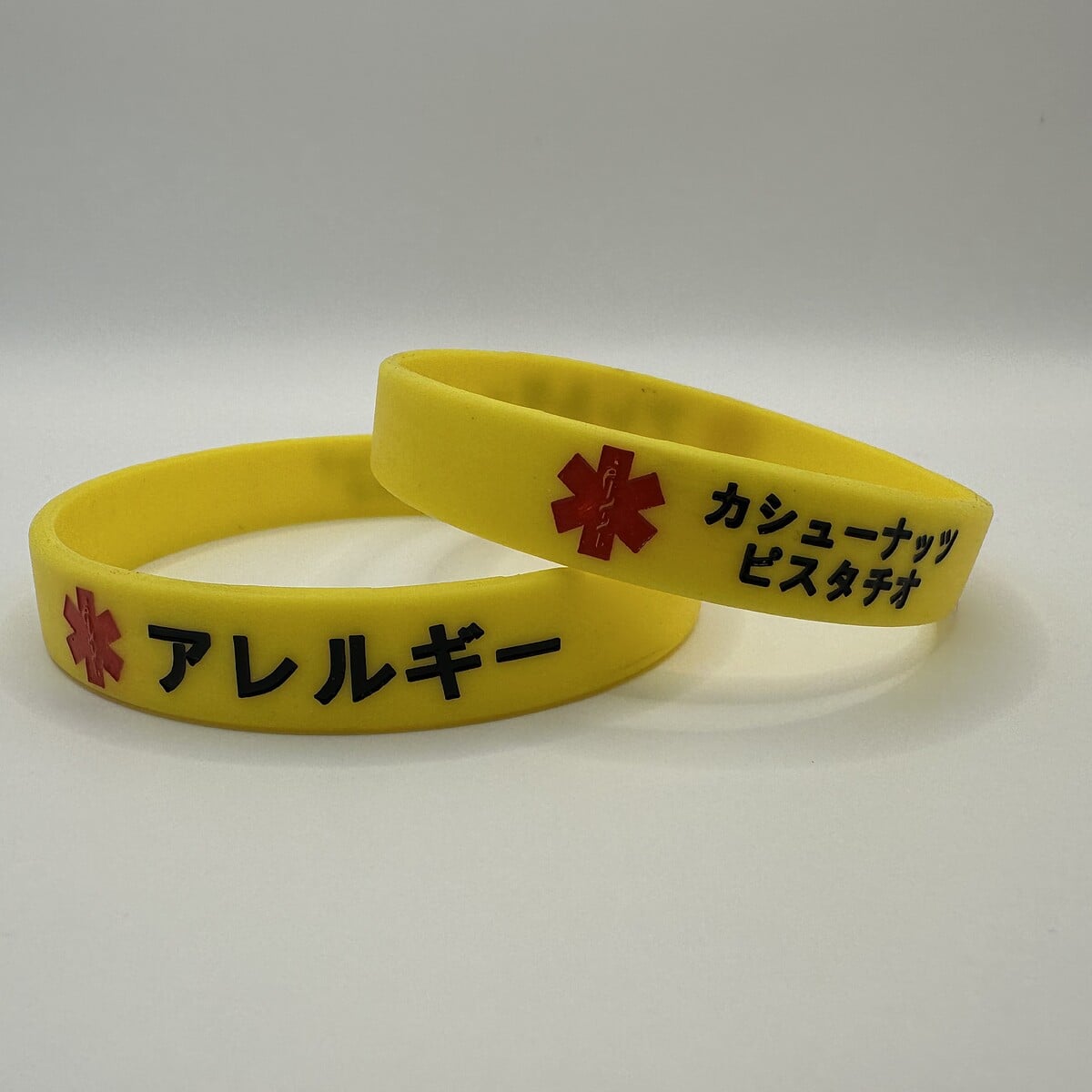
Japanese — アレルギー
Yellow or red silicone bands engraved in Japanese kana / kanji for travellers in Japan. The medical alert star plus the Japanese script identifies the condition or allergen to ambulance crews and ED clinicians in major cities and rural areas alike. For allergy travellers, the trigger ingredient name in katakana is the key engraving (peanut, shellfish, cashew, sesame) because these are common in Japanese cuisine and not always translated on menus.
Common requests: アレルギー (allergy), カシューナッツ (cashew), ピスタチオ (pistachio), ペニシリン (penicillin), 糖尿病 (diabetes).
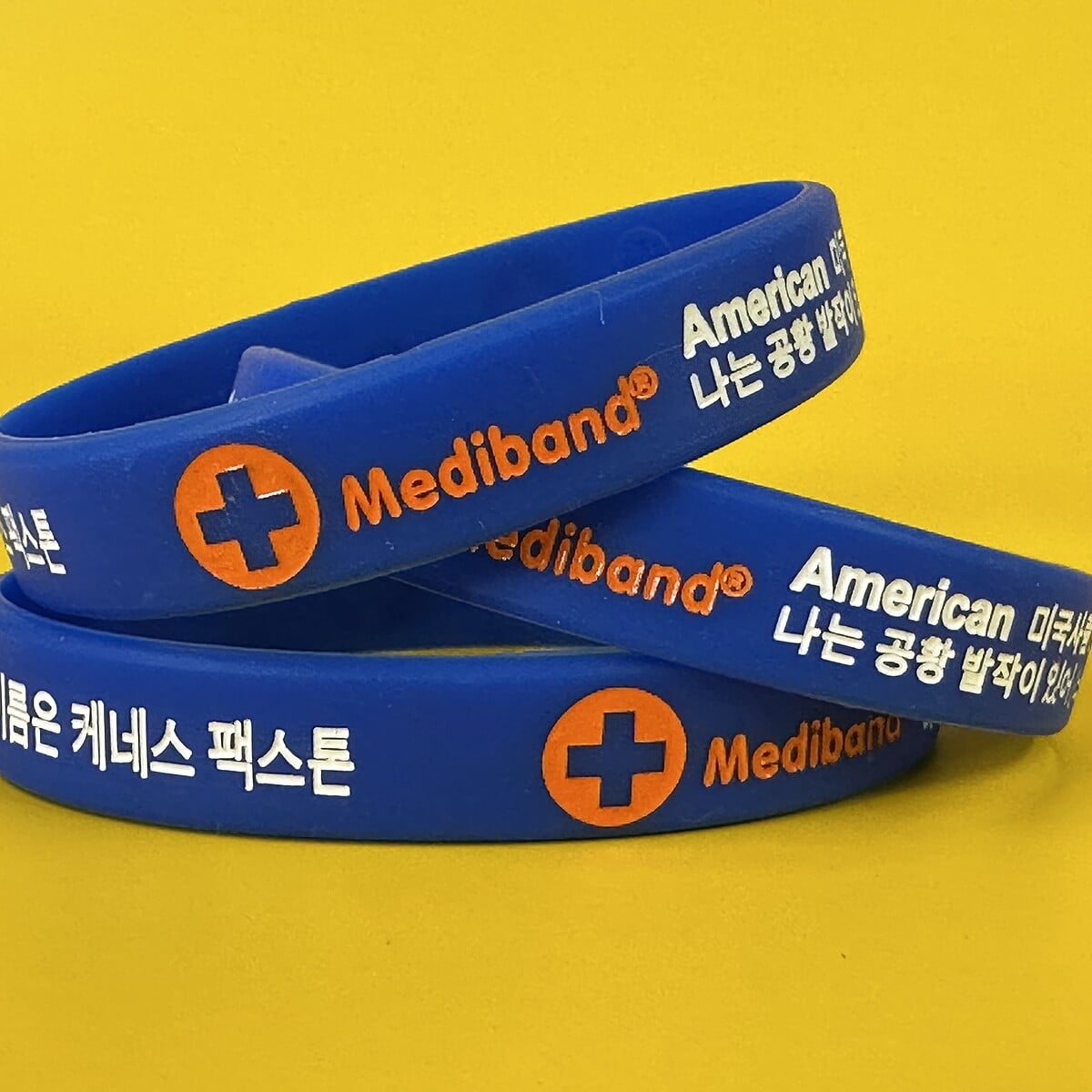
Korean — 한국어
Blue or red silicone bands engraved in Korean Hangul, often paired with English on the same band for travellers in Seoul, Busan and across South Korea. Common for Australian visitors with mental-health conditions (panic disorder, anxiety), drug allergies, or insulin-dependent diabetes. The Hangul script reads naturally to Korean emergency responders; English is a useful backup for international staff at major hospitals.
Common requests: 나는 공황 발작이 있어요 (I have panic attacks), 커페인 (caffeine), 페니실린 (penicillin), 당녺병 (diabetes).
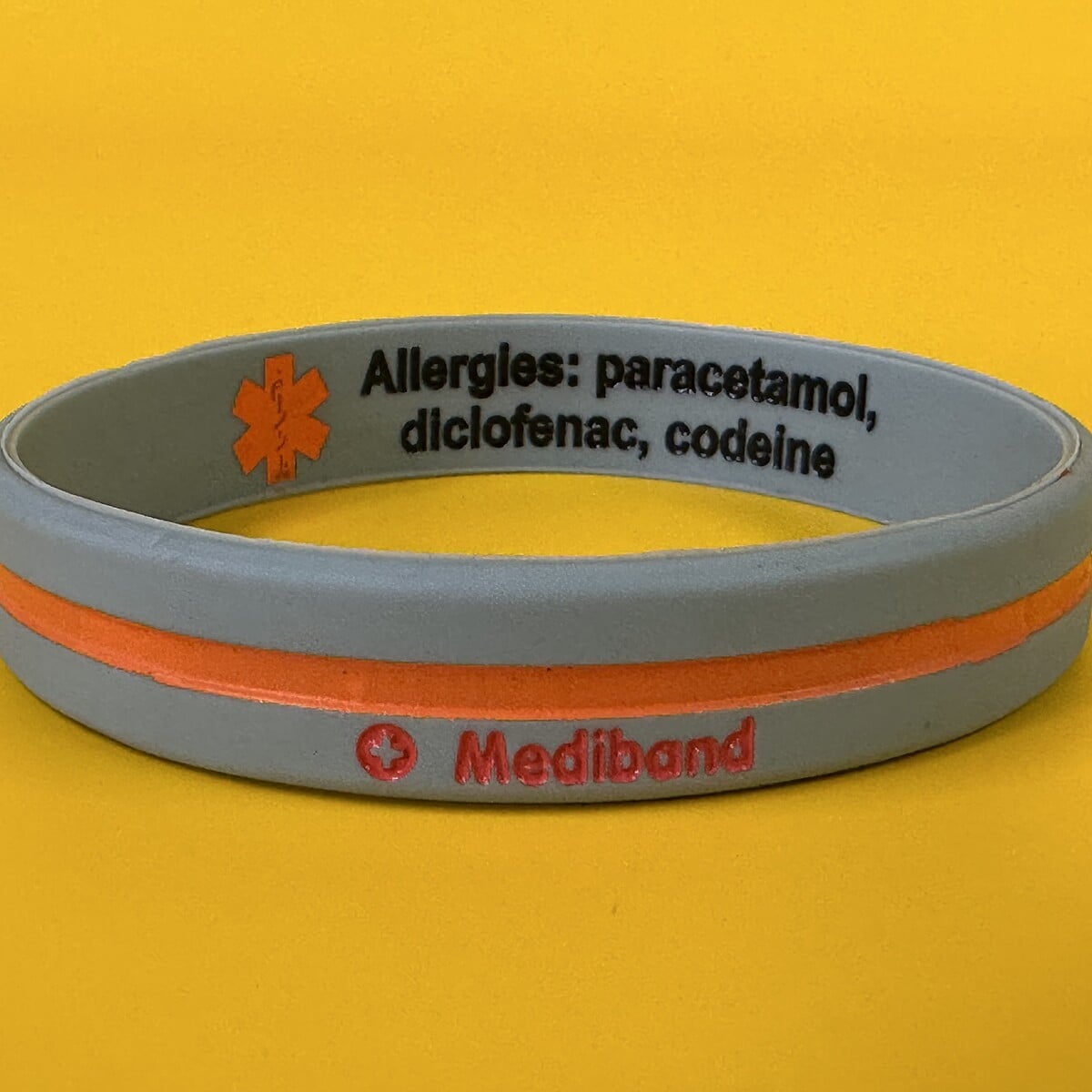
French — Allergies / Anticoagulants
Grey or red silicone bands engraved in French for travellers in France, French-speaking Switzerland, Belgium, Quebec and across French-speaking Africa. Drug-allergy bands are the most common French request (paracetamol — the European-name for acetaminophen, diclofenac, codeine). For paediatric anaphylaxis travellers, the food trigger in French (arachide for peanut, fruits à coque for tree nuts, lait for milk) prevents menu-translation misadventures.
Common requests: Allergies: paracetamol diclofenac, Diabétique Type 1, Anaphylaxie Arachide, Anticoagulants apixaban.
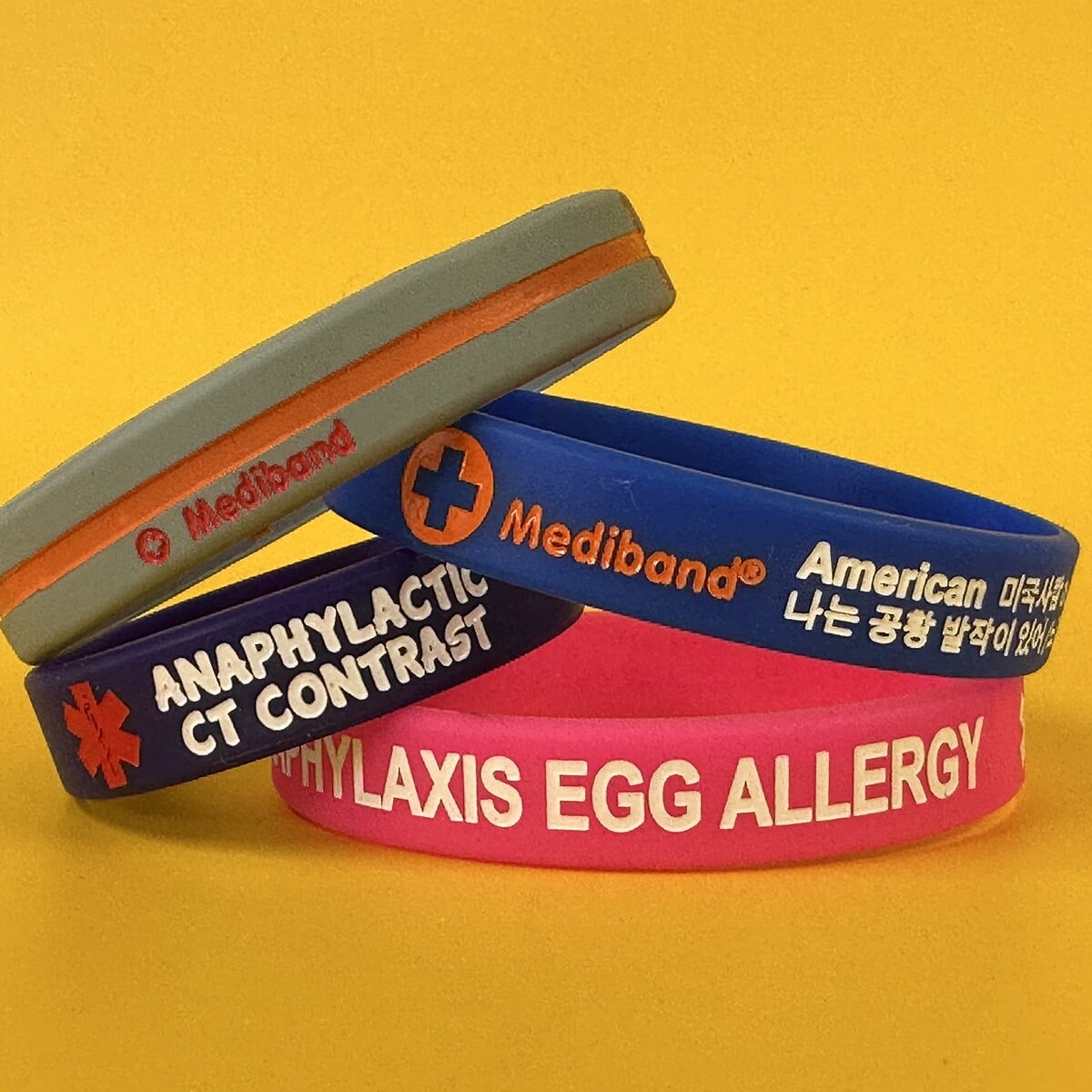
German, Italian, Mandarin & more
Beyond the four most common languages, Mediband regularly engraves German (Allergie / Diabetiker / Antikoagulans), Italian (Allergia / Diabetico / Anticoagulante), Mandarin (过敏 / 糖尿病 / 抗凝血剂), Portuguese, Greek, Vietnamese, Thai and Arabic. For multi-country itineraries — a Europe tour through Spain, France, Italy and Germany — we recommend the medical alert symbol plus the most readable language across the route, often supplemented with an English version on a second band or wallet card.
Tip: for multi-country trips, the medical-alert star is universal — first responders recognise it regardless of language.
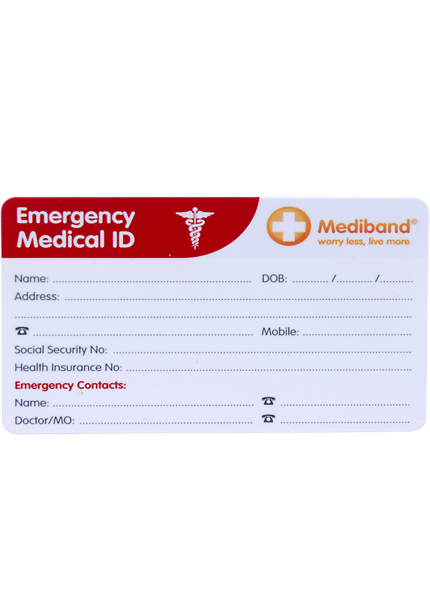
Wallet card — full profile in the destination language
For travellers on multiple medications or with complex conditions, pair the band with a Mediband wallet card carrying the full medication list, dosing schedule, treating Australian GP / specialist contacts in international format (+61 country code), travel insurance pointer, and ACD status. The card can be printed in both English and the destination language for the receiving ED.
Recommended for: Webster pack travellers, multimorbidity travellers, kids on long-term medication, travellers with ACD on file.
What to engrave for each destination — worked examples
Each band carries: the condition or allergen in the destination language, the patient's name (international convention is FIRST LAST in Roman characters even on non-Roman-script bands so the receiving system can match), and a primary contact in international format (+61 4XX XXX XXX so the number works from any country without needing the Australia code). Wallet cards carry the full picture.
Example — cycling tour of Spain, anticoagulant patient
| Front | ATENCIÓN, ANTICOAGULANTES — APIXABAN |
| Back | RON STEWART | ICE Wife +61 412 345 678 | GP +61 2 9XXX XXXX |
Example — family holiday to Japan, child with tree-nut allergy
| Front | アレルギー | カシューナッツ | ピスタチオ |
| Back | EMMA TAYLOR | Parent +61 412 345 678 | EpiPen Jr in bag |
Example — business trip to Seoul, panic-disorder patient on benzodiazepines
| Front | 나는 공황 발작이 있어요 | I HAVE PANIC ATTACKS |
| Back | KENNETH PAXTON · 케네스 홑스터 | ICE Wife +61 412 345 678 |
Example — multi-country Europe tour, drug allergies
| Front | ALLERGIES: PARACETAMOL, DICLOFENAC, CODEINE |
| Back | JEAN HARRIS | ICE Daughter +61 412 345 678 | GP +61 2 9XXX XXXX |
Tip: where one band can't carry every language for a multi-country trip, pair an English-language band with the wallet card carrying full medication and clinician detail in the most-used destination language. Or order two bands — one in your primary destination's language, one in English — and wear both.
Travel scenarios where a band changes the outcome
Cycling, hiking and adventure travel
The Camino de Santiago, the Tour Aotearoa, a self-guided Alps trek — long-distance solo or small-group travel where you may be hours from a clinical handover when something goes wrong. The band stays on through rain, sweat and showers; the wallet card stays dry in a sealed pocket. Pair the local-language band with an emergency contact who speaks the local language if possible.
Family holidays with paediatric allergies
Japan, Italy, Spain — cuisines built around peanut, tree nuts, dairy, gluten and shellfish in ways that don't always translate clearly on a menu. A band engraved with the trigger in the local language gives a waiter, a hotel chef, a school excursion teacher, or a first responder the right information in their first language. Pair the band with an EpiPen Jr or Anapen Jr in the family day bag and an ASCIA Action Plan translated for the destination.
Business travel on chronic medications
Frequent flyers on apixaban, lithium, methotrexate, sertraline, clozapine or any clinically time-sensitive medication. A band engraved in the destination language — or the airline hub language for layover medical events — gives the cabin crew, the airport medical desk, and the receiving city's ambulance crew the critical drug name without needing to wake the patient. Pair with a wallet card carrying the full schedule and the home prescribing clinician's number.
Cruise travel and remote-port emergencies
A medical incident at sea or in a small port-of-call town where the local hospital may not have an English-speaking ED clinician on duty. The band carries the headline; the wallet card carries the medication chart and treating Australian clinician contacts. Most cruise medical teams will photograph the band and card during patient onboarding so the information travels with the case file.
Airport security, ASCIA Action Plans, and Smart Traveller
Adrenaline autoinjectors at airport security. EpiPen and Anapen autoinjectors are permitted in cabin baggage on all major airlines from Australia, but the security screening process can be smoother if the device is labelled with the prescribing clinician's details and the patient's name. ASCIA's Travel and Allergies guidance recommends carrying a copy of the ASCIA Action Plan (translated for the destination where possible), a doctor's letter listing all carried medications, and the original pharmacy packaging for medications travelling in carry-on. The Mediband wallet card carries the clinician summary alongside the band's headline.
Smart Traveller registration. The Department of Foreign Affairs and Trade's Smart Traveller service lets Australians overseas register their itinerary so DFAT can contact next-of-kin in an emergency. Registering before departure pairs naturally with wearing a Mediband — the band identifies the condition at the scene, Smart Traveller identifies the traveller in the system.
Travel insurance and pre-existing conditions. Most Australian travel insurers require disclosure of pre-existing conditions and current medications. Carrying a band and a wallet card matching the disclosure documentation makes the insurer's medical-emergency claim process noticeably faster — the band content matches the disclosure form which matches the hospital admission notes, so there's no inconsistency for the insurer to query.
What Mediband travellers say
★★★★★ Three verified Mediband customer reviews from travellers and their families — a long-time customer cycling the Camino on anticoagulants, an anaphylaxis traveller, and a 10+ year wearer of a pacemaker recipient band describing the band's effect on his clinical care.
★★★★★
Keep it on the whole trip.
“I keep my band on all the time I’m in Spain. Presently in Estella, bike riding 850km for six weeks.”
Mediband customer, Spain — June 2026. Anticoagulant patient, custom-engraved Spanish band.
★★★★★
Emergency Services know.
“My husband had an anaphylactic reaction to Penicillin — he collapsed and almost died. The Mediband lets Emergency Services know, if he’s unconscious, what the problem is.”
Cazza — Anaphylaxis Alert Camouflage Medical ID.
★★★★★
Speak for me when I can't.
“100 percent of the medical personnel I’ve come in contact with have noticed this bracelet. I wear it 24/7 to speak for me when I can’t speak for myself.”
Michael S. — Pacemaker Recipient Bracelet — USA — 10+ year customer.
Why Mediband for travellers
Mediband has been designing medical IDs in Australia since 2004 — more than 22 years of engraving for Australian travellers heading overseas and international visitors coming the other way. We have engraved bands in more than 30 languages over that time. Every band is engraved to order in Australia; pre-printed B-series and W-series bands ship same business day from Australian stock when ordered before midday AEST. Custom-engraved bands ship in 10–14 business days, with expedited turnarounds available on application for travellers with locked-in departure dates.
For travellers specifically: we accept international shipping addresses, we know the common engraving conventions for the major travel destinations, and we handle the script differences (Roman, kana / kanji, Hangul, Cyrillic, simplified and traditional Chinese, Greek, Thai, Vietnamese, Arabic) routinely. NDIS-registered (provider 4050021192) for participants travelling overseas with their plan.
Related condition hubs
If you're travelling with a specific condition, the dedicated hub for that condition has more detail on engraving conventions, recommended bands and supporting wallet-card content — all of which apply to the multilingual travel band as well.
Anaphylaxis
Food, insect, drug, latex allergy →
Diabetes
Type 1, Type 2 and pump users →
Epilepsy
Seizure disorders, AED medications →
Pacemaker, ICD & CRT-D
MRI-conditional flags, AED placement →
Frequently asked questions
What languages can Mediband engrave?
Mediband has engraved bands in more than 30 languages over the last 20 years. The most common travel destinations — Spanish, Japanese, Korean, French, Italian, German, Mandarin (simplified and traditional), Portuguese, Greek, Vietnamese, Thai, Arabic — are routine. Less-common scripts including Cyrillic (Russian, Bulgarian), Hindi, Hebrew and Indonesian Bahasa are also available on application. Order through custom engraving and specify the language and exact characters in the order notes.
How long does a custom multilingual band take to ship?
Custom-engraved silicone bands ship in 10–14 business days from the order date. Expedited turnarounds are available on application for travellers with locked-in departure dates — call 1300 796 401 during business hours AEST or note your departure date in the order. International shipping is available; transit time depends on the destination country.
Should I order a band in just the local language or in both English and the local language?
For a single-country trip, the local language is usually enough — the medical alert symbol is internationally recognised and the local script reads naturally to first responders. For multi-country trips or layover-heavy itineraries, pair a destination-language band with an English-language band (or English text on the second face) so any English-speaking clinician at a major hub airport also reads the band fluently. The wallet card is the better place to carry detailed multi-language information.
Can I take my EpiPen / Anapen through airport security?
Yes, adrenaline autoinjectors are permitted in cabin baggage on all major airlines departing Australia. ASCIA recommends carrying the device in its original pharmacy packaging (with the patient name and prescribing-clinician details visible), a copy of the ASCIA Action Plan (ideally translated for the destination), and a doctor's letter listing all carried medications. The Mediband wallet card pairs with these documents and stays in your day bag for the duration of the trip.
Does my Australian travel insurance recognise a Mediband?
Most Australian travel insurers don't require a Mediband, but carrying one paired with the wallet card noticeably speeds up the claims process for medical emergencies overseas. The band content matches the pre-existing-condition disclosure form you complete at policy purchase, which matches the hospital admission notes overseas, which matches the claim documentation you submit on return. Consistency across those three artefacts reduces the queries the insurer's medical-claims team has to chase.
Does Mediband ship internationally?
Yes. Mediband ships to most countries via Australia Post International. Transit times vary by destination: 7–14 business days to the US, UK and EU; 5–10 to Asia-Pacific; longer to South America and parts of Africa. For travellers already overseas who need a band shipped to a hotel or pickup point, contact [email protected] with the address and required-by date and we'll quote an expedited option.
Is Mediband recognised internationally?
Mediband bands carry the internationally recognised medical alert star symbol on the outer face. Clinicians at hospital systems including Boston Children's Hospital, LA County Hospital and major UK and Asia-Pacific centres regularly identify Mediband-style alert jewellery during patient assessment. The local-language engraving is what makes the band useful in the specific destination — the star tells responders it's a medical ID; the script tells them what it says.
Pack your medical ID with your passport
Custom-engrave a Mediband in your destination's language — Spanish, Japanese, Korean, French, German, Italian, Mandarin and 20+ more. Designed in Australia since 2004. NDIS-registered (provider 4050021192). Expedited turnarounds available on application for locked-in departure dates.
Custom-engrave a travel band → Add a wallet card →
Travelling soon and need an expedited turnaround? Call 1300 796 401 — business hours AEST — or email [email protected].
About this page: Mediband has been designing medical IDs in Australia since 2004. We are an NDIS-registered supplier (provider 4050021192). Australian peak-body references on this page are: ASCIA (Travel and Allergies guidance), Allergy & Anaphylaxis Australia, Diabetes WA, Epilepsy Action Australia and Dementia Australia — each of which publishes guidance recommending medical identification jewellery for people living with the conditions they support. Travel-document references: Department of Foreign Affairs and Trade (Smart Traveller). Resuscitation reference: ANZCOR Guideline 2 (Managing an Emergency, April 2021) which directs rescuers to check for physical alert devices including alert jewellery. Customer testimonials are verbatim from verified Mediband customers; the Spain bike-tour customer's testimonial is shared with permission. Engraving examples reflect common Mediband requests; they are not a substitute for the patient's treating clinician and should be reviewed against the current diagnosis and medication chart before engraving. Language conventions reflect common practice; double-check uncommon medical terminology with a translator or local clinician before engraving.