
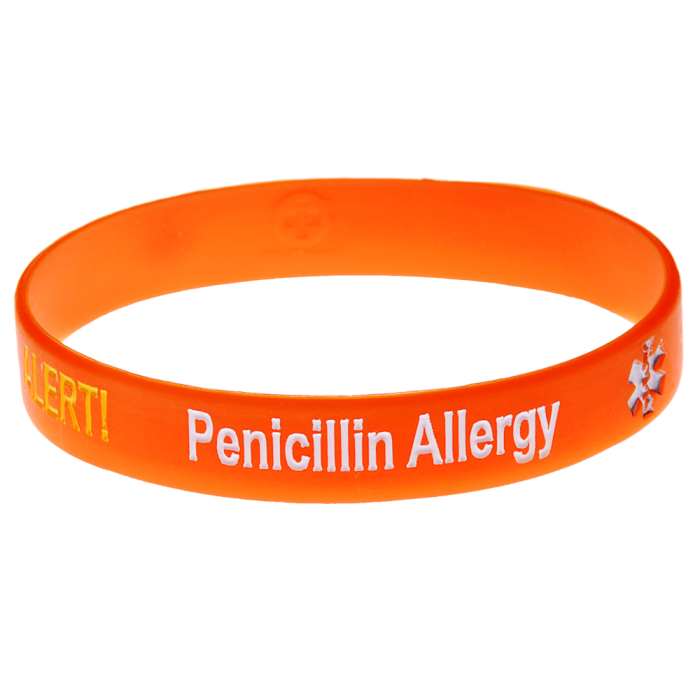
Penicillin Allergy Medical Bracelet
$7.08
SKU
B0776


| SKU | B0776 |
|---|---|
| Manufacturer | Mediband |
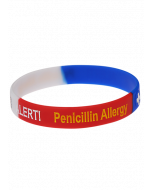
Penicillin Allergy Medical Alert Bracelet
The Penicillin Allergy Medical ID Bracelet is essential safety wear for anyone with a documented allergy to penicillin or any beta-lactam antibiotic. Around 10% of Australians report a penicillin allergy — one of the most common drug allergies — and in an emergency, ED staff need to know in seconds. Administering penicillin (or any related beta-lactam) to an allergic patient can trigger anaphylaxis, hives, severe skin reactions or fatal cardiovascular collapse.
The bracelet tells paramedics, anaesthetists, surgeons and ED staff: do not use penicillin, amoxicillin, augmentin, cephalosporins or carbapenems — choose an alternative antibiotic class.
Why a Visible Penicillin Allergy Bracelet Matters
In healthcare settings:
- Emergency surgery — routine prophylactic antibiotic is usually a cephalosporin (often beta-lactam) — the bracelet triggers immediate substitution
- Sepsis treatment — first-line empirical therapy commonly includes penicillin or piperacillin/tazobactam
- Unconscious patient — staff cannot ask about allergies; bracelet speaks for the patient
- Hospital admission — allergy is flagged on the chart from minute one
Without a visible alert, a serious cross-reactive antibiotic can be administered before the chart is checked — with consequences that range from rash to fatal anaphylaxis.
What to Engrave on a Penicillin Allergy Bracelet
- "Penicillin Allergy" — clear and unambiguous
- Reaction type if known — "Anaphylaxis", "Hives", "Stevens-Johnson"
- Cross-reactive class — "Avoid all beta-lactams" if true
- Your name + emergency contact mobile
- (Optional) other drug allergies on the reverse
Who Should Wear One
- Anyone with a documented true penicillin allergy
- Patients with reactions to amoxicillin, augmentin or any beta-lactam
- Patients with cross-reactivity to cephalosporins (less than 1%)
- Children with diagnosed penicillin allergy — especially for school + sport contexts
- Anyone with anaphylaxis history to antibiotics
The Cross-Reactivity Question
Recent Australian and international research shows:
- Around 90% of self-reported penicillin allergies are NOT true allergies — the original "reaction" was a viral rash or non-allergic side effect
- True IgE-mediated penicillin allergy carries less than 1% cross-reactivity to modern cephalosporins (cefazolin, cefuroxime)
- Patients with anaphylaxis history should still avoid all beta-lactams without specialist review
If you've never had formal allergy testing and your "allergy" is decades old, ask your GP for an immunologist referral — you may be able to de-label safely. Until then, wear the bracelet.
How Paramedics + ED Read the Bracelet
Orange silicone + Star of Life makes "Penicillin Allergy" visible in seconds. ED staff add the allergy to your chart on arrival, brief the treating team, and substitute alternative antibiotics (clindamycin, vancomycin, macrolides, or fluoroquinolones depending on indication).
Care & Sizing
Medical-grade silicone, waterproof, sweat-proof, dishwasher-safe, 4-5 year lifespan. S/M/L/XL.
Related Mediband Medical Alert Bracelets
Frequently Asked Questions
Quick answers from the Mediband team
What is a penicillin allergy bracelet?
A medical alert bracelet engraved with 'Penicillin Allergy' that tells paramedics, anaesthetists, ED staff and surgeons to avoid penicillin, amoxicillin, augmentin and (in severe cases) all beta-lactam antibiotics.
Is penicillin allergy really that dangerous?
Yes for true IgE-mediated allergy — reactions range from severe rash to anaphylaxis and fatal cardiovascular collapse. Around 10% of Australians report a penicillin allergy; the bracelet ensures that warning reaches every clinician within seconds.
What if my 'allergy' was from childhood and I'm not sure?
Recent research suggests 90% of self-reported penicillin allergies are not true allergies — often a viral rash misattributed. Ask your GP for an immunologist referral to formally test and potentially de-label. Until then, keep wearing the bracelet.
Do I need to avoid cephalosporins too?
True penicillin allergy carries less than 1% cross-reactivity to modern cephalosporins (cefazolin, cefuroxime). However if you had anaphylaxis, the safer policy is 'avoid all beta-lactams' until allergist-cleared — engrave that on the bracelet.
Can children wear a penicillin allergy bracelet?
Yes — soft silicone is safe from age 3. Many Australian parents put one on their child with documented penicillin allergy for school, sport, sleepovers and any travel. Include 'See parent' or an emergency contact mobile.
Related Products
Check items to add to the cart or
We found other products you might like!