
Quick answer
The abbreviations and symbols on a medical alert bracelet tell a first responder, in a few characters, what matters in an emergency — a condition (T1DM, AF, EPILEPSY), an allergy (NKDA, ALLERGY: PENICILLIN), a device (ICD, CRT-D), a medication instruction (PRN, BD), or a care directive (DNR). This guide explains the common ones in plain English, and shows which are safe to engrave and which are better written out in full.
Medical ID abbreviations and symbols: what the letters on a medical alert bracelet mean
A medical ID has very little room, so it leans on abbreviations and a recognised symbol to carry the message. The trade-off is that an abbreviation only works if the person reading it understands it. This page is a plain-English reference to the abbreviations and symbols you are most likely to see — or consider engraving — on a medical alert bracelet, necklace or wallet card, grouped by what they describe.

Shop engraved medical alert bracelets →
Designed in Australia
Since 2004
NDIS-registered
For eligible participants
Engraved to order
Laser-engraved, permanent
22+ years
Designing medical IDs
On this page: The symbols · Condition & alert abbreviations · Device abbreviations · Medication & dosage abbreviations · General clinical abbreviations · What to actually engrave · FAQ
The symbols on a medical ID: the snake, the Star of Life and the caduceus
The single most-asked question about a medical bracelet is what the snake means. The snake coiled around a staff is the Rod of Asclepius, the genuine emblem of medicine and the mark that signals “there is medical information here”. Three symbols turn up in this space, and they are not interchangeable.
| Symbol | What it looks like | What it means |
|---|---|---|
| Rod of Asclepius | One snake around a single staff | The true symbol of medicine and medical alert IDs. This is “the snake” on most medical bracelets. |
| Star of Life | Blue six-pointed star with a Rod of Asclepius in the centre | Used by ambulance and emergency medical services. Often paired with “MEDICAL ALERT”. |
| Caduceus | Two snakes around a winged staff | Historically the symbol of commerce, not medicine. Widely used in error — the Rod of Asclepius is the correct medical mark. |
Condition and allergy abbreviations a first responder looks for
These are the flags that change what happens in the first minutes of an emergency — a condition that affects treatment, or an allergy that rules a medication out.
| Abbreviation | Stands for |
|---|---|
| NKA / NKDA | No known allergies / no known drug allergies |
| T1DM / T2DM | Type 1 / Type 2 diabetes mellitus (older form: IDDM, insulin-dependent diabetes mellitus) |
| AF / AFib | Atrial fibrillation (an irregular heart rhythm) |
| HTN | Hypertension (high blood pressure) |
| CHF | Congestive heart failure |
| COPD | Chronic obstructive pulmonary disease |
| CKD | Chronic kidney disease |
| DVT / PE | Deep vein thrombosis / pulmonary embolism (blood clots) |
| G6PD | Glucose-6-phosphate dehydrogenase deficiency (affects which drugs are safe) |
| ALLERGY: … | A named allergen, e.g. PENICILLIN, NUTS, LATEX, SULFA — best written in full |
A medical ID works in the first 60 seconds, before anyone has the wearer’s history. That is why the critical flag — the allergy or the condition — matters more than how many abbreviations you can fit.
Implanted-device abbreviations
An implanted cardiac or neurological device changes what a clinician can do — for example, whether an MRI is safe, or where a defibrillator’s pads can be placed.
| Abbreviation | Stands for |
|---|---|
| PPM | Permanent pacemaker |
| ICD | Implantable cardioverter defibrillator |
| CRT-D / CRT-P | Cardiac resynchronisation therapy — defibrillator / pacemaker |
| VNS | Vagus nerve stimulator (used for some epilepsy) |
| VP shunt | Ventriculoperitoneal shunt (drains fluid from the brain) |
| AED | Automated external defibrillator (the device used to restart a heart) |
| MRI conditional | A device that is safe for MRI only under set conditions |
Medication and dosage abbreviations (including the twice-daily ones)
Most dosing abbreviations come from Latin. The one people search for most is the medical abbreviation for twice daily — that is BD (or BID). Here are the common ones, plus how a medication is taken.
| Abbreviation | Means |
|---|---|
| OD | Once daily (Latin: omni die) |
| BD / BID | Twice a day (bis in die) |
| TDS / TID | Three times a day (ter die sumendum) |
| QID / QDS | Four times a day |
| PRN | As needed (pro re nata) |
| mane / nocte | In the morning / at night |
| stat | Immediately, at once |
| PO / SL | By mouth / under the tongue (sublingual) |
| IV / IM / SC | Intravenous / intramuscular / subcutaneous (under the skin) |
| DOAC | Direct oral anticoagulant — a blood thinner such as apixaban, rivaroxaban or dabigatran |
| Rx | Prescription or treatment |
Other clinical abbreviations you might come across
Some abbreviations have more than one meaning depending on context, so where that happens we have noted both.
| Abbreviation | Stands for |
|---|---|
| DNR / DNAR / NFR | Do not resuscitate / do not attempt resuscitation / not for resuscitation (a documented care directive) |
| ICE | In case of emergency (used before an emergency contact) |
| ART | Antiretroviral therapy (HIV); also assisted reproductive technology |
| OP | Outpatient; also an operation |
| EPS | Electrophysiology study (heart rhythm); also extrapyramidal symptoms (a medication side effect) |
| Hx / Dx / Tx / Sx | History / diagnosis / treatment / symptoms (Sx can also mean surgery) |
| SOB | Shortness of breath |
| PEG | Percutaneous endoscopic gastrostomy (a feeding tube) |
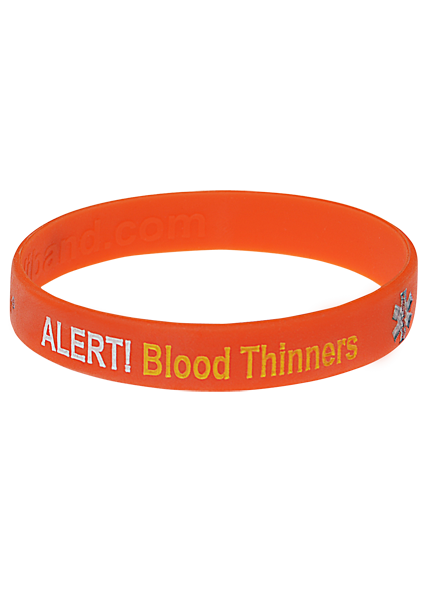
A flag written in full is read faster than an abbreviation under pressure.
What to actually engrave: use abbreviations sparingly
An abbreviation only helps if it is read the way you intend, and not every responder reads every abbreviation the same way. The safest approach is to spell out the one or two things that change emergency treatment, and reserve abbreviations for widely understood flags.
- Write the critical flag in full where you can — “TYPE 1 DIABETES”, “EPILEPSY”, “ALLERGY: PENICILLIN”.
- Use abbreviations only when they are universally recognised — NKDA, DNR, AF, ICD are well understood; obscure ones are not.
- Lead with the condition or allergy, then the emergency contact — identity and address details do not help in the first 60 seconds and reduce privacy.
- Put the detail on a wallet card. Full medication lists and clinician contacts belong on a card, not the band.
Shop engraved medical alert bracelets →
Not sure what to put on yours? Read our guide to what to engrave on a medical alert bracelet or necklace, or call 1300 796 401 (AEST).
Find the right ID for your condition
Many of the abbreviations above map to a condition with its own engraving guidance. Browse the hub that fits.
Diabetes
T1DM and T2DM medical ID bracelets →
Anaphylaxis & allergies
Allergy alert bracelets (NKDA, named allergens) →
Epilepsy
Epilepsy and seizure medical IDs (incl. VNS) →
Pacemaker & ICD
Bracelets for PPM, ICD and CRT-D devices →
Autism
Custom IDs for children on the autism spectrum →
Wallet cards
For the full medication and contact detail →
Frequently asked questions
What does the snake symbol mean on a medical bracelet?
The snake coiled around a single staff is the Rod of Asclepius, the recognised symbol of medicine. On a medical alert bracelet it signals to a first responder that the wearer is carrying medical information worth reading. It is sometimes confused with the caduceus, which has two snakes and wings and is historically a symbol of commerce rather than medicine.
What is the medical abbreviation for twice daily?
Twice daily is BD (from the Latin bis die) or BID (bis in die). Related dosing abbreviations are OD (once daily), TDS or TID (three times a day) and QID (four times a day). PRN means a medication is taken as needed rather than on a fixed schedule.
What does NKDA mean?
NKDA means “no known drug allergies”. NKA means “no known allergies” more broadly. Both tell a clinician there is no recorded allergy to weigh up before treating.
What does DNR stand for?
DNR stands for “do not resuscitate”. You may also see DNAR (do not attempt resuscitation) or, in Australia, NFR (not for resuscitation). These reflect a documented care directive and should always be backed by the correct paperwork — a band alone is not a legal order.
Should I use abbreviations on my medical ID?
Use them sparingly. Spell out the one or two things that change emergency treatment — a condition such as “EPILEPSY” or an allergy such as “ALLERGY: PENICILLIN” — and reserve abbreviations for ones that are universally understood, like NKDA or ICD. Anything obscure risks being misread when it matters most.
What does ICE mean on a medical bracelet?
ICE stands for “in case of emergency” and is usually placed before a contact name and phone number, so a responder knows who to call. On a Mediband ID the emergency contact is engraved on the band, while the full detail can sit on a matching wallet card.
Engrave it clearly. Mediband does the rest.
Every Mediband ID is laser-engraved to order and designed in Australia. Choose the condition flag, the contact, and the band that suits the wearer.
Shop medical alert bracelets →
Prefer to talk? Call 1300 796 401 — business hours AEST.
About this page: Mediband has been designing medical IDs in Australia since 2004. We are an NDIS-registered supplier (provider 4050021192). This guide is general information about commonly used medical abbreviations and symbols. It is not medical advice; abbreviations can carry more than one meaning, so check anything you intend to engrave with the wearer’s clinician.