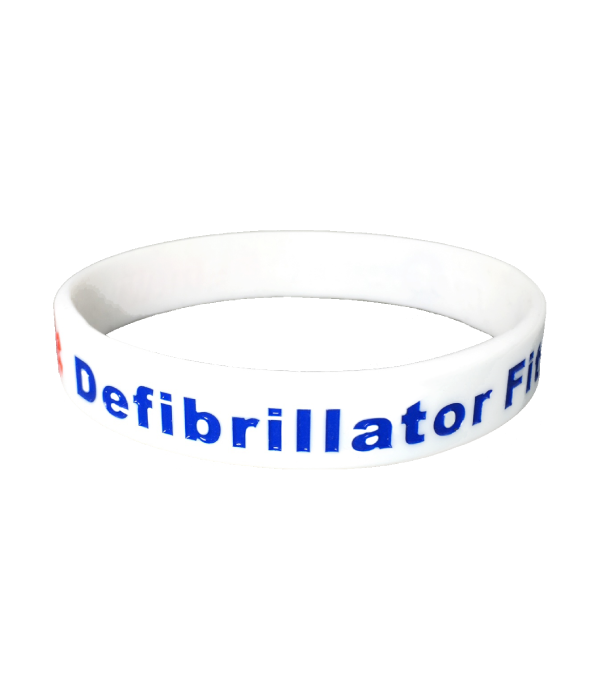
Defibrillator Fitted Alert Medical ID
$7.66
SKU
B6382
Secure checkout
VISA
Mastercard
Apple Pay
Google Pay
+5 more
Also accepted
AMEX
Afterpay
Zip
Klarna
PayPal
Phrase 1: (Mediband alert logo) ALERT!
Phrase 2: (star of life logo) Defibrillator Fitted
Colour: White
Colour Infill: Blue/Red/Silver
4.9 · 45 reviews
Since 2004
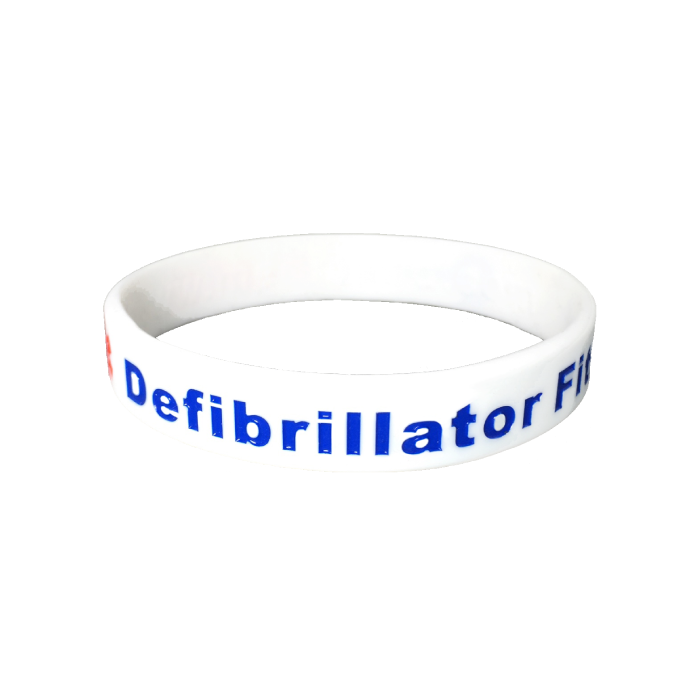
A white band that names the device
A white silicone band reading ALERT! and Defibrillator fitted in blue, with the Mediband and Star of Life marks. One piece, no clasp, no metal, nothing to scan — and nothing to take off before imaging.
It answers one question, early: is there an implanted cardiac device under the skin of this person's chest?
Why that question matters in the first minutes
Healthdirect describes an implanted cardiac device as a battery and leads placed under the skin, usually on the upper left or right side of the chest just below the collarbone. That is exactly the area a responder works over during resuscitation and external defibrillation — and it is not visible on a clothed, unconscious person.
Healthdirect also sets out, on the same page, that your doctor will arrange a medical ID bracelet or a card so people know about the device in an emergency. For implanted cardiac devices, carrying identification is not a nice-to-have a patient thinks of on their own; it is listed as part of living with the device.
An ICD is not the same as a pacemaker
Healthdirect treats the difference as its own question, and so should the wording on your wrist. A pacemaker paces a rhythm that is too slow or irregular. An implantable cardioverter defibrillator monitors for a dangerous rhythm and delivers a shock to stop it. Many people carry a device that does both.
If your device is a pacemaker rather than an ICD, the pacemaker recipient band is the right wording. If you are not certain which you have, your device card says so — and our pacemaker and ICD guide walks through what else is worth recording.
Who should wear one
- Anyone with an implantable cardioverter defibrillator (ICD)
- Recipients of a combined pacemaker and defibrillator, including cardiac resynchronisation devices
- People with a subcutaneous ICD, where the device sits further round the chest wall than staff may expect
- Anyone in the weeks after implantation, when the site is still healing and the device card has not yet become a habit
Anticoagulation very often sits alongside a cardiac device, and it changes emergency management independently — that is worth carrying as a second band. See the on anticoagulants band, or our heart condition medical ID guide for the wider picture. Many people wear one band on each wrist.
Which band names your situation
Cardiac patients commonly carry more than one fact worth flagging. This table is the short version of the conversation.
| Band | States | Wear it when |
|---|---|---|
| This band — defibrillator fitted | An ICD is implanted | Your device can deliver a shock |
| Pacemaker recipient | A pacemaker is implanted | Your device paces rhythm only |
| On anticoagulants | You take a blood thinner | Alongside either device band — it changes bleeding management separately |
| Custom engraved ID | Whatever you specify | You want device, model and a contact on one permanent ID |
There is no prize for wearing only one. Two plain bands that each say one true thing are read faster than a single crowded one.
What this band does, and what it cannot
This is a ready-to-wear, pre-printed band. The wording is moulded in at manufacture and fixed — there is no engraving plate and no write-on panel, so a device model, an implant date, a cardiologist's number or MR-conditional status cannot be added to it.
If you need those details carried
Use a write-on band you can fill in by hand, or a made-to-order Mediband Custom ID in engraved steel or custom-printed silicone. Device model and MR-conditional status are the two details most worth having in writing, and our guide to medical ID abbreviations covers wording that clinicians read reliably.
It also does not replace your device card, your cardiology follow-up or telling staff before a procedure. Healthdirect's advice is to tell healthcare providers about the device before procedures such as MRI scans. The band is for the occasions when you cannot.
Why silicone rather than metal for this one
A device recipient spends more time around imaging than most people. A silicone band has no metal, so it raises none of the questions a steel bracelet does in an imaging suite, and there is no clasp to unfasten with a cannula in the back of your hand.
It is also waterproof and light enough to wear overnight, which matters because the point of an alert band is that it is still on at three in the morning, not sitting on a bedside table.
One practical note from device recipients: in the first weeks after implantation the chest site is tender and sleep is awkward, and that is precisely the period when you are most likely to be back in a hospital unexpectedly. A band costs nothing to put on and is the only part of your record that travels on your body.
Fit and care
Sizing
Available in small, medium, large and extra large. Measure around the wrist and compare against our wrist measurement guide. Snug enough that it will not slide over the hand, loose enough to rotate and take a fingertip underneath.
Keeping it legible
Wash with warm water and mild soap; rinse after chlorine, salt water or sunscreen; air dry. Replace it once the blue infill has worn back far enough that the wording no longer reads at a glance. A white band shows grime sooner than a dark one — give it a proper wash before deciding it is worn out.
Checking wrists and neck for identification is part of a standard primary survey, which we go through in do paramedics check medical ID. The full range is under medical alert bracelets.
For cardiology clinics and device services
Single bands can be ordered here. For a cardiology clinic, a device follow-up service, a cardiac rehabilitation programme or an aged-care provider, tell us quantities and sizes and we will come back with pricing and a date.
Frequently asked questions
Should I wear this or the pacemaker band?
Wear the one that names your device. If you have an ICD, this band. If you have a pacemaker, the pacemaker recipient band. If your device does both, either is defensible — many people choose the ICD wording because the shock function is the more surprising fact for a responder.
Can I have my device model added?
Not on this band — the wording is moulded in and fixed. Use a write-on band or a custom engraved ID for the model, implant date or MR-conditional status, and keep carrying your device card.
Is the band safe around MRI?
The band is silicone with no metal, so it raises none of the questions a metal bracelet does. Whether your device is safe for a given scan is an entirely separate decision for your cardiology and imaging teams — Healthdirect's advice is to tell providers about the device before procedures such as MRIs.
Do I still need my device card?
Yes. Healthdirect lists the bracelet and the card together, not as alternatives. The card carries manufacturer, model and implant date for the clinician who has your wallet; the band speaks for you to whoever has only found you.
Can I wear it in the shower or the pool?
Yes — waterproof silicone with nothing to corrode. Rinse after chlorine or salt water. Wearing it continuously is the point.
What if I also take blood thinners?
Carry that too, on a second band. Anticoagulation changes emergency management on its own, independently of the device — see the on anticoagulants band, or put both facts on one custom ID.
SKU B6382Manufacturer Mediband
| SKU | B6382 |
|---|---|
| Manufacturer | Mediband |
Shipping
In-stock orders are dispatched the same business day when placed before 12pm AEST, Monday to Friday (excluding public holidays). Orders placed after 12pm AEST, or on weekends and public holidays, are dispatched the next business day.
Express, Regular and Courier delivery estimates are shown at checkout and apply from the dispatch date.
More information about shipment and delivery times can be found on our shipping page.
Returns & guarantee
100% Quality Guarantee. Your satisfaction is our priority. If there is a confirmed quality issue, return the item to us in its original condition and packaging within 14 days of receipt and we will issue a full refund (excluding the original delivery charge) or replace the item.
In-stock items may be exchanged for a different size or colour, provided they are returned as new, unworn and in their original packaging within 14 days of receipt.
Custom and made-to-order items are produced to your specification, so we do not accept returns or exchanges for change of mind, size or colour. Please check your size, colour, spelling and details carefully before ordering. First Aid Kits and Defibrillator Supplies also cannot be returned or exchanged except for a confirmed quality issue.
Please view terms and conditions for further information.
Loading reviews…
Based on this product