
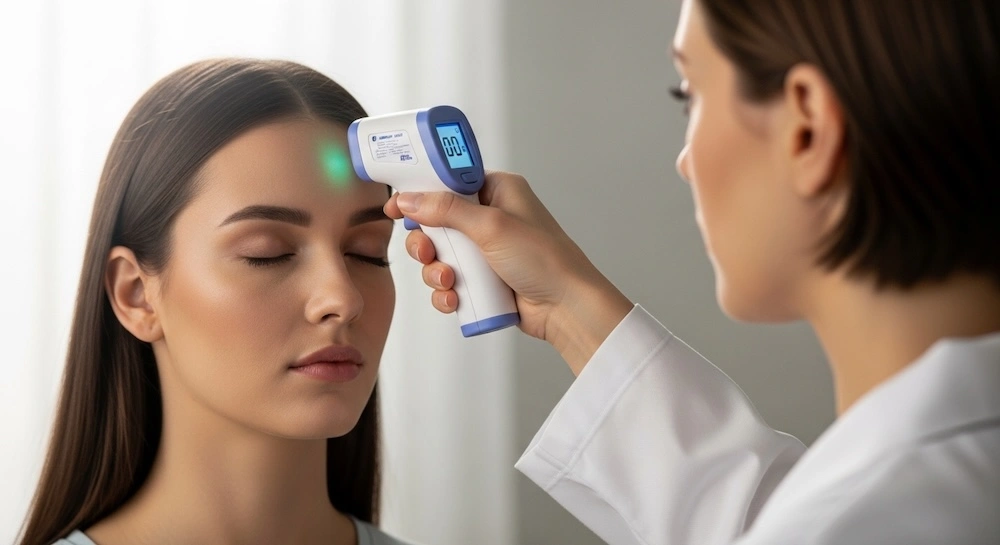




Person using infrared thermometer on forehead

There's something oddly satisfying about getting a temperature reading in under two seconds without waking a sleeping child or making anyone sit still with a thermometer under their tongue. Infrared forehead thermometers have quietly become one of the most practical health tools in both homes and clinics — and for good reason. 

They're fast, hygienic, and surprisingly simple once you know what you're doing. But "simple" doesn't mean "foolproof." A lot of people unknowingly take readings that are off by a degree or two just because of small technique errors. This guide breaks down exactly how to usean infrared thermometer on the forehead correctly, what the numbers mean, and how to get the most reliable reading every single time.

What Is an Infrared Thermometer and How Does It Work?

An infrared thermometer is a non-contact device that measures body temperature by detecting the infrared energy (heat) emitted from the skin. Inside the device, a small lens focuses that energy onto a thermopile — a sensor that converts the heat signal into an electrical reading, which then gets displayed as a temperature on the screen.

The forehead sits directly above the temporal artery, a blood vessel that runs close to the skin's surface and reflects the body's core temperature fairly well. This makes it one of the more accessible and consistent spots for a quick, non-invasive reading. Compared to the armpit or mouth, the forehead is less influenced by recently consumed food or drink, and it doesn't require any physical contact — a big plus when dealing with someone unwell or uncooperative.

Infrared forehead thermometers are used across a wide range of settings:

  • At home — checking children's temperature during illness without waking them
  • In clinics and hospitals, triaging patients and doing quick wellness checks
  • In public spaces — mass screening during health events (as seen during the COVID-19 pandemic)

Preparing the Infrared Thermometer for Use

Before taking any reading, a little preparation goes a long way toward accuracy. Start by making sure the battery is charged or has sufficient power, since a low battery can lead to inconsistent results. It’s also important to check the unit settings — most thermometers allow you to switch between Celsius and Fahrenheit, so confirm it’s set to your preferred scale.

Take a moment to understand how your thermometer works. Most models use a single trigger button to take a reading and display the result on a small LCD screen. Some devices also include a color-coded backlight — typically green for normal temperature, orange for slightly elevated, and red for fever. Because designs can vary, it’s worth briefly reviewing the manual for your specific model to understand the controls and display indicators.

Proper storage and maintenance also play a key role in accuracy. Although infrared thermometers come factory calibrated, they should be kept at room temperature and cleaned regularly. If the device has been stored in a very cold or hot environment — such as a car — allow it to adjust to room temperature for about 20–30 minutes before use. Using a thermometer that hasn’t acclimated can result in inaccurate readings.

Step-by-Step Guide on Using the Infrared Thermometer on Forehead

Here's the full process for getting a reliable reading. Following these steps every time makes a real difference in accuracy.

Step 1: Ensure the Forehead Is Clean and Dry

Sweat, sunscreen, makeup, or even a thin layer of hairspray can all interfere with the infrared sensor's ability to read the skin accurately. Gently wipe the forehead with a clean, dry cloth before taking a reading. If someone has just come in from outside on a hot day or after exercise, wait about 10–15 minutes before measuring.

Distance matters more than most people realize. Manufacturers typically recommend holding the device 1–3 cm from the center of the forehead. A published study from York Teaching Hospital NHS Trust found that the narrowest limits of agreement — meaning the most accurate readings — were achieved when the infrared device was held at approximately 3 cm from the forehead. Holding it too far away introduces measurement error, while touching the skin can cause the sensor to read incorrectly as well.

Step 3: Position the Thermometer Properly

Point the sensor toward the center of the forehead, between the eyebrows, and the hairline. Make sure there's no hair, hat, bandage, or headband covering that area. The sensor needs a clear, unobstructed line to the skin. When learning how to use an infrared thermometer on the forehead, positioning is one of the steps people most often rush through — and it's where a lot of errors happen.

Press and hold the measurement button while keeping the device steady. Some models require a quick press while others need to scan slowly from the center of the forehead toward the temple. Either way, keep the device aligned and parallel to the forehead throughout the process. You'll typically hear a beep when the reading is complete.

Step 5: Read and Interpret the Temperature

The result appears on the screen within seconds. This leads to an important question many people have: What is the normal forehead temperature with an infrared thermometer? For most adults, a normal reading falls between 36.1°C and 37.2°C (97°F–99°F). Readings above 37.5°C (99.5°F) on the forehead are generally considered elevated and may suggest a fever, though the exact threshold can vary slightly by device model and individual baseline. It's always worth taking two or three readings a few seconds apart and noting the average.

Step 6: Clean the Thermometer After Use

Wipe the sensor tip with a soft cloth lightly dampened with alcohol. Avoid submerging the device in water or using harsh sprays directly on the sensor. Proper cleaning helps maintain accuracy over the device's lifespan.

What Is Normal Forehead Temperature with an Infrared Thermometer?

Understanding what a normal forehead temperature is with ian nfrared thermometer helps avoid unnecessary worry. For healthy adults, normal forehead readings typically fall between 36.1°C and 37.2°C (97°F to 99°F). In children, normal readings can run slightly higher depending on age and activity level.

It's worth noting that forehead skin surface temperatures tend to read slightly lower than actual core body temperature. Manufacturers account for this by building adjustment algorithms into the device's software. Still, context matters — a single reading should be interpreted alongside other symptoms rather than in isolation. If the reading is borderline, take it again after a few minutes of rest in a comfortable room.

How Accurate Are Infrared Forehead Thermometers?

A lot of people wonder: how accurate are infrared forehead thermometers compared to oral or rectal thermometers? The answer is — it depends on how they're used.

A 2022 observational study published in the journal Children (MDPI), conducted at Samsung Medical Center in South Korea, evaluated 255 pediatric patients by comparing non-contact forehead infrared thermometers (NCFITs) with infrared tympanic thermometers (IRTTs). The study found an intraclass correlation coefficient of 0.87 between the two methods, indicating good agreement. The mean temperatures recorded were 37.24°C for the forehead device and 37.36°C for the tympanic device — a difference of just 0.12°C. Researchers concluded that non-contact forehead thermometers showed reliable clinical utility, particularly for pediatric use.

That said, how accurate are infrared forehead thermometers in less controlled settings? The honest answer is that environmental factors can reduce accuracy. Wind, direct sunlight, drafts, or even standing near a radiant heat source can all affect the reading. The FDA has noted these environmental influences as genuine variables to watch out for.

For home use and general health screening, infrared forehead thermometers are a practical and reasonably accurate option. For situations requiring precise clinical measurements — such as monitoring a newborn with suspected infection — a healthcare provider may choose a more controlled method.

Common Mistakes to Avoid When Using Infrared Thermometers

Even with a good device, it's easy to get unreliable results if a few key habits aren't in place. Below are the most common errors people make when learning how to use an infrared thermometer on the forehead.

Taking Readings in Unfavorable Conditions

Room temperature has a direct effect on infrared readings. The ideal ambient temperature for use is typically between 16°C and 35°C (60°F–95°F). Taking a reading in a very cold or very hot room can skew results. Similarly, measuring someone who just came in from cold weather or stepped out of a hot shower will produce inaccurate data until the skin has had time to stabilize.

Not Waiting Long Enough Between Activities

Physical activity, eating a hot meal, or even being outside on a warm day can temporarily raise skin temperature. Waiting 10–15 minutes before taking a reading gives the body time to reflect a more stable baseline. Skipping this wait is one of the most common reasons people get readings that seem too high or inconsistent.

Holding the Device at the Wrong Angle or Distance

The thermometer should be held at a right angle to the forehead — not tilted to the side — and within the recommended 1–3 cm distance. Holding it at an angle or too far away introduces measurement error. Three common positioning mistakes to watch out for:

  • Holding the device more than 5 cm away from the skin
  • Pointing the sensor toward the hairline instead of the center of the forehead
  • Tilting the device rather than keeping it parallel to the skin surface

Skipping the Cleaning Step

A dusty or residue-covered sensor will not read accurately. Cleaning after each use with a soft alcohol wipe takes about 10 seconds and can meaningfully improve consistency over time.

Final Thoughts

Getting a reliable forehead temperature reading isn't complicated, but it does require a bit of technique. The key steps are straightforward: start with a clean, dry forehead; hold the device at the correct distance (around 1–3 cm); position it over the center of the forehead; press the button; and read the result. Knowing what normal forehead temperature is with an infrared thermometer — roughly 36.1°C to 37.2°C — helps put any reading in context.

When used correctly and in appropriate conditions, infrared forehead thermometers are a genuinely useful tool. They're non-invasive, fast, and practical across all ages. Just remember that any reading should be considered alongside the broader clinical picture rather than treated as a standalone verdict. When in doubt about a temperature reading or accompanying symptoms, consulting a healthcare professional is always the right call.