By Michael Randall · Founder, Mediband · Published 12 May 2026 · 8 min read
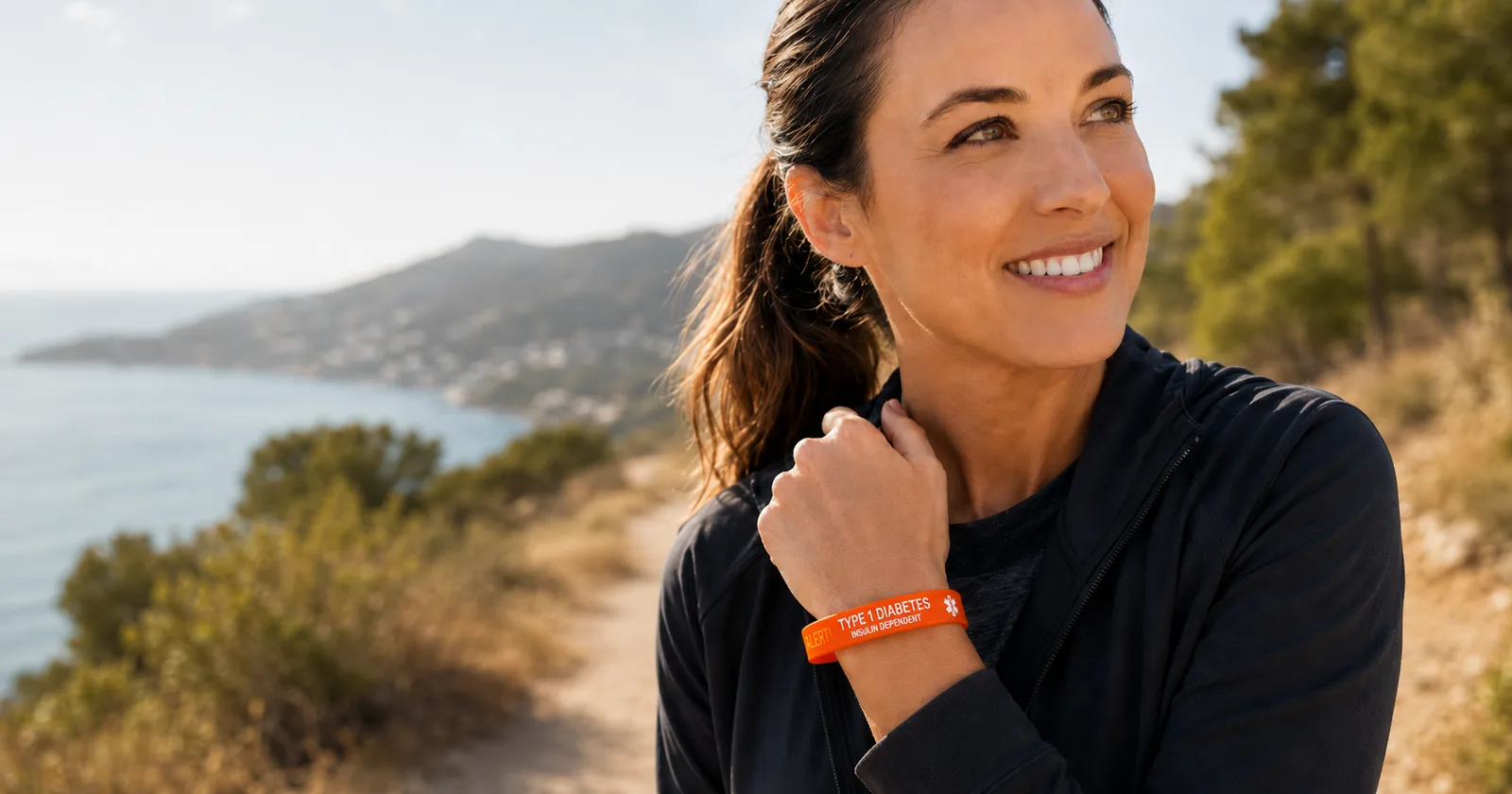
In a diabetes emergency, the first responder isn't always you. It might be a paramedic, a teacher, a coach, a stranger on the train. A medical ID is the single quickest way for someone to know what's happening and what to do.
This guide covers exactly what to engrave on a medical ID if you or someone in your care lives with Type 1 or Type 2 diabetes — including pump-specific guidance and full engraving examples for adults and children.
Why a medical ID matters when you live with diabetes
Around 1.5 million Australians live with diabetes, according to Diabetes Australia. For most, day-to-day management is steady. The reason for a medical ID is the small fraction of moments when management slips out of reach — and someone else has to make decisions.
Hypoglycaemia and unconsciousness. A severe low can present as confusion, slurred speech, aggression, or unconsciousness. Without a visible ID, this can be mistaken for intoxication, stroke, or seizure. Paramedics treating an unconscious patient need to know about diabetes before administering glucose or insulin.
Pump and CGM misidentification. A continuous glucose monitor or insulin pump on the body can be mistaken for an unrelated medical device, removed, or damaged during a response. An engraved instruction not to remove the pump can prevent this.
Diabetic ketoacidosis (DKA). In Type 1 diabetes, DKA can be mistaken for a viral illness or food poisoning by people who don't know the patient is diabetic. The label "Type 1 diabetes — insulin dependent" gives a clinician an immediate working diagnosis.
Medication interactions. Diabetes treatments — insulin, sulfonylureas, GLP-1 agonists, SGLT2 inhibitors — interact with other drugs. An ID that lists current medication helps emergency staff make safer decisions in the first minutes.
A medical ID doesn't replace the alert services many Australians use. It supplements them — it's there in the seconds before help arrives and through every handover afterwards.
What to engrave: the starting point
Regardless of type, every diabetes medical ID should carry these six pieces of information:
- Diabetes type — "Type 1 diabetes" or "Type 2 diabetes"
- Insulin dependence — if applicable, "Insulin dependent" makes treatment decisions faster
- Name — first and last
- Emergency contact — "ICE" plus name and Australian mobile in international format (+61 4XX XXX XXX)
- Allergies — or "Nil known allergies" if none
- Primary medications — at least the most clinically important
After that, what you add depends on age, treatment, and how active you are. The sections below cover the most common cases, with sample engraving you can adapt directly.
Ready to start engraving?
Browse Mediband's custom engravable bracelet range — silicone, stainless steel, or gold — and pick the format that fits your day-to-day.
Recommended for you
Products related to this article
Hand-picked to go with what you just read.
Type 1 diabetes — adults
For adults living with Type 1, the most important additions are pump or pen status, recent CGM use, and any complication history (gastroparesis, autonomic neuropathy, hypoglycaemia unawareness) that changes how a low presents.
Example — Type 1 adult, MDI
| Front | TYPE 1 DIABETES | INSULIN DEPENDENT |
| Back | ICE Sam Smith +61 412 345 678 | Allergies: Nil | NovoRapid + Lantus |
Example — Type 1 adult, pump
| Front | TYPE 1 DIABETES | INSULIN PUMP — DO NOT REMOVE |
| Back | ICE Sam Smith +61 412 345 678 | Allergies: Penicillin |
If you have hypoglycaemia unawareness, consider adding "Hypo unawareness" to the back — it's a meaningful clinical flag.
Type 1 diabetes — children
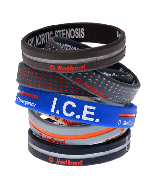
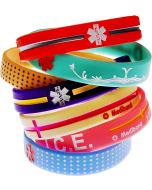
For a child, the ID needs to be readable by a teacher, coach, camp leader, or first responder who has never met them. Keep it simple, complete, and tamper-resistant. Silicone bands work well for active children — they're durable, water-resistant, and harder to remove than a clasp bracelet.
Example — Type 1 child, pump
| Front | TYPE 1 DIABETES | Alex | DOB 14/03/2017 |
| Back | Parent Sam Smith +61 412 345 678 | Pump — do not remove |
For children with severe allergies on top of Type 1 (a common combination), the back can list the allergy and any auto-injector instructions in shorthand — for example, "Peanut allergy — EpiPen in bag".
If your child carries a Type 1 management card from Diabetes Australia or your endocrinologist, the medical ID supplements it — it's not a replacement.
Type 2 diabetes — adults
For Type 2, the engraving focus shifts. Whether the person is on insulin is the most important detail, followed by medication list and any complications (renal involvement, neuropathy, vision changes) that affect treatment decisions.
Example — Type 2 adult, oral medications
| Front | TYPE 2 DIABETES |
| Back | ICE Sam Smith +61 412 345 678 | Metformin, Empagliflozin | Allergies: Nil |
Example — Type 2 adult, insulin
| Front | TYPE 2 DIABETES | INSULIN DEPENDENT |
| Back | ICE Sam Smith +61 412 345 678 | Lantus + Metformin |
If you've had a previous hypoglycaemic event severe enough to require ambulance attendance, it's worth flagging "Prior severe hypo" on the back — it changes the threshold at which a clinician treats.
Insulin pump and CGM users — what's different
Insulin pumps. A pump attached to the body looks unfamiliar to anyone who hasn't seen one. In a road accident, fall, or unconscious event, well-meaning helpers may try to remove it. Two engravings address this:
- "Insulin pump — do not remove" on the visible side of the ID
- Pump make/model and site location if there's room ("Tandem t:slim — left abdomen")
If you switch pumps every few years, choose engraving that won't go stale — "Insulin pump" alone is fine; the brand can stay off the band.
Continuous glucose monitors. A CGM sensor on the arm or abdomen is increasingly common and rarely needs identification — it's visible, and clinicians recognise it. The exception is paediatric care or sport, where it can be dislodged and worth flagging:
- "CGM sensor — left arm" on the back of a child's band
Which Mediband ID suits your use case
Mediband has been designing medical IDs in Australia since 2004. The right format depends on how active you are, how much you need to engrave, and how the band needs to wear day-to-day.
| Format | Best for | Engraving capacity | Browse |
|---|---|---|---|
| Silicone band | Children, sport, manual work, sensitive skin, water exposure | Short-form, high-contrast text on the band itself | Custom silicone → |
| Active hybrid | Active adults wanting metal-plate engraving on a silicone strap | Mid-range — engraved metal plate, longer text than pure silicone | Active hybrid → |
| Stainless steel | Office, dress wear, daily use, durability | Generous — multi-line engraving front and back | Stainless steel → |
| Gold | Formal wear, gift, longevity | Generous — same as stainless | Gold → |
| Wallet card | Supplement to a band — carries the full medication list | High — full card surface, both sides | Wallet card → |
For most adults with diabetes, a silicone band plus a wallet card is the most practical combination — the band is always on, the card carries the detail that doesn't fit on a wristband.
NDIS funding for medical IDs
For NDIS participants whose plan includes Assistive Technology or Consumables, a medical ID can be a fundable item. Mediband is an NDIS-registered supplier. Eligibility depends on your plan and the way your support coordinator has structured your goals — speak to your support coordinator or LAC before assuming coverage.
If your plan covers it, we can invoice the NDIA directly or work with your plan manager.
NDIS participant or support coordinator?
See how Mediband works under the NDIS, including plan-manager invoicing and the bracelet ranges typically funded.
Frequently asked questions
What should I engrave on a Type 1 diabetes medical ID?
At minimum: "Type 1 diabetes — insulin dependent", your name, an emergency contact in international format (+61 4XX XXX XXX), allergies (or "Nil"), and your primary insulin regimen. Add "Insulin pump — do not remove" if you wear one, and "Hypo unawareness" if applicable. See the Type 1 adults section for full examples.
Do I need to mention my insulin pump on the band?
Yes — "Insulin pump — do not remove" on the visible side of the ID is one of the highest-value engravings you can include. A pump attached to the body is unfamiliar to anyone who hasn't seen one, and well-meaning helpers may try to remove it during a road accident, fall, or unconscious event. Engraving the brand and model is optional and only useful if you don't change pumps often.
Is a silicone band or metal bracelet better for a child with diabetes?
For most diabetic children, silicone is the better choice. Silicone bands are durable, water-resistant, hypoallergenic, harder to remove accidentally, and the engraving lasts the life of the band. Metal bracelets carry more text but can snag during play or sport. If your child is older and prefers a metal look, a hybrid silicone-and-metal-plate option (the "Active" range) gives the metal engraving on a more durable strap.
Are diabetes medical IDs covered by the NDIS?
For NDIS participants whose plan includes Assistive Technology or Consumables funding, a medical ID can be a fundable item. Eligibility depends on the way your goals are structured in your plan, so check with your support coordinator or LAC before assuming coverage. Mediband is an NDIS-registered supplier and can invoice the NDIA directly or work with your plan manager. See the NDIS information page for details.
How often should I update my diabetes medical ID?
Update whenever your engraving stops reflecting your current treatment — specifically when you start or stop insulin, change pump model, add a clinically significant medication, develop a new allergy, or change emergency contact. Out-of-date information on a medical ID is worse than no ID — it can send a clinician in the wrong direction. As a baseline, review the engraving every 12 months even if nothing has changed.
Will a paramedic actually check the medical ID?
Yes — checking for a medical ID is a standard step in the primary survey for an unconscious or impaired patient. Paramedics, emergency department clinicians, and many bystander first-aiders are trained to look at the wrists, neck, and wallet. The Australian Resuscitation Council's guidelines on patient assessment include this step.
Where to start
If you're new to medical IDs, the simplest first step is to pick a format, draft the engraving text using the examples above, and run it past a partner, parent, or endocrinologist for a sanity check before you order.
If you're replacing an old ID, check the engraving still reflects current medications and pump status — and refresh anything that's drifted.
Ready to order your diabetes medical ID?
Browse Mediband's full engravable range — silicone, hybrid, stainless steel, gold — and pick what fits your day.
Sources and further reading
- Diabetes Australia — diabetesaustralia.com.au
- National Diabetes Services Scheme (NDSS) — ndss.com.au
- JDRF Australia — jdrf.org.au
- Healthdirect Australia — healthdirect.gov.au
- Australian Resuscitation Council — resus.org.au
About this article: Mediband has been designing medical IDs in Australia since 2004. We are an NDIS-registered supplier supporting participants, support coordinators, plan managers, hospitals, and peak bodies across Australia. The clinical examples in this article reflect common engraving practice — they are not medical advice and should not replace guidance from your endocrinologist or diabetes educator.

Written by
Founder, Mediband
Founder of Mediband; over 20 years providing medical IDs worldwide.
← Previous
Medical IDs for anaphylaxis — what to engrave and why it matters
Next →
Medical IDs for pacemaker recipients — what to engrave and why it matters
Comment(s)