By Michael Randall · Founder, Mediband · Published 12 May 2026 · 8 min read
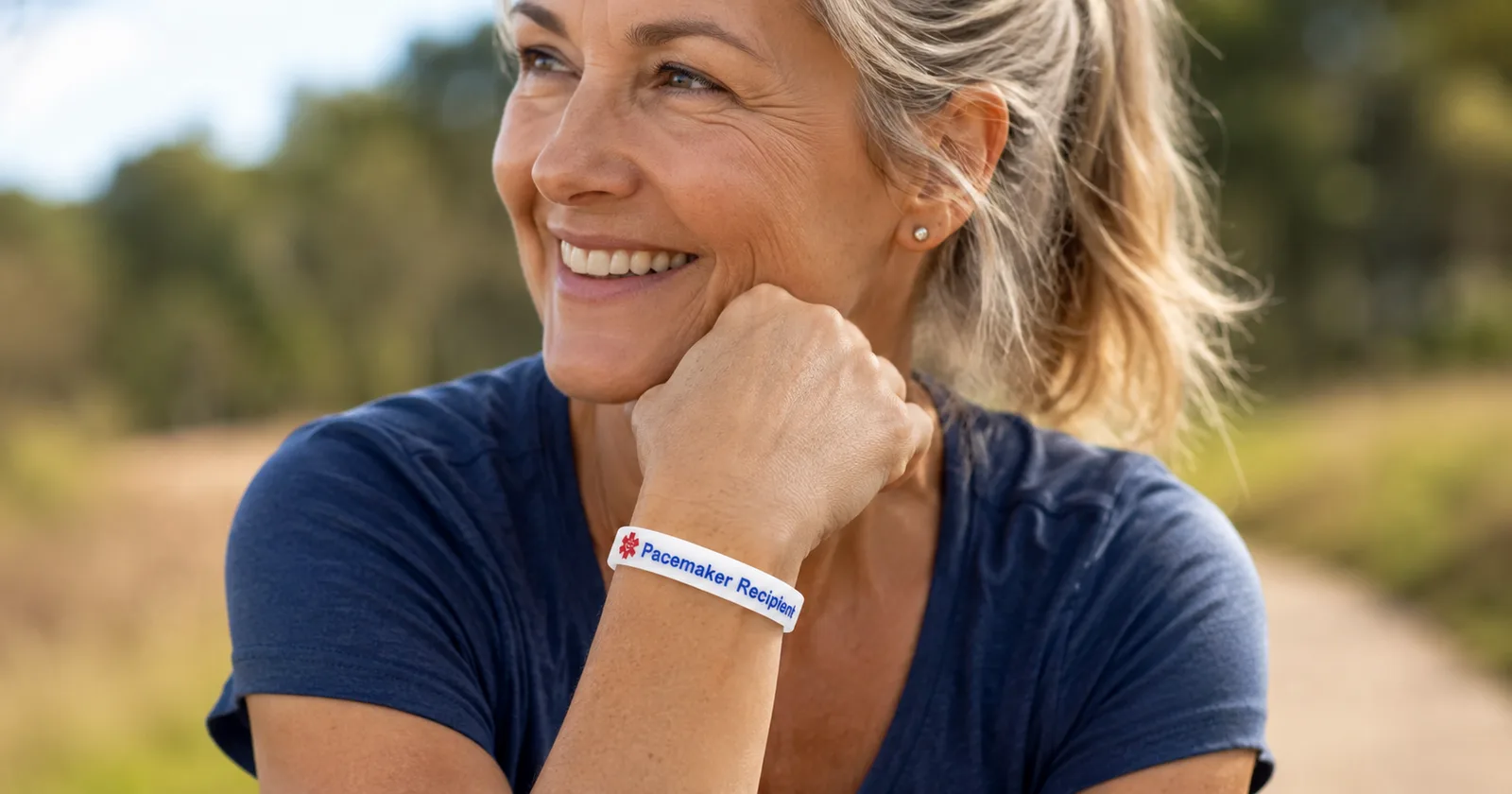
If you have a pacemaker or implantable cardioverter-defibrillator (ICD), there are moments when a stranger making the wrong assumption costs you minutes you don't have. A medical ID is the cheapest, lowest-friction way to remove that risk.
This guide covers what to engrave on a medical ID if you have a pacemaker or ICD — including device-specific guidance, MRI-conditional notes, and full engraving examples you can adapt.
Why a medical ID matters for pacemaker carriers
Around 16,000 Australians have a pacemaker fitted each year, according to the Cardiac Society of Australia and New Zealand. Most days, the device does its job quietly and no one needs to know it's there. The reason for a medical ID is the small set of moments where it does matter — and where the wrong assumption causes a problem.
AED and defibrillation placement. When a paramedic or first-aider uses an automated external defibrillator (AED) on someone in cardiac arrest, they place pads on the chest. If the pacemaker housing is directly under one of those pad positions, the shock can damage the device or fail to deliver effective current. The standard guidance: place pads at least 10 cm away from the visible bulge of the device. A visible "PACEMAKER" engraving prompts that check in the first seconds.
MRI and procedure planning. Many modern pacemakers are MRI-conditional — meaning they can safely undergo MRI scanning under specific conditions, programmed by your cardiologist before the scan. Older devices and some current ICDs are not. The "MRI conditional" engraving lets a clinician know not to dismiss the option outright, and prompts the right pre-scan check.
Electrosurgical interference. Surgery using electrocautery (most operations, including dental procedures with electrocautery) can interfere with pacemaker function. The surgical team needs to know the device is present and whether it needs to be reprogrammed during the procedure. Engraving prompts the conversation before incision.
Identification when you can't speak. In a road accident, fall, or stroke, the paramedic checking your wrist or wallet may not know you have a pacemaker. The engraved cue tells them. It also flags the manufacturer and model if you've engraved that, which speeds up clinical decisions on the device's behaviour during the response.
A medical ID for a pacemaker recipient isn't about announcing a condition. It's about removing the assumptions someone else might make about your chest in an emergency.
What to engrave: the starting point
Every pacemaker or ICD medical ID should carry at minimum:
- Device type — "Pacemaker", "ICD", or "CRT-D" (if applicable)
- Manufacturer and model — e.g. "Medtronic Azure XT" or "Boston Scientific Accolade" (manufacturer alone is fine if model won't fit)
- MRI conditional status — "MRI conditional" if your device supports it; absent if it does not
- Name — first and last
- Emergency contact — "ICE" plus name and Australian mobile in international format (+61 4XX XXX XXX)
- Cardiologist or hospital — useful if there's room; helps the responding clinician make follow-up calls
If you also live with another condition that's clinically significant in an emergency (anti-coagulant medication, diabetes, severe allergies, chronic kidney disease), add that on the back. Cardiac patients are often on warfarin or a DOAC, and that detail changes how a clinician treats a head injury or internal bleeding.
Ready to start engraving?
Browse Mediband's custom engravable bracelet range — silicone, stainless steel, or gold — and pick the format that suits day-to-day wear.
Recommended for you
Products related to this article
Hand-picked to go with what you just read.
Pacemaker, ICD, or CRT-D — what's different
The three implantable cardiac devices look similar but behave differently. The engraving choices follow from the behaviour.
Pacemaker. Regulates the heart's rhythm by sending small electrical impulses when the rate drops too low. Common indications: bradycardia, heart block, sick sinus syndrome. Engrave "PACEMAKER" plus manufacturer and model. AED placement offset is the main clinical concern.
ICD (implantable cardioverter-defibrillator). Detects life-threatening arrhythmia (ventricular tachycardia, ventricular fibrillation) and delivers a shock to restore rhythm. Common indications: prior cardiac arrest, certain inherited arrhythmias, severe heart failure. Engrave "ICD" or "DEFIBRILLATOR". This is more critical than pacemaker identification — an ICD can shock the patient during a paramedic response, which the responder needs to be ready for.
CRT-D (cardiac resynchronisation therapy defibrillator). Combines pacemaker pacing with ICD shock capability, typically for advanced heart failure. Engrave "CRT-D" or "PACEMAKER + ICD". Treat the engraving guidance as the ICD version — the shock capability matters most clinically.
Engraving examples
Example — Pacemaker adult, MRI conditional
| Front | PACEMAKER | MEDTRONIC AZURE | MRI CONDITIONAL |
| Back | ICE Sam Smith +61 412 345 678 | Warfarin | St Vincent's Cardiology |
Example — ICD adult
| Front | ICD | BOSTON SCIENTIFIC | DO NOT PLACE AED OVER DEVICE |
| Back | ICE Sam Smith +61 412 345 678 | Amiodarone | Allergies: Nil |
Example — CRT-D adult, heart failure
| Front | CRT-D | ABBOTT | HEART FAILURE |
| Back | ICE Sam Smith +61 412 345 678 | Apixaban + Entresto | St Vincent's Cardiology |
If you carry a Medtronic CareLink, Boston Scientific LATITUDE, or Abbott Merlin remote-monitoring transmitter at home, mentioning the brand on the front of the band gives a responder a quick lock on the device's family. They don't need the serial number on the band — that lives in your cardiologist's records.
MRI-conditional considerations
Most pacemakers and ICDs implanted in Australia since around 2015 are MRI-conditional. That means MRI scanning is safe under specific conditions, programmed by your cardiologist or the cardiology technician before the scan. Older devices and some current high-end CRT-Ds are not MRI-conditional, which restricts imaging options.
For an emergency department clinician deciding whether to send you for an MRI to investigate a stroke, head injury, or spinal complaint, this distinction is time-sensitive. Engraving "MRI conditional" on the front of the band gives them a fast answer to the first question.
Even with an MRI-conditional device, a cardiology technician needs to reprogram the device into "MRI mode" before the scan and restore the standard programming after. The engraving doesn't replace that step — it just signals that the option is open.
Which Mediband ID suits your use case
Mediband has been designing medical IDs in Australia since 2004. The right format for a pacemaker carrier depends on how active you are, how much engraving you need, and what you're comfortable wearing daily.
| Format | Best for pacemaker carriers | Engraving capacity | Browse |
|---|---|---|---|
| Stainless steel | The default fit for most adult pacemaker carriers — office wear, daily use, durable, formal appearance | Generous — fits device type, brand, MRI status, and ICE on one band | Stainless steel → |
| Gold | Gift, dress wear, longevity — the engraving still does the clinical job | Generous — same as stainless | Gold → |
| Active hybrid | Active pacemaker carriers — engraved metal plate on a silicone strap for sport, gardening, beach | Mid-range — metal plate fits the essentials | Active hybrid → |
| Silicone band | Less common for pacemaker carriers but practical for hot climates, sensitive skin, manual work | Short-form — the essentials only | Custom silicone → |
| Wallet card | Supplement to a band — carries device serial number, implant date, lead model, full medication list | High — full card surface, both sides | Wallet card → |
For most adult pacemaker carriers, a stainless steel band plus a wallet card is the most practical combination — the band carries the high-signal information for a paramedic glance, the wallet card holds the detail (serial number, implant date, lead model, cardiologist phone) that a hospital admission needs.
NDIS funding for cardiac medical IDs
For NDIS participants with cardiac conditions whose plan includes Assistive Technology or Consumables, a medical ID can be a fundable item. Cardiac conditions in younger participants (congenital heart disease, inherited arrhythmia syndromes, paediatric pacemaker recipients) are the most common path. Eligibility depends on the way your support coordinator has structured your goals — speak to them or your LAC before assuming coverage.
Mediband is an NDIS-registered supplier. If your plan covers a medical ID, we can invoice the NDIA directly or work with your plan manager.
NDIS participant, support coordinator, or plan manager?
See how Mediband works under the NDIS, including plan-manager invoicing and the bracelet ranges typically funded for cardiac patients.
Frequently asked questions
What should I engrave on a pacemaker medical ID?
At minimum: "PACEMAKER", the manufacturer (Medtronic, Boston Scientific, Abbott, Biotronik, MicroPort), "MRI conditional" if applicable, your name, an emergency contact in international format (+61 4XX XXX XXX), and your primary anti-coagulant if you're on one. Add your cardiologist or hospital on the back if there's room. See the engraving examples for full templates.
Do I need a different medical ID if I have an ICD instead of a pacemaker?
Yes — engrave "ICD" or "DEFIBRILLATOR" instead of "PACEMAKER", because an ICD can deliver shocks to convert dangerous heart rhythms. Paramedics responding to an unconscious patient with an ICD need to be aware the device may shock during the response, which changes how they manage hands-on care. The "Do not place AED over device" engraving is also worth including, since AED placement matters for both devices but ICDs additionally have shock capability that an external defibrillator might compete with.
Is my pacemaker MRI safe?
Most pacemakers and ICDs implanted in Australia since approximately 2015 are MRI-conditional, meaning MRI scans are safe under specific conditions programmed by your cardiologist or cardiology technician before the scan. Older devices and some current high-end CRT-Ds are not. Your cardiologist or device card from the manufacturer will state your specific status. If your device is MRI-conditional, engraving that on the band gives emergency clinicians a faster answer when deciding on imaging.
What should paramedics know about my pacemaker?
Three things: (1) the device is there, so AED pads are placed at least 10 cm away from the visible bulge; (2) device type (pacemaker vs ICD vs CRT-D), because ICDs can shock during the response; (3) manufacturer and ideally model, which speeds up clinical decisions about device behaviour. All three fit comfortably on a single engraved band. Adding cardiologist contact on the back gives the hospital admission team a starting point.
Are medical IDs for cardiac patients covered by the NDIS?
For NDIS participants whose plan includes Assistive Technology or Consumables funding, a medical ID can be a fundable item. Eligibility depends on the way your goals are structured in your plan — check with your support coordinator or LAC before assuming coverage. Mediband is an NDIS-registered supplier and can invoice the NDIA directly or work with your plan manager. See the NDIS information page for details.
How often should I update my pacemaker medical ID?
Update whenever your device or medication regimen materially changes — specifically when your pacemaker is replaced (typically every 7-10 years), when you start or stop an anti-coagulant, when you change cardiologist or hospital, or when your emergency contact changes. As a baseline, review the engraving every 12 months even if nothing has changed. Out-of-date device information on a medical ID is worse than no ID — it can send a clinician in the wrong direction.
Where to start
If you're new to medical IDs, pick a format, draft the engraving text using the examples above, and run it past your cardiologist or cardiology nurse for a sanity check before you order. They'll tell you whether anything is missing or worth condensing.
If you're replacing an existing medical ID after a device replacement procedure, check the new device's manufacturer, model, and MRI conditional status, then update the band to match. The old engraving may be inaccurate for your current device.
Ready to order your pacemaker medical ID?
Browse Mediband's full engravable range — stainless steel, gold, active hybrid, silicone — and pick what fits your day.
Sources and further reading
- Heart Foundation — heartfoundation.org.au
- Cardiac Society of Australia and New Zealand (CSANZ) — csanz.edu.au
- Healthdirect Australia — healthdirect.gov.au
- Australian Resuscitation Council — resus.org.au
- HeartKids Australia — heartkids.org.au
About this article: Mediband has been designing medical IDs in Australia since 2004. We are an NDIS-registered supplier supporting participants, support coordinators, plan managers, hospitals, and peak bodies across Australia. The clinical examples in this article reflect common engraving practice — they are not medical advice and should not replace guidance from your cardiologist or cardiac nurse.
Frequently Asked Questions
Quick answers from the Mediband team
Does a pacemaker really need a medical alert bracelet?
Yes. Pacemaker information changes emergency decisions: defibrillation pad placement, MRI safety, surgical electrocautery choices, and how chest compressions are performed. A bracelet ensures paramedics have this info within the first 30 seconds on scene — far faster than finding a pacemaker card in your wallet.
What should I engrave on a pacemaker bracelet?
Engrave 'Pacemaker' (or 'ICD' if you have an implantable defibrillator), the implant year (e.g. 'PM 2024'), MR-conditional status if applicable, and one emergency contact. Manufacturer model is optional but helpful (Medtronic, Boston Scientific, Abbott or Biotronik).
Can I have an MRI with a pacemaker?
Only with an MR-conditional pacemaker in an MRI suite with cardiologist clearance and device reprogramming for the scan. Engraving 'MR-conditional' on your bracelet speeds this up significantly. Older non-MR-conditional pacemakers remain a contraindication to standard MRI imaging.
Is it safe to wear a silicone bracelet near a pacemaker?
Yes — silicone is electromagnetically inert and 100% safe to wear 24/7 regardless of device location. Many pacemaker patients wear the bracelet on the opposite wrist for comfort, but either wrist is fine and won't affect the device.
What's the difference between a pacemaker and an ICD bracelet?
A pacemaker prevents abnormally slow heartbeats; an ICD (implantable cardioverter-defibrillator) detects and shocks dangerous fast arrhythmias. Both need a medical alert bracelet for the same emergency reasons. Engrave the specific device type so emergency teams know what to expect.
How does the bracelet help in defibrillation?
External defibrillator pads must avoid the pacemaker site (usually upper-left chest) to prevent device damage. The bracelet alerts paramedics to position pads either anterior-posterior or to the right of the chest — preserving the pacemaker while still delivering a life-saving shock.
Should airport security or shop entrance sensors worry me?
Airport security: carry your pacemaker card, inform staff, request hand-screening if possible. Modern walk-through detectors are usually fine but can occasionally cause brief sensing changes. Shop entrance anti-theft gates are safe for transient exposure — just don't linger near them.

Written by
Founder, Mediband
Founder of Mediband; over 20 years providing medical IDs worldwide.
← Previous
Medical IDs for diabetes — what to engrave and why it matters
Next →
Medical Alert Bracelets for Ozempic & GLP-1 Users: 2026 Safety Guide
1 Comment(s)
info
Nov 04, 2019 13:57
During this initial period, you should watch for signs of bleeding or infection, such as swelling, increased redness or worsening pain, and let your doctor know if any of these signs occur. Fortunately, these complications are infrequent.