
By Michael Randall · Founder, Mediband
Medically reviewed · Updated April 2025 · 12 min read
Medically reviewed · Updated April 2025 · 12 min read
Why Posture Counts — Australian Spine + Health Guide 2025
Updated April 2025. Australian adults now spend an average of 9.6 hours per day seated — the highest sedentary time on record (ABS 2024). The downstream effects show up as chronic back pain (the most common reason for GP visits in Australia), breathing restriction, circulation problems, neck stiffness, headaches, mood disturbance, and digestion issues. Most of it traces back to one root cause: bad posture.
This 2025 guide is the practical Australian playbook for understanding why posture matters, fixing common posture problems, and knowing when spinal or musculoskeletal conditions warrant a medical alert bracelet. Built on Australian Physiotherapy Association, RACGP, and Spine Society of Australia guidance.
What posture actually does
Posture isn’t aesthetic — it’s a system of mechanical, neurological, and physiological functions:
- Spine alignment — protects discs, nerves, spinal cord from compression injury
- Breathing volume — upright posture allows 30% more lung expansion than slumped
- Blood flow — circulation to extremities + brain depends on un-pinched arteries
- Digestion — sitting slumped after meals slows gastric emptying + reflux
- Mood — upright posture measurably reduces cortisol; slumped posture increases it (Harvard 2017)
- Focus + cognition — brain blood flow + breathing volume = sharper thinking
- Joint longevity — balanced load on hips, knees, shoulders prevents arthritis acceleration
One factor, seven systems. That’s why posture compounds.
Recommended for you
Products related to this article
Hand-picked to go with what you just read.


The four common Australian posture problems
1. Forward head (text neck)
Phone + laptop dominance has pushed Australian adult head posture forward by an average 4 cm from neutral. Every centimetre forward adds 5-7 kg of effective load on the upper spine. Result: chronic neck pain, headaches, upper-back tension.
2. Rounded shoulders
From keyboard work + driving + scrolling. Shoulders roll forward, chest muscles tighten, upper back muscles weaken. Restricts breathing volume; can compress brachial nerves causing arm tingling.
3. Anterior pelvic tilt
From sitting + weak glutes + tight hip flexors. Lower spine hyperextends, pelvis tilts forward, lower-back muscles overwork. Most common cause of chronic lower-back pain in Australian office workers.
4. Posterior pelvic tilt (slumped sitting)
The opposite problem — pelvis rolls back, lower back flattens, discs bear uneven load. Common in soft couches, low-back-support cars, and habitually slumped sitting.
The five-minute posture self-check
- Stand against a wall. Heels, bum, shoulder blades, head should all touch.
- If head doesn’t touch without straining — forward head
- If shoulder blades don’t touch — rounded shoulders
- Slide a hand between lower back + wall. Palm-thickness gap is normal. More = anterior tilt. Less = posterior tilt.
- Take a photo from the side. Compare ear, shoulder, hip, knee, ankle — should all line up vertically.
The fix — daily 10-minute posture routine
- Chin tucks x10 — tuck chin straight back (not down), hold 5 seconds. Resets forward head.
- Doorway pec stretch x3 each arm — hand on doorframe, lean forward, hold 30s. Opens rounded shoulders.
- Cat-cow x10 — on hands + knees, alternate arching + rounding spine. Mobilises whole back.
- Glute bridges x15 — on back, lift hips. Strengthens posterior chain.
- Hip flexor stretch 30s each side — kneel lunge, push hips forward. Releases anterior tilt.
- Wall sits 30s x2 — builds quad + glute strength for upright stance.
Do this once daily. Within 4 weeks, most office workers notice measurable posture + pain improvements.
Workspace ergonomics for Australian adults
- Monitor top at eye level (use a stand or stack of books)
- Keyboard at elbow height — elbows at 90°
- Feet flat on the floor (or footrest)
- Chair: support lower back curve, not slumped
- Standing desk option for 30-40% of work day
- 20-20-20 rule for eye + posture breaks: every 20 minutes, look 20 feet away for 20 seconds + stand up
Posture + chronic-condition management
For Australians with chronic conditions, posture matters more:
- Asthma + COPD — upright posture allows 30% more lung expansion
- Cardiovascular — better circulation in legs reduces DVT risk
- Diabetes — better posture supports the daily walking that controls blood sugar
- Mental health — upright posture measurably reduces stress hormones
- Spinal conditions — scoliosis, herniated disc, spondylolisthesis — require professional postural management
When posture problems become medical conditions
Some conditions are more than “bad habits” — they need medical management + emergency identification:
- Scoliosis (lateral spine curvature) — especially adolescent + progressive
- Ankylosing spondylitis — autoimmune spinal fusion
- Spondylolisthesis — vertebra slippage
- Herniated disc with nerve compression
- Spinal stenosis — channel narrowing causing nerve symptoms
- Post-surgical spinal fusion or stabilisation hardware
- Marfan syndrome, Ehlers-Danlos — connective-tissue conditions affecting posture
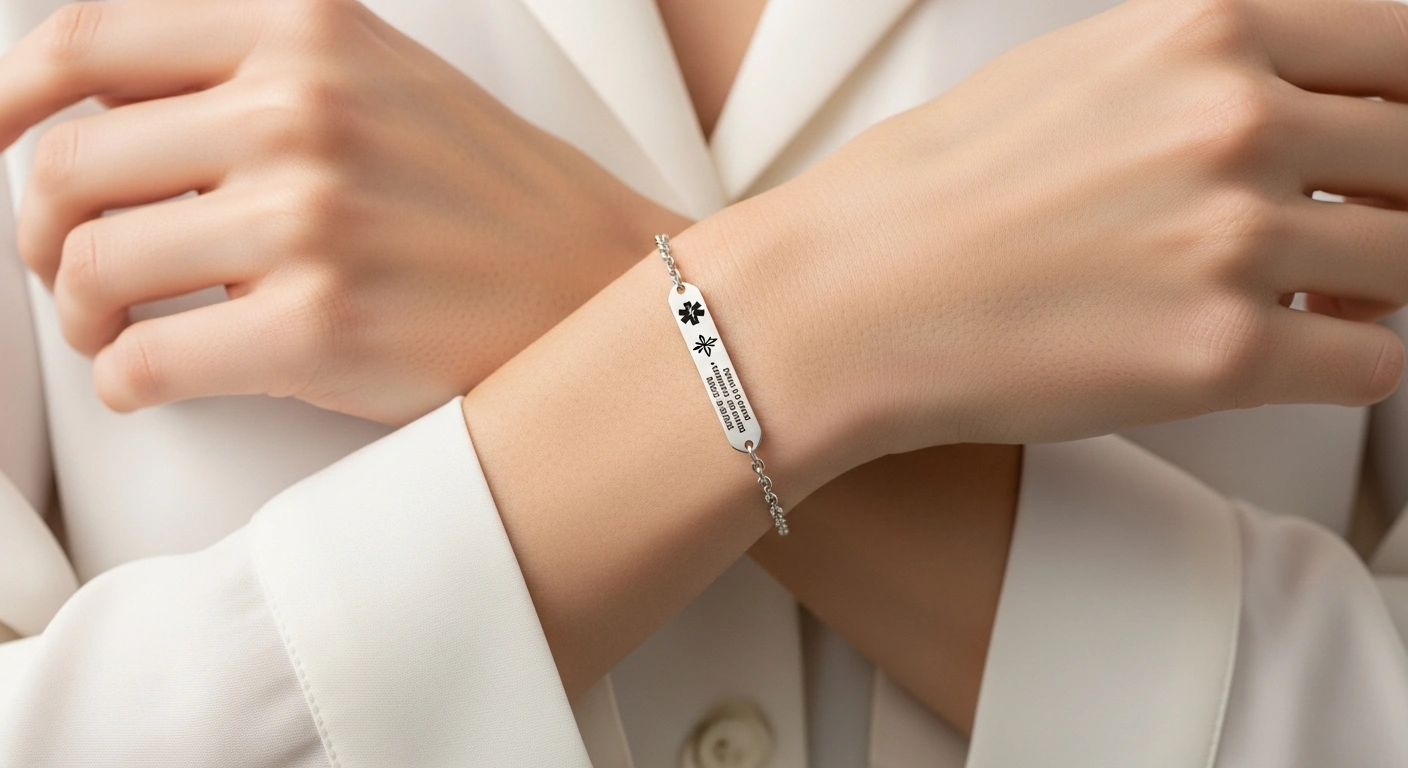
For any of these, a medical alert bracelet engraved with the specific condition becomes critical for emergencies (especially after motor vehicle accidents or falls when wrong handling causes neurological harm).
For Australians with spinal hardware
Spinal surgery patients with rods, screws, plates, or fusions need a Mediband engraved with: “Spinal Hardware T6-T9” (or similar). Paramedics responding to falls or accidents need to know NOT to flex the spine in transport. This single piece of information prevents secondary spinal cord injury.
For young athletes + scoliosis patients
Adolescent scoliosis patients (typically 10-18 years old) often wear bracing during growth spurts. Adult athletes with old back surgeries need emergency-staff awareness if they collapse during sport. Kids medical alert bracelets work well for older adolescents who may need to communicate “spine surgery 2023” or “scoliosis brace patient”.
Other curiosities — underrated health truths
- Foot health affects spine — flat feet or over-pronation cascade up to knee + hip + back
- Backpack weight matters for kids — max 10% of body weight per Australian Physiotherapy Association
- Driving posture is the worst — most drivers sit with rounded shoulders + slumped back; lumbar support cushion helps
- Sleep posture matters — stomach sleeping rotates the cervical spine 90° for 7+ hours
- Watch position — phone-watching dropping head forward is now a measurable public health issue
- Pillow height — too high or too low causes morning neck pain that lasts all day
When to see an Australian physiotherapist
- Back pain lasting >2 weeks unresponsive to stretches
- Pain radiating into arms or legs (possible nerve involvement)
- Numbness or tingling in extremities
- Posture problems your daily exercise routine isn’t fixing
- Recent injury (sports, fall, accident)
- Pre-pregnancy + post-pregnancy posture reset
- Following spinal surgery for ongoing management
Australian Physiotherapy Association directory: choose.physio. Medicare-rebated under Chronic Disease Management plans.
The Mediband promise
Mediband supports 500,000+ Australian adults + families managing chronic conditions since 2008. Permanent laser engraving, medical-grade silicone + steel, NDIS-registered, Australian-designed. Trusted by Australian physiotherapists, GPs, and spinal specialists.
References & further reading
- ABS (2024) — Australian Health Survey: Sedentary Time Statistics.
- Australian Physiotherapy Association — Workstation Ergonomics + Posture Resources.
- Spine Society of Australia — Adult Scoliosis + Post-Surgical Care Guidelines.
- RACGP — Back Pain Management Guidelines.
- Harvard Business School (2017) — Posture + Cortisol Study.
Frequently Asked Questions
Quick answers from the Mediband team
How long does it take to fix bad posture?
Visible improvements in 4 weeks with daily routine; full habit change in 3-6 months. Forward-head and rounded shoulders are the fastest to address (stretches + chin tucks). Anterior pelvic tilt and spinal-curve issues can take 6-12 months of consistent work + sometimes professional physiotherapy.
Does standing all day at a standing desk fix my posture?
Not by itself. Standing for 100% of the work day shifts strain to feet + knees + lower back. Best practice: alternate sitting and standing roughly 60/40. Move every 20-30 minutes regardless of position. Movement variety beats any single posture.
Should kids with scoliosis wear a medical alert bracelet?
Yes if they have active spinal hardware (rods, screws, fusion) or are in advanced bracing. The bracelet should engrave the surgery type or hardware level so paramedics handling a fall or sports injury know not to manipulate the spine without imaging.
Can I claim a medical alert bracelet for spinal conditions on NDIS?
Yes, for participants with documented spinal conditions (post-surgical hardware, advanced scoliosis, ankylosing spondylitis, Ehlers-Danlos affecting the spine). Bracelet purchase invoiced under Consumables. Mediband is an NDIS-registered provider.
Does a chiropractor adjustment fix posture?
Short-term: yes for joint mobility and pain relief. Long-term: no — without daily strengthening + stretching, posture reverts within days. Combine chiropractic with physiotherapy + ergonomic adjustments + daily routine for lasting change.
How does posture affect breathing and asthma?
Upright posture allows 30% more lung expansion than slumped. For Australian asthma patients, especially those with severe or exercise-induced asthma, postural correction can reduce attack frequency. Many Australian respiratory physiotherapists now include posture training in asthma management.
What's the worst posture habit for Australian office workers?
Forward head from looking down at phones + low laptops, combined with rounded shoulders. This combination causes the most chronic neck/upper back pain seen in Australian physiotherapy practice. Raising the laptop to eye level + daily chin tucks fixes most of it within 6-8 weeks.

Written by
Founder, Mediband
Founder of Mediband; over 20 years providing medical IDs worldwide.
← Previous
Keeping School-Age Children Safe — 2025 Australian Parent Guide
Next →
Staying Healthy in an Unhealthy World — Practical Daily Habits for Australian Adults
Comment(s)