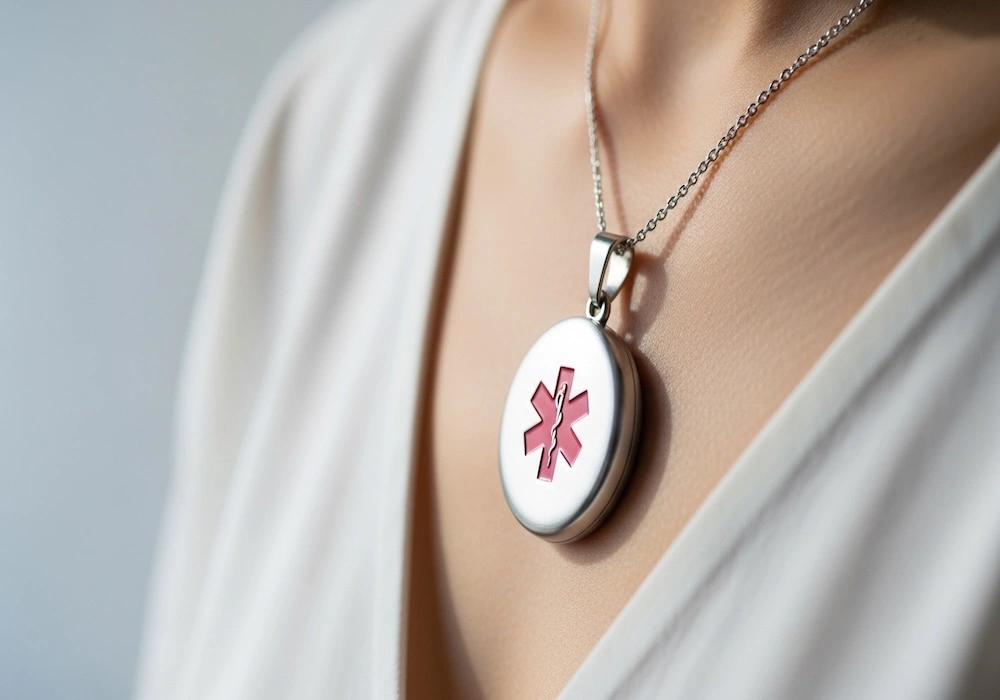

By Michael Randall · Founder, Mediband
Medically reviewed · Updated September 2025 · 11 min read
Medically reviewed · Updated September 2025 · 11 min read
Travelling With Allergic Children — Complete Australian Safety Guide
Updated September 2025. One in 20 Australian children now lives with a diagnosed food allergy — the highest paediatric allergy rate in the world (ASCIA 2024). For these families, travel is doable, often wonderful, but it requires planning that other families simply don’t need to do. Different airline meal protocols, foreign menu translation, time-zoned medication, allergen-free accommodation, hospital-emergency know-how.
This is the practical, evidence-based guide to travelling with allergic children — whether you’re flying interstate, going camping, doing an overseas holiday, or just driving regional Australia. Written for Australian parents, drawing on ASCIA Action Plan protocols, anaphylaxis research, and 17 years of customer feedback from Mediband families who travel.
Why Travelling With Allergies Is Different
Five risk factors that make travel uniquely challenging:
- Unfamiliar food + ingredient labelling — especially overseas where allergen disclosure rules differ
- Language barriers — cross-cultural restaurants, hotel staff, taxi drivers
- Time zones + medication schedules — antihistamine + EpiPen timing
- Distance from familiar emergency services — rural Australia + remote regions
- Excitement-driven impulsivity — children break their own rules on holiday
The good news: with the right preparation, allergic families travel as confidently as anyone. The Mediband + ASCIA combination of preparation tools is the gold standard.
Recommended for you
Products related to this article
Hand-picked to go with what you just read.
Before You Travel — The 14-Day Checklist
Start preparation 2 weeks before departure:
- 14 days before — GP check-up, prescription renewal for EpiPen + antihistamines + inhalers
- 10 days before — print 3 copies of the ASCIA Action Plan (one in carry-on, one in checked luggage, one with travel companion)
- 7 days before — contact airline to register medical needs + special meals (most airlines need 48-72 hours notice)
- 5 days before — pre-screen restaurants at destination + research nearest hospitals to accommodation
- 3 days before — check child’s allergy alert bracelet is in date + readable; replace if worn
- 1 day before — pack medical kit + freeze cooler packs for medication
What to Pack — The Allergic Family Travel Kit
The essentials, broken down:
- 2 EpiPens minimum (not 1 — second dose may be needed before paramedics arrive)
- Antihistamine — appropriate paediatric dose, in original packaging
- Asthma inhaler + spacer — if applicable
- Printed ASCIA Action Plan — 3 copies, photo if you can’t print
- Allergy translation cards — if travelling overseas; "I am allergic to peanut" in 6 languages
- Safe snacks for 48 hours — in case destination food fails inspection
- Wallet card — condition + emergency contact + insurance
- Allergy alert bracelet on the child — the public-facing alert
Flying With Allergic Children
Australian + international airline allergy protocols:
- Qantas + Virgin Australia — will avoid peanut snacks on domestic if requested; allow you to pre-board for cabin wipe-down
- Jetstar — meals are pre-packaged; check ingredients via app before flight
- Singapore Airlines + Emirates — offer nut-free meals if booked 48-72 hours in advance
- EpiPens in cabin — mandatory; show prescription label at security if asked
- Stay seated near front — lower air circulation from rear galley
Bring antibacterial wipes to clean tray, armrest, seatbelt buckle — small amounts of allergen can transfer from previous passengers.
Eating Out + Restaurant Strategies
Three rules for restaurant safety:
- Call ahead — talk to the chef or manager. Ask what cooking oils they use, whether allergens are stored separately, and what their cross-contamination protocol is.
- Use translation cards overseas — "I am allergic to peanut, this could kill me. Please avoid all nuts + peanut oil." Card not phone — battery doesn’t go flat.
- The 80/20 rule — 20% of restaurants cause 80% of allergy incidents. Avoid buffets, bakeries, ice cream shops with shared scoops, salad bars.
Choosing Allergy-Safe Accommodation
Look for:
- Self-catering with full kitchen (Airbnb, holiday rental) — reduces eating-out risk
- Hotels with allergen-aware kitchens — ask before booking, get written confirmation
- Distance to nearest hospital + ambulance — aim for <30 min response time
- Non-smoking rooms (residual smoke can trigger asthma)
- Allergen-free bedding options for severe dust mite / pet allergies
Why a Visible Medical Alert Bracelet Matters on Holiday
Travel multiplies the importance of a visible medical alert. Reasons:
- You’re NOT with your child every minute (kids’ club, sport, beach, sleepover)
- Other carers (grandparents, friends, hotel staff) may not know the full allergy picture
- Overseas emergency services may not speak English
- The bracelet works without the parent being present, without battery, without language
A Mediband food allergy bracelet in bright colour with clear text + your contact mobile is the single highest-impact safety tool on holiday.
Pre-Brief Your Child for the Trip
Age-appropriate scripts:
- Ages 3-6 — "Mum + Dad always check your food first. If something doesn’t come from us, say no, even if it’s yummy."
- Ages 6-10 — show them their bracelet, explain what to do if they feel "weird" (tell an adult immediately, find their EpiPen if old enough, take a deep breath)
- Ages 10+ — full self-management. They can carry their own EpiPen. Run a calm role-play of a reaction.
Recognising an Anaphylactic Reaction
Symptoms to spot fast:
- Lip, tongue or throat swelling
- Voice change — hoarse or husky
- Breathing difficulty — wheeze, persistent cough
- Hives spreading rapidly
- Severe abdominal pain or vomiting
- Collapse, drowsiness, pale + floppy
Action: administer EpiPen immediately at first sign, then call 000 or local emergency. Keep child lying flat unless vomiting. Do NOT let them stand — collapses are sudden.
Country-Specific Tips
Top destinations + their quirks:
- South-East Asia (Thailand, Vietnam, Bali) — peanut + fish sauce are everywhere; learn the local words for nut + peanut
- USA — allergen labelling is mandatory; medical care is excellent but expensive without insurance
- Europe — EU allergen labelling is strong; restaurants in Italy/Spain are usually helpful
- Pacific Islands (Fiji, Vanuatu) — coconut is the main allergen; emergency response time can be slow on remote islands
- New Zealand — food labelling is similar to Australia; allergic-friendly culture
- Outback Australia — emergency response time can be 1-2 hours; carry extra EpiPens
Travel Insurance for Allergic Families
What to check in your policy:
- Anaphylaxis treatment + hospital admission covered
- EpiPen replacement if used + lost
- Medication evacuation if your supply runs out
- Pre-existing condition declaration (declare allergies at policy purchase)
- Coverage at remote destinations + cruise ships
Camping + Outdoor Holidays
Allergy considerations for bush + beach:
- Insect allergies (bees, wasps, ants) — carry EpiPen even if "just food allergic"; cross-reactions occur
- Pollen + grass — asthma triggers in spring + early summer
- Sunscreen + insect repellent — check ingredients for personal sensitivities
- Distance to hospital — research nearest emergency department before booking
- Mobile reception — carry a satellite communicator if going truly remote
What to Do If a Reaction Happens Overseas
Step-by-step:
- Administer EpiPen immediately at first sign of anaphylaxis
- Call local emergency number (most countries have a tourist hotline)
- Show the ASCIA Action Plan + medical alert bracelet to responders
- Get a hospital interpreter if needed (most major hospitals have phone interpreting)
- Contact your travel insurer within 24 hours
- Replace the used EpiPen the next business day (pharmacies in major cities can usually fill an Australian script with translation)
The Mediband Promise
Mediband ships allergy-specific silicone bracelets Australia-wide with next-day delivery to all capital cities. Peanut, penicillin, dairy, gluten and custom-engraved options are available in kid sizes from age 3 up. Designed for the school+sport+travel reality of Australian allergic families. Over 100,000 Australian families trust Mediband for daily-wear allergy safety.
References + Further Reading
- ASCIA (Australasian Society of Clinical Immunology and Allergy) — Travel With Food Allergies: Patient Resource.
- Allergy + Anaphylaxis Australia — Travel Translation Cards + Country Guides.
- Smartraveller (Australian Government) — Health Considerations for Australians Travelling Overseas.
- Sydney Children’s Hospital Network — Paediatric Anaphylaxis Outcomes Data 2018-2024.
- Diabetes Australia — Travel Diabetes Management Guide.
Frequently Asked Questions
Quick answers from the Mediband team
Should I tell the airline about my child's food allergy?
Yes — 48-72 hours before flying. Major Australian carriers (Qantas, Virgin Australia) and most international airlines (Singapore, Emirates) accommodate nut-free meals or general allergen awareness when notified. Bring your own safe snacks regardless of airline confirmation.
How many EpiPens should I bring on holiday?
Minimum 2 — one may be needed before paramedics arrive, and a second dose may be required after 5-15 minutes if symptoms persist. For remote destinations or 7+ day trips, 3 EpiPens is safer. Keep them in cabin baggage, not checked luggage.
What should my child's allergy bracelet say when travelling?
The specific allergen ('Peanut Allergy', 'Anaphylaxis - Nut Allergy'), the child's first name, and your mobile number with country code (e.g. +61 4xx xxx xxx). For overseas travel, consider adding 'EpiPen in bag' to alert non-English-speaking responders.
Can I take EpiPens through international airport security?
Yes — EpiPens are universally accepted at security with a prescription label or doctor's letter. Carry the original packaging. Some countries require a doctor's letter in their language for stricter security checks (China, parts of Middle East).
What if my child eats something allergenic on holiday?
Administer EpiPen at first sign of anaphylaxis (lip/throat swelling, breathing difficulty, hives spreading). Call local emergency, show the ASCIA Action Plan + medical alert bracelet. Keep child lying flat unless vomiting. Always contact travel insurer within 24 hours for replacement EpiPen + medical cost coverage.
Is travel insurance more expensive for allergic kids?
Slightly — expect a 5-15% premium for declared food allergies. Don't skip declaration — an undeclared pre-existing condition can void the entire policy if an incident happens. Compare a few insurers; some specialise in chronic-condition coverage at better rates.
Should we visit the local hospital before holiday begins?
For severe allergies or first-time international travel — yes. A 30-minute orientation visit to the nearest hospital lets you know location, parking, ED procedure, and reduces stress if you need to return urgently. Many Australian families do this on day 1 of overseas holidays.

Written by
Founder, Mediband
Founder of Mediband; over 20 years providing medical IDs worldwide.
← Previous
Heart Health for Australians — 10 Practical Daily Habits That Move the Needle
Next →
5 Healthy Daily Routines for Better Health (Australian Guide)
Comment(s)