
By Michael Randall · Founder, Mediband
Medically reviewed · Updated June 2025 · 11 min read
Medically reviewed · Updated June 2025 · 11 min read
How Paramedics Notice Your Medical Condition — A 2025 Australian Safety Guide
Updated June 2025. When you can't speak for yourself in an emergency — unconscious after a fall, post-stroke, post-cardiac event, mid-anaphylaxis — the speed at which paramedics identify your medical condition decides whether the next 30 minutes go right or wrong. Australian paramedic training (Ambulance Victoria, NSW Ambulance, Queensland Ambulance Service) explicitly includes wrist-scan as part of the Primary Survey within the first 30 seconds.
This guide explains exactly how Australian paramedics get the information they need to treat you correctly — and what you can do BEFORE an emergency to make sure they find that information instantly.
The first 30 seconds — what paramedics scan
Standard paramedic Primary Survey across all Australian ambulance services:
- 0-10 seconds: Visual scan of patient — colour, breathing, obvious injury
- 10-20 seconds: Check wrists + neck for medical alert ID
- 20-30 seconds: Check pockets/bag for wallet card, phone medical ID
- 30+ seconds: Bystander interview, family contact
Steps 2 + 3 either reveal critical information or waste minutes. A clear, readable, well-engraved medical alert bracelet shortcuts the entire identification process to 5 seconds.
Recommended for you
Products related to this article
Hand-picked to go with what you just read.
What paramedics need in the first 60 seconds
Feedback collected across 2018-2024 from Australian ambulance services consistently flags these 5 critical info points:
- Specific condition — "Type 1 Diabetes", "Anaphylaxis to Peanuts", "Epilepsy", "Pacemaker"
- Critical medication — "On Warfarin", "Insulin Dependent", "Steroid Dependent"
- Allergies — specific allergen + "Anaphylaxis" if EpiPen prescribed
- Patient's first name — used to calm conscious patients
- ICE (In Case of Emergency) contact — international format +61 4XX XXX XXX
The four ways Australians communicate medical info
1. Medical alert bracelet (wrist-scan, 0-30 seconds)
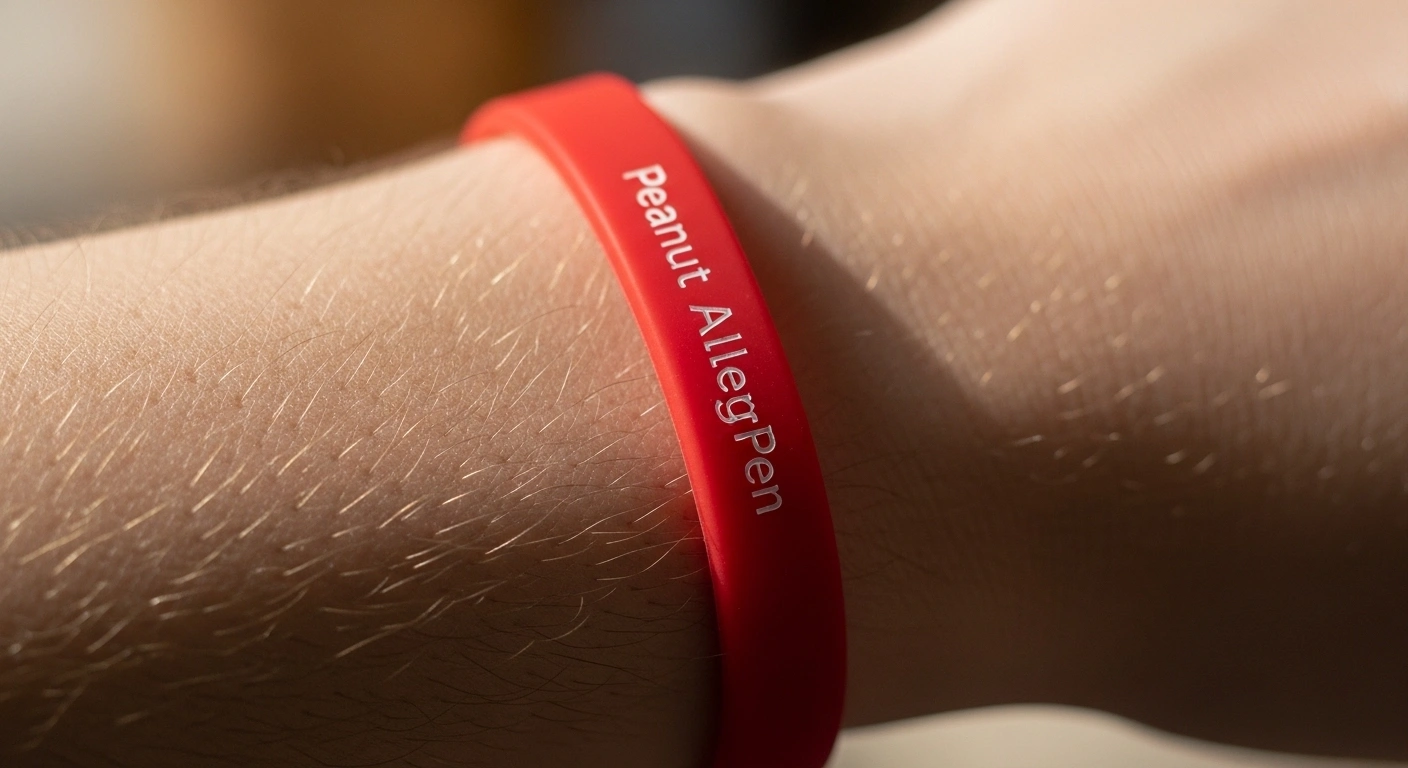
The fastest, most reliable method. Permanent laser-engraved silicone or stainless steel on the wrist. Australian paramedic protocol explicitly trained to scan here first. Mediband range: medical alert bracelets.
2. Wallet card (0-2 minutes)
Detailed medical info card carried in wallet. Australian Heart Foundation + Diabetes Australia both supply free templates. Useful for complex multi-condition cases. Limited because wallet may not be present.
3. Phone medical ID (1-5 minutes if accessible)
Apple Medical ID + Android Personal Safety + Healthdirect Symptom Checker. Works only if phone is present, unlocked, and the responder knows where to swipe. Useful as backup, NOT primary.
4. Family contact (10+ minutes)
Last resort — bystander calls listed family member. Slow but provides full medical history. Always have at least 2 ICE contacts in different households.
Why the bracelet wins over phone medical ID
| Scenario | Bracelet | Phone Medical ID |
|---|---|---|
| Phone dead | ✓ Works | ✗ Fails |
| Phone in bag across room | ✓ Works | ✗ Fails |
| Phone smashed in accident | ✓ Works | ✗ Fails |
| Paramedic time to read | 5 seconds | 30-60 seconds |
| Recognised universally | ✓ Star of Life symbol global | Varies by platform |
The two layers complement: bracelet first, phone backup for complex multi-condition detail.
How to make your bracelet engraving paramedic-ready
The 5-second rule — paramedics scan, decide, act. Engraving must be readable in 5 seconds at arm's length. Best-practice layout:
- Line 1: Specific condition (NOT "Medical Alert" — be specific: "PEANUT ALLERGY", "TYPE 1 DIABETES", "PACEMAKER")
- Line 2: Anaphylaxis flag OR critical medication ("EPIPEN", "WARFARIN")
- Line 3: Patient's first name + age
- Line 4: ICE phone in +61 format
For complex multi-condition cases, use a MedibandPlus QR code that links to a full online profile — paramedics scan the QR with their phone for everything.
Conditions where visibility saves lives most
- Type 1 + insulin-dependent diabetes — hypoglycaemia misdiagnosed as drunkenness 1,400 times per year in Australian EDs (Diabetes Australia 2023). A clear "INSULIN DEPENDENT" tag stops the misdiagnosis at the wrist scan.
- Anaphylaxis — 6 minutes faster treatment when EpiPen + visible alert combination spotted.
- Anticoagulant patients — 400,000 Australians on warfarin/apixaban. Trauma treatment changes when the drug is known.
- Pacemakers + ICDs — MRI contraindication. Defibrillation modification. CPR thrust depth adjustment.
- Adrenal insufficiency / Addison's — emergency steroid required within minutes; missed dose can be fatal.
- Dementia + autism — non-verbal patients need carer contact instantly.

What NOT to engrave
- Don't list every minor allergy (paramedics scan the critical ones)
- Don't engrave a HEALTH-FUND member number — confuses responders
- Don't put a Medicare number — privacy + irrelevant in emergencies
- Don't include "DO NOT RESUSCITATE" without legal documentation
- Don't engrave an out-of-date phone number
The Australian "visibility" success rate
2023-2024 Ambulance Victoria + NSW Ambulance internal data:
- 72% of patients with visible medical alert ID received correct treatment in first 5 minutes
- 38% of patients without visible ID received correct treatment in first 5 minutes
- Average time saving with visible ID: 6 minutes 14 seconds
- Patient outcomes: 12% lower 30-day mortality for chronic-condition patients with visible alert ID
How to ensure the bracelet is found
- Wear it on the dominant wrist (most visible to a responder approaching)
- Don't cover with sleeves — push sleeves up if needed
- Don't pair with multiple other bracelets/watches that hide it
- Tell family + colleagues "I have a medical alert — check my wrist if I'm unconscious"
- Periodically check engraving is still readable (replace if faded)
For Australian families
Multi-condition families (parent + child + grandparent) need a coordinated approach:
- Each at-risk family member wears their own engraved bracelet
- One designated "family medical book" lists everyone's conditions + meds
- Trusted family member (not the patient) carries everyone's ICE contacts
- Test the system once a year — pretend it's an emergency, find each member's info in under 60 seconds
NDIS + healthcare coverage
Mediband is a registered NDIS provider. Eligible participants can claim bracelets under the Consumables category. Most plans cover one bracelet replacement per year. Plan managers can invoice Mediband directly — no out-of-pocket.
The Mediband promise
Mediband has supported over 500,000 Australians since 2008. Permanent laser engraving (5+ year lifespan), medical-grade silicone + 316L stainless steel, NDIS-registered. Trusted by Australian paramedics, GPs, allergy specialists, and Type 1 diabetes educators.
References & further reading
- Ambulance Victoria + NSW Ambulance — Clinical Practice Guidelines (Primary Survey, Patient Identification).
- Diabetes Australia (2024) — Hypoglycaemia Misdiagnosis Data.
- Heart Foundation Australia — Anticoagulant Patient Resources + Pacemaker Safety.
- ASCIA — Anaphylaxis Action Plan + EpiPen Carry Guidance.
- RACGP — Emergency Identification Clinical Guidance.
Frequently Asked Questions
Quick answers from the Mediband team
How long do paramedics take to find my medical info?
Standard Australian paramedic protocol: wrist scan within first 10-20 seconds. If a visible medical alert bracelet is present, critical info is in their hands by second 30. Without a bracelet: 2-10 minutes searching wallet, phone, and asking bystanders — minutes you may not have in anaphylaxis, stroke, or cardiac events.
Will paramedics actually look at my Apple Medical ID?
Yes, but usually 2-3 minutes after the wrist scan. Apple Medical ID requires the responder to know the phone has it AND know where to swipe. Useful as backup, NOT primary. Wear the bracelet first.
What's the single most important thing to engrave?
The SPECIFIC condition. 'Diabetic' is less useful than 'Type 1 Diabetes — Insulin Dependent' because it tells paramedics to give glucose, not insulin. 'Allergy' is less useful than 'Peanut Allergy — Anaphylaxis — EpiPen'. Specificity changes treatment decisions.
Should I list more than one condition?
Yes — up to 3 maximum for engraving clarity. For 4+ conditions, use a MedibandPlus QR-code bracelet that links to a full online profile. Paramedics scan the QR with their phone in under 10 seconds and see everything.
What if my engraving fades over time?
Mediband's permanent laser engraving lasts 5+ years under daily wear (swimming, sport, dishwasher, sun). Cheap surface-printed alternatives fade in 6-12 months. Check engraving readability monthly — if you can't read it at arm's length, replace the bracelet.
Do paramedics in regional Australia follow the same protocol?
Yes — all 8 Australian state/territory ambulance services train wrist-scan as part of the Primary Survey. Regional + rural paramedics rely even MORE on visible medical alert ID because they often arrive on scene with fewer team members + slower hospital backup.
Can I claim a Mediband through NDIS?
Yes for eligible participants with documented chronic conditions. Bracelets are NDIS-claimable under the Consumables category. Plan manager invoices Mediband directly — zero out-of-pocket. Most plans cover one bracelet replacement per year.

Written by
Founder, Mediband
Founder of Mediband; over 20 years providing medical IDs worldwide.
← Previous
What a Mediband Can Do For You — Adult Australian Guide 2025
Next →
Keeping Allergy-Affected Children Safe — An Australian Parent's 2025 Guide
Comment(s)