By Michael Randall · Founder, Mediband · Published 13 May 2026 · 9 min read
An anaphylactic reaction can move from first symptom to airway compromise in minutes. In those minutes, the people around you — bystanders, paramedics, school staff — need to know two things fast: what triggered it, and where the adrenaline is. A medical ID puts both within reach.
This guide covers exactly what to engrave on a medical ID if you or someone in your care lives with severe allergy or anaphylaxis — including allergen-specific examples, paediatric guidance, and how to record adrenaline auto-injector use on the band.
Why a medical ID matters when you live with anaphylaxis
Around one in 10 Australian infants and one in 50 adults lives with food allergy, according to the Australasian Society of Clinical Immunology and Allergy (ASCIA). Hospital admissions for anaphylaxis in Australia have risen substantially since 2000, particularly in children under five. Most days, the strategy is avoidance and an ASCIA Action Plan. The reason for a medical ID is the small set of moments where avoidance fails and decisions have to be made fast by someone who doesn't know you.
Speed of the reaction. Anaphylaxis from food, venom, or drugs typically begins within minutes and can progress to airway swelling, low blood pressure, or collapse before an ambulance arrives. ASCIA guidance is clear: give adrenaline first, antihistamines and asthma puffers are not a substitute. A visible engraving of the trigger and the location of the auto-injector compresses the time between symptom and treatment.
Unconscious or collapsed presentation. A patient found unresponsive after a meal, a sting, or a medication dose can be mistaken for a faint, a seizure, or a cardiac event. The label "Anaphylaxis — EpiPen in bag" gives the first responder a working diagnosis in seconds.
Carer handover. Schools, sports clubs, camps, restaurants, and casual childcare rotate through staff. A medical ID is the consistent piece of information that travels with the child regardless of who is on duty that day.
Co-existing asthma. Most fatal anaphylaxis cases in Australia involve someone with poorly controlled asthma. An ID that flags asthma alongside the allergen helps clinicians anticipate the airway pattern they're about to see.
A medical ID doesn't replace an ASCIA Action Plan or an adrenaline auto-injector. It supplements them — it's there in the seconds before help arrives and through every handover afterwards.
What to engrave: the starting point
Regardless of trigger, every anaphylaxis medical ID should carry these six pieces of information:
- The word "Anaphylaxis" — it tells a clinician the severity in one word
- The trigger — the specific allergen, named clearly (e.g. "Peanut", "Bee venom", "Penicillin")
- Adrenaline carriage — "EpiPen" or "Anapen" plus where it's kept ("in bag", "in school office")
- Name — first and last; for children include date of birth
- Emergency contact — "ICE" plus name and Australian mobile in international format (+61 4XX XXX XXX)
- Asthma status — if applicable, "Asthma" on the back is high-value information
What you add after that depends on the trigger, the age of the wearer, and any co-existing conditions. The sections below cover the most common cases, with sample engraving you can adapt directly.
Ready to start engraving?
Browse Mediband's custom engravable bracelet range — silicone, stainless steel, or gold — and pick the format that fits your day-to-day.
Food allergy — adults
For adults with food-triggered anaphylaxis, the engraving should name the food clearly, flag the auto-injector, and call out asthma if relevant. Avoid vague terms like "nut allergy" — "peanut" and "tree nut" are clinically distinct, and clinicians will treat them differently.
Example — peanut anaphylaxis, adult
| Front | ANAPHYLAXIS | PEANUT |
| Back | ICE Sam Smith +61 412 345 678 | EpiPen in bag | Asthma |
Example — shellfish anaphylaxis, adult
| Front | ANAPHYLAXIS | SHELLFISH (PRAWN, CRAB) |
| Back | ICE Sam Smith +61 412 345 678 | Anapen 300 in bag |
If you carry two auto-injectors (recommended for adults at significant risk), note "x2" on the back — it tells a responder there's a second dose available if needed.
Food allergy — children
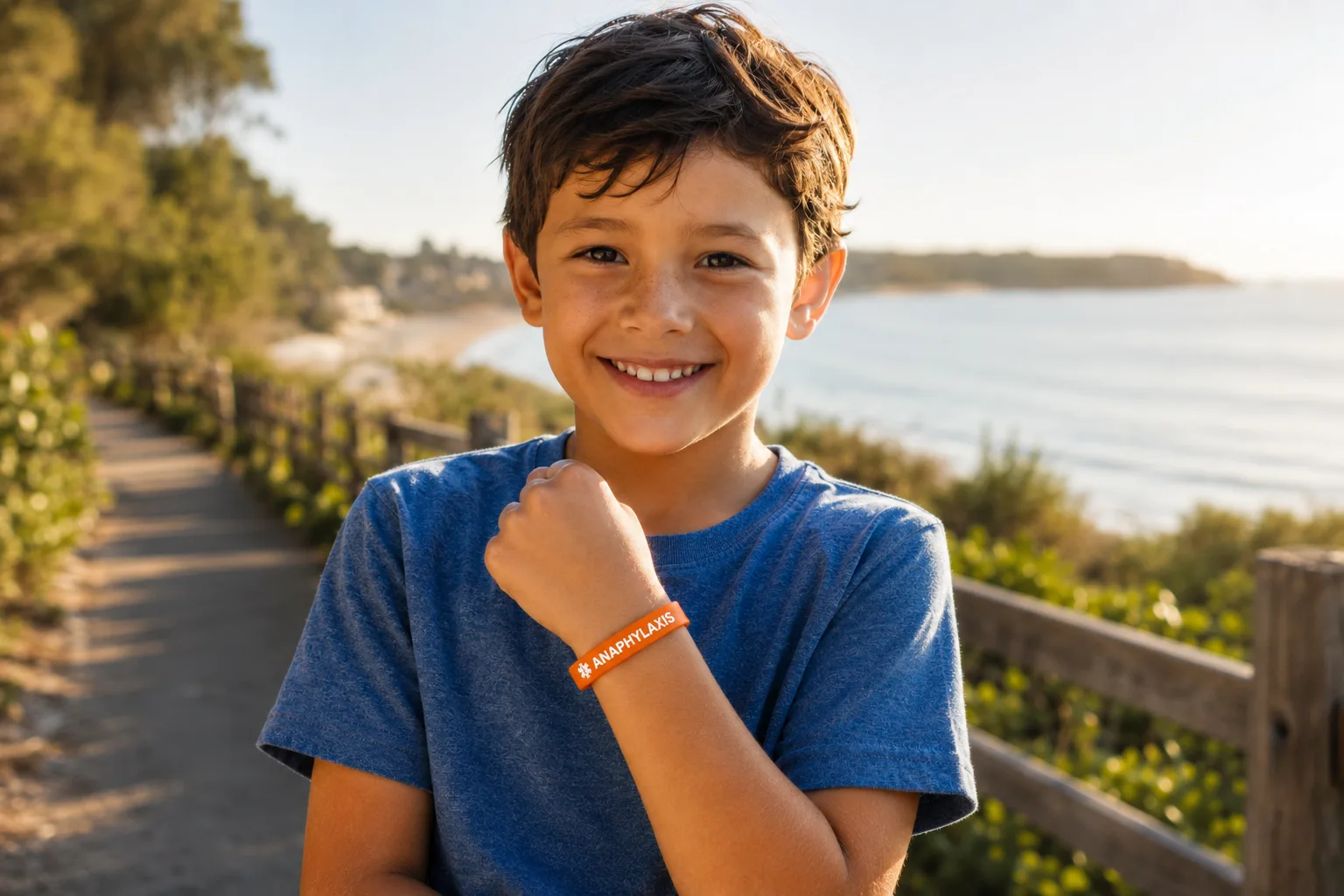
For a child, the ID needs to be readable by a teacher, coach, camp leader, or first responder who has never met them. Keep it simple, complete, and tamper-resistant. Silicone bands work well for active children — they're durable, water-resistant, and harder to remove than a clasp bracelet. Pair the band with a copy of the ASCIA Action Plan in the school office or sports bag.
Example — child, peanut and tree nut
| Front | ANAPHYLAXIS | PEANUT + TREE NUT | Alex | DOB 14/03/2017 |
| Back | Parent Sam Smith +61 412 345 678 | EpiPen Jr in office | Asthma |
Example — child, dairy and egg
| Front | ANAPHYLAXIS | DAIRY + EGG | Mia | DOB 02/08/2019 |
| Back | Parent Sam Smith +61 412 345 678 | EpiPen Jr with carer |
For very young children (under three), the band format matters as much as the engraving. Choose a soft silicone band sized to the wrist that won't pull off in play and won't sit loose enough to flip out of view.
Insect venom allergy
Insect-triggered anaphylaxis in Australia most commonly involves honey bee, European wasp, and jack jumper ant (notably in Tasmania, Victoria, and the ACT). Many people with insect venom allergy go through venom immunotherapy — if you're partway through, the medical ID still matters because reactions can occur until immunotherapy is complete.
Example — bee venom anaphylaxis, adult
| Front | ANAPHYLAXIS | BEE VENOM |
| Back | ICE Sam Smith +61 412 345 678 | EpiPen in bag | On VIT |
"VIT" is recognised shorthand for venom immunotherapy. If space permits and you want clarity for non-specialist responders, "Venom immunotherapy in progress" reads cleanly.
Drug and latex allergy
Drug-triggered anaphylaxis is one of the highest-stakes cases for a medical ID because the wearer cannot always speak for themselves before treatment begins. Common triggers include penicillin and other beta-lactam antibiotics, NSAIDs (ibuprofen, aspirin), neuromuscular blocking agents used in anaesthesia, and chlorhexidine. Latex allergy is a separate category that matters most in clinical settings — gloves, catheters, and tape can all expose a sensitised patient.
Example — penicillin anaphylaxis
| Front | ANAPHYLAXIS | PENICILLIN |
| Back | ICE Sam Smith +61 412 345 678 | No penicillin or cephalosporins |
Example — latex anaphylaxis, surgical context
| Front | ANAPHYLAXIS | LATEX |
| Back | ICE Sam Smith +61 412 345 678 | Latex-free environment required |
For drug allergies, name the drug class on the back where it fits ("No penicillin or cephalosporins") — it removes ambiguity when a clinician is choosing an alternative.
Multiple triggers, idiopathic, and exercise-induced anaphylaxis
For people with several confirmed triggers, the ID should prioritise the most severe and most likely to be encountered. Listing every allergen on a wristband fragments the message — a wallet card carries the full picture, and the band carries the headline.
Idiopathic anaphylaxis. When no trigger has been identified, engrave "Idiopathic anaphylaxis" so a responder knows to treat the presentation rather than search for a cause. Specialist follow-up details belong on the wallet card, not the band.
Exercise-induced anaphylaxis. Often food-dependent (wheat is a common co-factor). The band can carry "Exercise-induced anaphylaxis — food co-factor" with the relevant food on the back.
Mastocytosis. A clinical flag in itself — "Mastocytosis" on the back tells a responder the reaction threshold is lower and the response should be faster.
Recording your adrenaline auto-injector on the band
The single highest-value engraving on an anaphylaxis medical ID, after the trigger, is the auto-injector. Two patterns work:
- "EpiPen in bag" — tells a bystander where to find it
- "EpiPen Jr with carer" — for a child whose injector travels with a teacher or parent
If you carry the newer Anapen device, name it explicitly — the injection technique differs from EpiPen and a responder unfamiliar with Anapen may hesitate. "Anapen 300 in bag" reads clearly. For two-dose carriage (recommended in adolescents, adults at higher risk, and anyone with co-existing asthma), append "x2".
One thing to avoid on the band: shelf-life details. Auto-injectors expire every 12 to 18 months and engraving an expiry date locks the wearer into re-engraving on the same cycle. Keep the date check on a phone reminder or in the ASCIA Action Plan.
Which Mediband ID suits your use case
Mediband has been designing medical IDs in Australia since 2004. The right format depends on how active you are, how much you need to engrave, and how the band needs to wear day-to-day.
| Format | Best for | Engraving capacity | Browse |
|---|---|---|---|
| Silicone band | Children, sport, school, water exposure, sensitive skin | Short-form, high-contrast text on the band itself | Custom silicone → |
| Active hybrid | Active adults and teenagers wanting metal-plate engraving on a silicone strap | Mid-range — engraved metal plate, longer text than pure silicone | Active hybrid → |
| Stainless steel | Office, dress wear, daily use, durability | Generous — multi-line engraving front and back | Stainless steel → |
| Gold | Formal wear, gift, longevity | Generous — same as stainless | Gold → |
| Wallet card | Supplement to a band — carries the full trigger list, ASCIA plan number, specialist contact | High — full card surface, both sides | Wallet card → |
For most people with anaphylaxis, a silicone band plus a wallet card is the most practical combination — the band is always on, the card carries the detail that doesn't fit on a wristband.
NDIS funding for medical IDs
For NDIS participants whose plan includes Assistive Technology or Consumables, a medical ID can be a fundable item. Mediband is an NDIS-registered supplier. Eligibility depends on your plan and the way your support coordinator has structured your goals — speak to your support coordinator or LAC before assuming coverage.
If your plan covers it, we can invoice the NDIA directly or work with your plan manager.
NDIS participant or support coordinator?
See how Mediband works under the NDIS, including plan-manager invoicing and the bracelet ranges typically funded.
Frequently asked questions
What should I engrave on a medical ID for severe allergy?
At minimum: the word "Anaphylaxis", the specific trigger (e.g. "Peanut", "Bee venom", "Penicillin"), the auto-injector and where it's kept ("EpiPen in bag"), your name, an emergency contact in international format (+61 4XX XXX XXX), and asthma status if applicable. For children, include date of birth. See the food allergy section for full examples.
Should I write "EpiPen" or "Anapen" on the band?
Name the device you actually carry. EpiPen and Anapen are both adrenaline auto-injectors available in Australia, but the injection technique differs. A responder unfamiliar with Anapen may hesitate if the band only says "EpiPen" and an Anapen is what they find. "Anapen 300 in bag" or "EpiPen in bag" both read clearly. If you carry two devices, append "x2".
Is a silicone band or metal bracelet better for a child with severe allergy?
For most children with anaphylaxis, silicone is the better choice. Silicone bands are durable, water-resistant, hypoallergenic, harder to remove accidentally, and the engraving lasts the life of the band. Metal bracelets carry more text but can snag during play or sport. If your child is older and prefers a metal look, a hybrid silicone-and-metal-plate option (the "Active" range) gives the metal engraving on a more durable strap.
Does a medical ID replace an ASCIA Action Plan?
No. The medical ID supplements the ASCIA Action Plan — it doesn't replace it. The Action Plan is the formal clinical document used by schools, carers, and clinicians; the ID is the visible piece of information that travels with the wearer in the seconds before anyone reads the plan. Keep the Action Plan with the auto-injector and at the school office or workplace first-aid point.
Are anaphylaxis medical IDs covered by the NDIS?
For NDIS participants whose plan includes Assistive Technology or Consumables funding, a medical ID can be a fundable item. Eligibility depends on the way your goals are structured in your plan, so check with your support coordinator or LAC before assuming coverage. Mediband is an NDIS-registered supplier and can invoice the NDIA directly or work with your plan manager. See the NDIS information page for details.
How often should I update an anaphylaxis medical ID?
Update whenever the engraving stops reflecting the current situation — new or changed triggers, a new auto-injector type, a change in emergency contact, a new asthma diagnosis, or completion of venom immunotherapy. Out-of-date information on a medical ID is worse than no ID. As a baseline, review the engraving every 12 months even if nothing has changed, and check the auto-injector expiry date at the same time.
Will a paramedic actually check the medical ID?
Yes — checking for a medical ID is a standard step in the primary survey for an unconscious or impaired patient. Paramedics, emergency department clinicians, and many bystander first-aiders are trained to look at the wrists, neck, and wallet. The Australian Resuscitation Council's guidelines on patient assessment include this step.
Where to start
If you're new to medical IDs, the simplest first step is to pick a format, draft the engraving text using the examples above, and run it past your immunologist or GP before you order. If you have an ASCIA Action Plan, mirror its language — the trigger name and auto-injector model should match exactly.
If you're replacing an old ID, check the engraving still names the right device, the right trigger, and a current emergency contact — and refresh anything that's drifted.
Ready to order your anaphylaxis medical ID?
Browse Mediband's full engravable range — silicone, hybrid, stainless steel, gold — and pick what fits your day.
Sources and further reading
- Australasian Society of Clinical Immunology and Allergy (ASCIA) — allergy.org.au
- Allergy & Anaphylaxis Australia — allergyfacts.org.au
- National Allergy Council — nationalallergycouncil.org.au
- Healthdirect Australia — healthdirect.gov.au
- Australian Resuscitation Council — resus.org.au
About this article: Mediband has been designing medical IDs in Australia since 2004. We are an NDIS-registered supplier supporting participants, support coordinators, plan managers, hospitals, and peak bodies across Australia. The clinical examples in this article reflect common engraving practice — they are not medical advice and should not replace guidance from your immunologist, GP, or ASCIA Action Plan.

Written by
Founder, Mediband
Founder of Mediband; over 20 years providing medical IDs worldwide.
← Previous
Medical Bracelet Australia — 2026 Buying Guide for Medical ID Bracelets
Next →
Medical IDs for diabetes — what to engrave and why it matters
Comment(s)