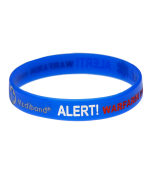
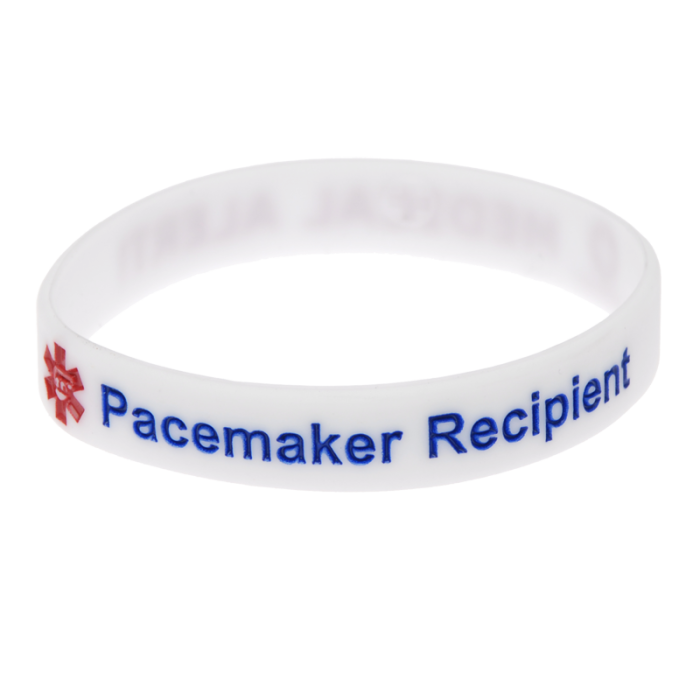
Pacemaker Recipient Medical Bracelet
£4.13
SKU
B2099
Secure checkout
VISA
Mastercard
Apple Pay
Google Pay
+5 more
Also accepted
AMEX
Afterpay
Zip
Klarna
PayPal
Enjoy life more knowing that you - or your loved one - can get immediate and appropriate treatment should something happen
4.9 · 55 reviews
Since 2004
Looking for the full pacemaker & ICD ID guide?
The Pacemaker hub covers MRI-conditional engraving, AED placement (10cm ARC guidance), anticoagulation (warfarin, apixaban, dabigatran, rivaroxaban + reversal agents), CRT-D heart failure, and brand-specific engraving for Medtronic, Abbott, Biotronik and Boston Scientific devices.
Pacemaker recipient medical alert bracelet
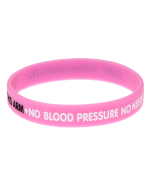
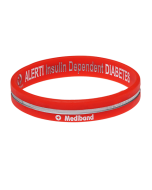
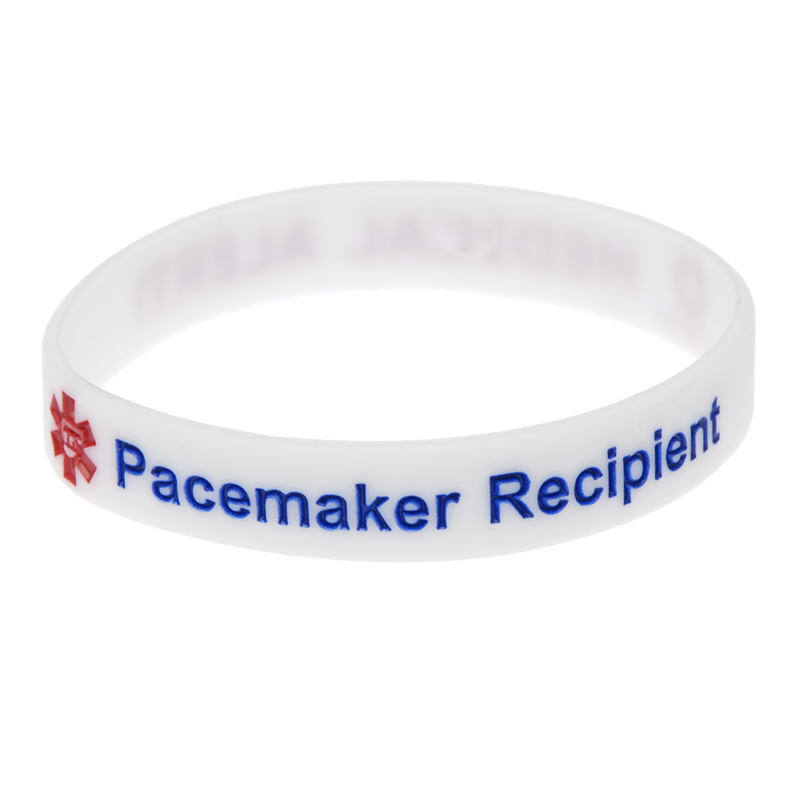
A white silicone band reading Pacemaker Recipient in blue, with a red Star of Life and a second alert phrase on the reverse face. One piece, no clasp, no metal, nothing to scan.
It answers a question that changes what happens next: whether there is an implanted cardiac device under the skin of the chest.
Healthdirect names this exact product
On its pacemaker page, Healthdirect states it plainly: “Your doctor will arrange a medical ID bracelet or a card for you to keep in your wallet. This lets people know you have a pacemaker in case of emergency.”
That is unusual. Most medical ID is a sensible precaution the patient decides on. For a pacemaker it is listed by Australia's national health information service as part of what living with the device involves — alongside the clinic check-ups and the travel advice.
Why a bracelet as well as the card
The card tells someone who has already found your wallet and opened it. The band tells someone who has found you. In the first minutes at a scene, those are different problems, and a card in a bag that is still in a car does not solve the first one.
What the device is, and where it sits
A pacemaker is a battery and leads that send electrical impulses to the heart to keep it beating at a normal rate. Healthdirect describes it as placed under the skin, usually on the upper left or right side of the chest just below the collarbone — which is precisely the area a responder works over during resuscitation and defibrillation.
That anatomy is why the band exists. Knowing a device is under that skin changes where pads go and how the chest is handled, and it is not something anyone can see on an unconscious patient from across a room.
Who should wear one
- Anyone with a single-chamber, dual-chamber or biventricular pacemaker
- People with an implantable cardioverter defibrillator (ICD)
- Cardiac resynchronisation therapy (CRT) device recipients
- Leadless pacemaker recipients
- People with an implanted cardiac monitor
- Anyone with a temporary pacing system in place
If a device recipient is also anticoagulated — which many are — that is a second fact worth carrying, and it is a separate band: the warfarin band, the Xarelto band or the broader on anticoagulants band. Many people wear one on each wrist.
Living with a pacemaker — what Healthdirect advises
Healthdirect's guidance on day-to-day life with a device, summarised:
| Situation | What Healthdirect says |
|---|---|
| Check-ups | Pacemaker clinic visits matter; the battery usually lasts between 5 and 15 years |
| Physical activity | Most people can play sport, swim and stay active; avoid contact sports such as football that could impact the chest |
| Electrical devices | A strong magnetic field can sometimes interfere; try not to carry your mobile phone close to the pacemaker |
| Medical procedures | Tell healthcare providers you have a pacemaker before procedures such as MRIs |
| Travel | Let airport security staff know — it may set off the metal detector |
| Work | If your job involves welding equipment or heavy electrical devices, check with your doctor that it is safe |
Most of these are conversations you have in advance, when you can speak. The wristband covers the one circumstance none of them do: when you cannot.
What this band shows — and what it cannot
This is a ready-to-wear, pre-printed band. The wording and the Star of Life are moulded in at manufacture and fixed. There is no engraving plate and no write-on panel, so a device model, an implant date, a cardiologist's number or an emergency contact cannot be added to this band.
If you need those details on an ID
Use a write-on band you can fill in by hand and update, or a made-to-order Mediband Custom ID in engraved stainless steel, gold or custom-printed silicone. Device model and MR-conditional status are the two details most worth carrying in writing, and our guide to medical ID abbreviations covers wording clinicians read reliably. The pacemaker medical ID hub goes through engraving examples in more detail.
It also does not replace your device card, your cardiology follow-up, or telling staff before a procedure. It is an alert, not advice.
Sizing, wear and care
Fit
Small, medium, large and extra large. Measure around the wrist and compare against our wrist measurement guide. Snug enough not to slide over the hand, loose enough to rotate and take a fingertip underneath.
Care
Medical-grade silicone with no metal parts and no clasp, so it is safe to leave on in the shower and the pool — and, unlike a metal ID, it raises no question in an imaging suite. Wash with warm water and mild soap, rinse after chlorine, salt water or sunscreen, and air dry. Replace it once the colour-fill has worn back far enough that the wording no longer reads at a glance; white bands show grime more than dark ones, so give it a proper wash rather than replacing it early.
For cardiology clinics and device services
Single bands can be ordered here. For a cardiology clinic, a device follow-up service, a cardiac rehabilitation programme or an aged-care provider, tell us quantities and sizes and we will come back with pricing and a date.
Frequently asked questions
Can I have my device model engraved on it?
Not on this band — it is pre-printed with fixed wording. For a model, an implant date or MR-conditional status, use a write-on band or a custom engraved ID. A lot of people wear this band for instant recognition and a custom one carrying the detail.
Is the bracelet itself safe around MRI?
The band is silicone with no metal parts, so it raises none of the questions a metal bracelet does. Whether your device is safe for MRI is a separate matter entirely — Healthdirect's advice is to tell healthcare providers you have a pacemaker before procedures such as MRIs, and that decision belongs to the imaging and cardiology teams.
Do I still need my pacemaker card?
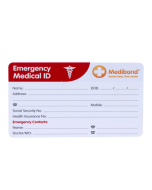
Yes. Keep carrying it. The card holds the detail — manufacturer, model, implant date — and Healthdirect lists the bracelet and the card together rather than as alternatives. They answer different questions: the card for the clinician who has your wallet, the band for the person who has only found you.
Will it set off airport security?
The band will not — there is no metal in it. Your device might: Healthdirect advises letting airport security staff know you have a pacemaker, as it may set off the metal detector. The band is a convenient way to start that conversation.
Can I wear it while swimming or playing sport?
Yes — it is waterproof with nothing to catch. Healthdirect notes most people with pacemakers can play sport and swim, while avoiding contact sports such as football that could impact the chest. Your cardiologist's advice for your situation comes first.
What if I also take blood thinners?
Wear a second band naming it. Anticoagulation changes emergency management independently of the device, so the two facts are worth carrying separately — see the warfarin, Xarelto and on anticoagulants bands, or put both on one custom ID.
SKU B2099Manufacturer Mediband
| SKU | B2099 |
|---|---|
| Manufacturer | Mediband |
Shipping
In-stock orders are dispatched the same business day when placed before 12pm AEST, Monday to Friday (excluding public holidays). Orders placed after 12pm AEST, or on weekends and public holidays, are dispatched the next business day.
Express, Regular and Courier delivery estimates are shown at checkout and apply from the dispatch date.
More information about shipment and delivery times can be found on our shipping page.
Returns & guarantee
100% Quality Guarantee. Your satisfaction is our priority. If there is a confirmed quality issue, return the item to us in its original condition and packaging within 14 days of receipt and we will issue a full refund (excluding the original delivery charge) or replace the item.
In-stock items may be exchanged for a different size or colour, provided they are returned as new, unworn and in their original packaging within 14 days of receipt.
Custom and made-to-order items are produced to your specification, so we do not accept returns or exchanges for change of mind, size or colour. Please check your size, colour, spelling and details carefully before ordering. First Aid Kits and Defibrillator Supplies also cannot be returned or exchanged except for a confirmed quality issue.
Please view terms and conditions for further information.
Loading reviews…
Frequently Asked Questions
Quick answers from the Mediband team
What is a pacemaker bracelet?
A medical alert bracelet engraved with 'Pacemaker' (or 'ICD') that tells paramedics, ED clinicians and any healthcare worker the wearer has an implanted cardiac device. It guides decisions on defibrillation pad placement, MRI safety, surgical cautery and emergency cardiology consults.
Why do pacemaker patients need this on top of their pacemaker card?
The card lives in your wallet; the bracelet lives on your wrist. In an emergency the bracelet is checked within 30 seconds of paramedic arrival — the wallet card may take 5-10 minutes to find, by which time critical decisions have already been made.
What's the difference between a pacemaker and an ICD?
A pacemaker prevents slow heartbeats; an ICD shocks dangerous fast arrhythmias. Both need a medical alert bracelet for the same reasons. Engrave the specific device type so emergency teams know what to expect.
Can I get an MRI with a pacemaker?
Only with an MR-conditional pacemaker, in an MRI suite with cardiologist clearance and pacemaker reprogramming for the scan. Engraving 'MR-conditional' on your bracelet speeds this up significantly. Older non-MR-conditional pacemakers are still a contraindication to standard MRI.
Does the bracelet interfere with the pacemaker?
No — silicone is electromagnetically inert and safe to wear 24/7 regardless of device location. Many pacemaker patients wear the bracelet on the opposite wrist for comfort, but either wrist is fine.
Complete your order