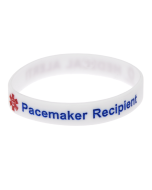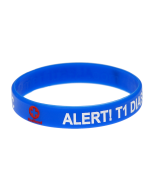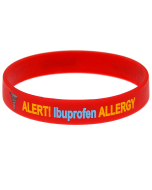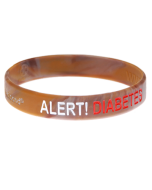
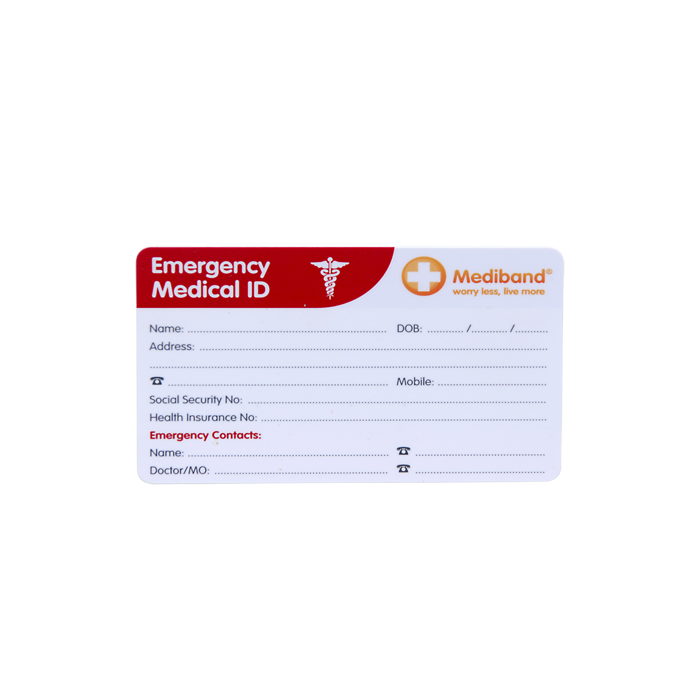
Emergency Information Medical Wallet Card
£3.09
SKU
CB0001
Buy more, save more
QuantityPrice eachSave
1–4
£1.80
—
5–24
£1.72
−5%
25–99
£1.64
−9%
100–199
£1.35
−25%
200+
£1.00
−44%
Secure checkout
VISA
Mastercard
Apple Pay
Google Pay
+5 more
Also accepted
AMEX
Afterpay
Zip
Klarna
PayPal
Emergency Information Medical Wallet Card
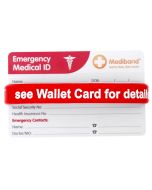
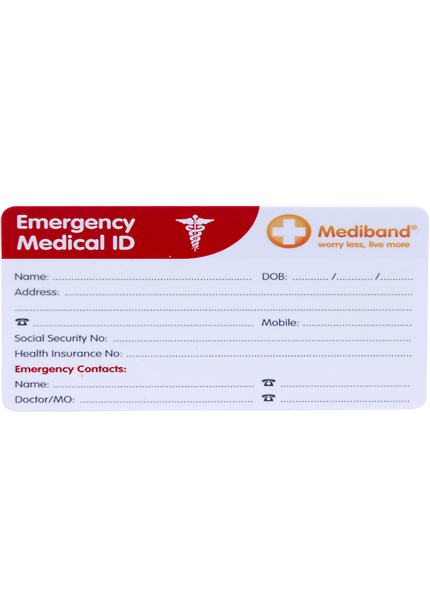
Side One Contents: Name, Address, Phone, Emergency Contacts, Doctor Contacts, Action In Case of Emergency
Side Two Contents: Medical Conditions, Current Medications, Known Allergies, Blood Group, Organ Donor, Signature, Date, Mediband Membership ID
Mediband recommends Staedtler Lumocolor permanent marking pens for use on all write-on products including wallet cards. www.medibandplus.com
*** Must be enrolled in MediBandPlus to receive Emergency Access Services & Online Medical Database Storage ***
4.9 · 27 reviews
Since 2004
Mediband Emergency Wallet Card
Stay Safe
If you or a family member has a medical condition, our emergency wallet cards can save your life. Mediband emergency wallet cards provide peace of mind so that when the unexpected happens, critical medical information can be conveyed to emergency personnel. Emergency personnel are trained to look for medical identification, and their speedy assessment is crucial.
- Insure against incorrect diagnosis and treatment
- Provide vital medical and contact information in emergencies
Mediband Emergency Wallet Card includes:
Side 1: Name, Address, Emergency Contact, Doctor's Contact, Action In Case of Emergency
Side 2: Condition, Current Medication, Allergies, Blood Group, Organ Donor, Signature, Date, Mediband Membership Card Number
Mediband recommends using Staedtler Lumocolor permanent marking pens for all our write-on products, including our emergency wallet card.
Please Note:
"Mediband Membership Card" can only be used by MedibandPlus members. Find out more At MedibandPlus why join us, and register at MedibandPlus to add your medical history onto our database, and wherever you are, you will have access to it.
A card and a band do different jobs
These are not alternatives. A band is found immediately and carries a few words; a card is found during a fuller search and carries everything behind those words. Most people who need one benefit from both.
| Wallet card | Wrist band | |
|---|---|---|
| How much it holds | A full page of detail | A few critical lines |
| When it is found | Once someone searches a wallet | In the first seconds, on the wrist |
| Updating it | Rewrite or replace the card | New band, or a write-on style |
| Best use | The detail behind the alert | The alert itself |
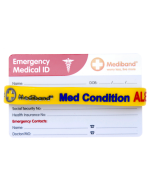
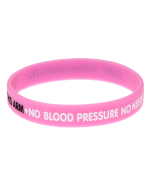
The practical pattern: the band says what changes treatment in the first minute, and the card holds the medications, allergies, history and contacts that shape what happens afterwards. Browse medical alert bracelets or the wider wallet card range.
Filling the card in so it can be used
Print, do not join up your writing
The card will be read under pressure by someone who has never seen your handwriting. Block capitals for medication names and allergies. A misread drug name is worse than a blank line. The same applies to allergies — write the substance rather than a brand name where you can, since brand names vary between countries and a reader may not recognise the one you know.
Use a permanent marker
Ballpoint smudges on the coated surface and fades in a warm pocket. A fine permanent marker bonds properly. Let it dry before folding the card back into the wallet.
Write the doses, not just the drugs
A medication name alone leaves a clinician asking how much and how often. If space is tight, prioritise the medications where dose matters most, and note that a full list is held with your GP.
Date it
An undated card cannot be trusted — a reader has no way of knowing whether it reflects last week or five years ago. Put the date you completed it, and redo the card whenever your medications change. A card dated this year carries weight; an undated one invites a clinician to disregard it entirely and start from scratch.
Tell someone it exists
A card nobody knows about relies entirely on a stranger searching your wallet. Tell your partner, housemate or closest colleague that you carry one and roughly what it says. In many emergencies the person who answers questions about you is someone who knows you, not a paramedic reading a card, and they can point to it straight away.
Check it after any hospital stay
Medications are most often changed during or just after an admission, which is exactly when an outdated card is most likely to be read. Make reviewing the card part of coming home, alongside filling the new prescriptions.
What to leave off
A wallet card is easier to lose than a wrist band, and it carries identity information as well as medical information. That is worth a moment’s thought before you fill every field.
Be cautious with identity numbers
Fields for identity and insurance numbers exist because the card is sold internationally, but a lost wallet containing a full identity number is a fraud risk as well as an inconvenience. Many people leave those blank, or record only the last few digits, and rely on name and date of birth for identification.
Keep the longer history elsewhere
Detail that will not fit belongs with your GP and on My Health Record, which treating clinicians can access. The card is a pointer to that, not a replacement for it.
Where to carry it
Behind a card that will be pulled out
Put it immediately behind your driver licence or bank card, not in a zipped compartment. Whoever searches a wallet in an emergency looks for identification first, so the card should be in that same stack.
One for every bag that travels
A card only works if it is with you. People who carry different bags for work, sport and travel are better off completing several identical cards than moving one between them and forgetting.
For children and dependants
A card in a school bag, with a carer or in a sports kit covers the times someone else is responsible. Pair it with a write-on band so the alert itself is on the child.
For general health information, Healthdirect Australia is the reference to use; for what belongs on your own card, ask your GP. We make identification products, not clinical recommendations.
Ordering
Order more than one. Cards are inexpensive, they get lost with wallets, and having spares means you can keep a current card in every bag and redo one the moment a medication changes rather than amending it. For fully engraved identification, see the custom ID builder.
Clinics, aged-care services, schools and NDIS providers issuing cards to many people can order in quantity — request a bulk quote.
Emergency wallet card FAQs
What should I write on the card?
Name, date of birth, emergency contacts and your doctor on one side; conditions, current medications with doses, allergies and blood group on the other. Print clearly in permanent marker and date it.
Does a card replace a medical ID bracelet?
No. A band is seen in the first seconds and carries the critical alert. A card is found when a wallet is searched and carries the detail behind it. They work together.
What pen should I use?
A fine permanent marker. Ballpoint smudges and fades on the card surface. Let the ink dry before putting the card away.
Should I fill in every field?
Not necessarily. Identity and insurance number fields carry a fraud risk if the wallet is lost. Many people leave those blank and rely on name and date of birth, keeping the rest with their GP or on My Health Record.
How often should I redo it?
Whenever your medications or conditions change, and otherwise review it once a year. Because you date the card, a reader can see how current it is — which is only useful if you keep it up to date.
Where should I keep it?
Behind your licence or bank card, where anyone searching for identification will find it. If you use several bags, complete a card for each rather than moving one around.
SKU CB0001Manufacturer Mediband
| SKU | CB0001 |
|---|---|
| Manufacturer | Mediband |
Shipping
In-stock orders are dispatched the same business day when placed before 12pm AEST, Monday to Friday (excluding public holidays). Orders placed after 12pm AEST, or on weekends and public holidays, are dispatched the next business day.
Express, Regular and Courier delivery estimates are shown at checkout and apply from the dispatch date.
More information about shipment and delivery times can be found on our shipping page.
Returns & guarantee
100% Quality Guarantee. Your satisfaction is our priority. If there is a confirmed quality issue, return the item to us in its original condition and packaging within 14 days of receipt and we will issue a full refund (excluding the original delivery charge) or replace the item.
In-stock items may be exchanged for a different size or colour, provided they are returned as new, unworn and in their original packaging within 14 days of receipt.
Custom and made-to-order items are produced to your specification, so we do not accept returns or exchanges for change of mind, size or colour. Please check your size, colour, spelling and details carefully before ordering. First Aid Kits and Defibrillator Supplies also cannot be returned or exchanged except for a confirmed quality issue.
Please view terms and conditions for further information.
Loading reviews…
Complete your order