
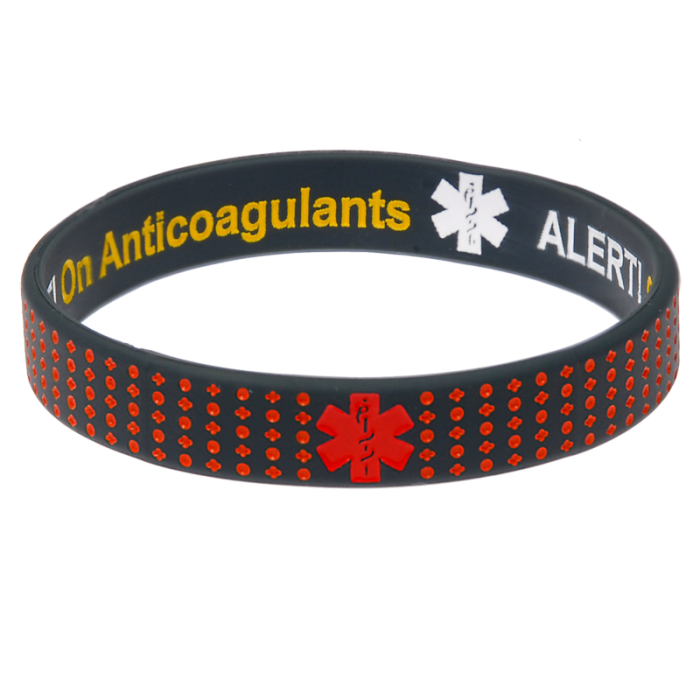
Anticoagulant Alert - Emergency Medical ID Bracelet (Reversible style)
£5.62
SKU
D2303
Secure checkout
VISA
Mastercard
Apple Pay
Google Pay
+5 more
Also accepted
AMEX
Afterpay
Zip
Klarna
PayPal
Stay safe with our Anticoagulant Alert Medical ID Bracelet. Designed to alert medical personnel of your medication in emergencies, it's a vital tool for those on anticoagulant medication.
With a stylish reversible design and a clear medical logo, it ensures your crucial information is quickly and easily accessible
4.9 · 88 reviews
Since 2004
Blood Thinner Bracelet — Anticoagulant Medical Alert
The Anticoagulant Alert bracelet is essential safety wear for anyone on warfarin, apixaban (Eliquis), rivaroxaban (Xarelto), dabigatran (Pradaxa), edoxaban (Lixiana) or any oral or injectable blood thinner. In an accident, trauma or unconscious admission, paramedics urgently need to know you're on anticoagulant therapy — it changes everything about how bleeding is managed, whether to reverse the medication, and how to dose new treatments.
Without this information, an internal or external bleed can spiral fast. The bracelet bridges the seconds between scene arrival and your medication record being found.
Why a Blood Thinner Bracelet Matters
Approximately 750,000 Australians take an oral anticoagulant for atrial fibrillation, mechanical heart valves, deep vein thrombosis, pulmonary embolism or stroke prevention. Each year tens of thousands present to emergency with trauma, falls or sudden illness. When paramedics see this bracelet:
- Reversal agents can be administered earlier — vitamin K for warfarin, prothrombin complex concentrate, andexanet alfa for factor Xa inhibitors, or idarucizumab for dabigatran
- Bleeding management shifts to higher-acuity protocols immediately
- Medication interactions are avoided in subsequent treatment
- Imaging decisions (CT scan for head trauma) are escalated automatically
- Surgical consults happen faster if intervention is needed
What This Bracelet Shows
This is a ready-to-wear, pre-printed alert band. Both sides are permanently printed with the Star of Life symbol and the word "Anticoagulant", so paramedics can spot your blood-thinner therapy at a glance. The wording is fixed — this band has no engraving and no write-on panel, so you do not add your own text to it.
If you need personal details on your ID — your name, the exact drug and dose, your indication (AF, mechanical valve, post-DVT) or an emergency contact — choose a Mediband Custom ID. The Custom ID range is made to order with your own details (engraved stainless steel and gold, or custom-printed silicone), and our write-on bands let you add details by hand.
Who Should Wear One
- Anyone on long-term oral anticoagulant therapy
- Patients with mechanical heart valves
- Atrial fibrillation patients on warfarin or DOACs
- Post-DVT and post-PE patients
- Stroke prevention patients
- Anyone on dual antiplatelet therapy after stent placement
- Patients on bridging therapy with low molecular weight heparin
How the Bracelet Works in Practice
Australian paramedic protocol on every unconscious patient or major trauma call includes a check for medical alert IDs — wrists, neck, ankles. The reversible Anticoagulant Alert bracelet displays the universal Star of Life symbol with the word "Anticoagulant" clearly visible on both sides, giving the treating crew the alert they need in 4-6 seconds.
Care & Sizing
Medical-grade silicone, waterproof, dishwasher-safe, comfortable for 24/7 wear. 4-5 year lifespan. Available in S/M/L/XL. Soft, flexible band suits thin wrists, post-surgical wrists and elderly skin.
Related Medical Alert Bracelets
Why reversible, and the trade-off it makes
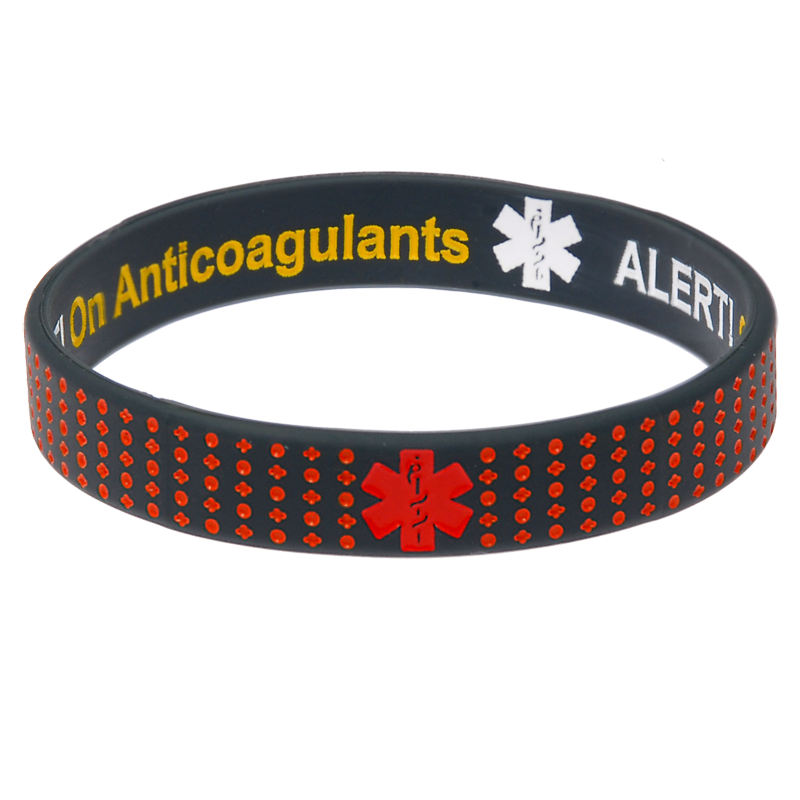
One face is patterned and looks like an ordinary bracelet. Turn it over and it reads ALERT! On Anticoagulants, with the Star of Life carried on both faces so a responder can find it either way round.
| Reversible (this band) | Open alert band | |
|---|---|---|
| Default appearance | Patterned, reads as a bracelet | Alert text visible at all times |
| Found by responders | Star of Life on both faces | Immediately, no handling |
| Best for | Wearers who value discretion | Fastest possible recognition |
| Risk | Needs turning to read | Some people stop wearing it |
Discretion is a safety feature, not vanity
The most common reason a medical ID fails is that it is not being worn. People stop wearing an openly-labelled band because they do not want to explain their health to colleagues, classmates or strangers. A band that looks like jewellery gets worn every day, and a band that is worn beats a band that is more legible but sits in a drawer.
The Star of Life is what makes it findable
Because the symbol appears on both faces, a paramedic checking wrists recognises it as a medical ID without needing the text face outward. Turning it over is one movement, and it is a movement responders are trained to make.
When to choose the open version instead
If the wearer has cognitive impairment, is a young child, or is likely to be found by members of the public rather than trained responders, an openly-labelled band removes a step. The condition range covers those, and the custom ID builder lets you set the wording yourself.
Making the most of the engraving
Name the specific anticoagulant
The printed face says you are on anticoagulants. The engraving is where you say which one. Naming the medication is more useful than the drug class alone, and worth updating if your prescription changes.
Add a contact who knows the plan
A number for someone who knows your prescriber and history turns a wrist band into a route to your full record. Keep the longer detail in a wallet card or on My Health Record.
For information about anticoagulant medicines, Healthdirect Australia is the reference to use. Anything about your own dose, bleeding risk or reversal plan is a question for your prescriber or pharmacist — we make identification products, not clinical recommendations.
Wearing and ordering
It is built to stay on
Silicone, waterproof and light, so it can be worn showering, swimming and playing sport. That is the point — an ID removed for water is an ID frequently left off afterwards.
Order a spare
A lost band leaves the wearer unidentified until a replacement arrives. At this price a second is cheap insurance, and the minimum order covers it.
Ordering for a service
Aged-care homes, anticoagulation clinics and NDIS providers order these in quantity with per-wearer engraving, handled as one order against an engraving list. Request a bulk quote.
Reversible anticoagulant bracelet FAQs
How does a responder know to turn it over?
The Star of Life appears on both faces, so the band is recognisable as a medical ID whichever way it is facing. Turning a band to read it is a standard check.
Is a reversible band less safe than an open one?
It adds one movement for the responder. Against that, it is far more likely to still be on the wrist, which is the bigger risk in practice. For wearers likely to be found by the public rather than trained responders, an open band is the safer choice.
Which anticoagulant should I engrave?
The one you are prescribed, by name. It is more useful than the class alone. If your prescription changes, replace the band rather than leaving outdated information on your wrist.
Will the printing or engraving wear off?
The alert is colour-filled into the silicone and the engraving is cut into it, both below the wear surface. Normal daily use, showering and sport do not remove either.
Can I wear it all the time?
Yes, and that is how it works best. It is waterproof and breakaway-safe, so there is no routine reason to take it off.
What size should I order?
One that sits snugly without sliding over the hand but still turns on the wrist — turning is how the alert face is revealed, so the fit should allow it.
SKU D2303Manufacturer Mediband
| SKU | D2303 |
|---|---|
| Manufacturer | Mediband |
Shipping
In-stock orders are dispatched the same business day when placed before 12pm AEST, Monday to Friday (excluding public holidays). Orders placed after 12pm AEST, or on weekends and public holidays, are dispatched the next business day.
Express, Regular and Courier delivery estimates are shown at checkout and apply from the dispatch date.
More information about shipment and delivery times can be found on our shipping page.
Returns & guarantee
100% Quality Guarantee. Your satisfaction is our priority. If there is a confirmed quality issue, return the item to us in its original condition and packaging within 14 days of receipt and we will issue a full refund (excluding the original delivery charge) or replace the item.
In-stock items may be exchanged for a different size or colour, provided they are returned as new, unworn and in their original packaging within 14 days of receipt.
Custom and made-to-order items are produced to your specification, so we do not accept returns or exchanges for change of mind, size or colour. Please check your size, colour, spelling and details carefully before ordering. First Aid Kits and Defibrillator Supplies also cannot be returned or exchanged except for a confirmed quality issue.
Please view terms and conditions for further information.
Loading reviews…
Frequently Asked Questions
Quick answers from the Mediband team
What is a blood thinner bracelet?
A medical alert bracelet that clearly shows the wearer is on an anticoagulant (blood thinner). This Mediband band is pre-printed with the Star of Life and the Anticoagulant alert, so paramedics and ED staff know to adjust bleeding management, reversal agents and imaging decisions immediately.
Do I really need one if I'm on Eliquis (apixaban) or Xarelto (rivaroxaban)?
Yes. Apixaban, rivaroxaban and dabigatran are still anticoagulants and have specific reversal agents (andexanet alfa for factor Xa inhibitors, idarucizumab for dabigatran). Paramedics need to know which drug you're on to administer the correct reversal — a bracelet saves critical minutes.
Can I add my name or medication to this band?
This band is pre-printed with the Anticoagulant alert and cannot be engraved or written on. If you need your name, a specific drug and dose, or an emergency contact on your ID, choose a Mediband Custom ID, which is made to order with your own text, or a write-on band you fill in by hand.
Is the bracelet waterproof?
Yes — medical-grade silicone is fully waterproof and shower-safe. You can wear it 24/7 including in the pool, shower, dishwashing and gym. Lifespan is 4-5 years.
What if my medication changes?
This is a pre-printed Anticoagulant alert band, so it stays accurate for as long as you are on a blood thinner, even if the specific drug changes. If you want the exact drug name shown, a made-to-order Custom ID is the better choice, and you would simply order a new one if that detail ever changes.
Which blood thinners does this anticoagulant bracelet suit?
This ON ANTICOAGULANTS reversible band can suit anyone taking anticoagulant medication, including warfarin, apixaban or rivaroxaban. It alerts responders that you are ON ANTICOAGULANTS.
Is this the same as an apixaban bracelet?
Yes — wearers on apixaban can use this ON ANTICOAGULANTS band. Med-specific engraved options are also available if you prefer to name apixaban directly.