
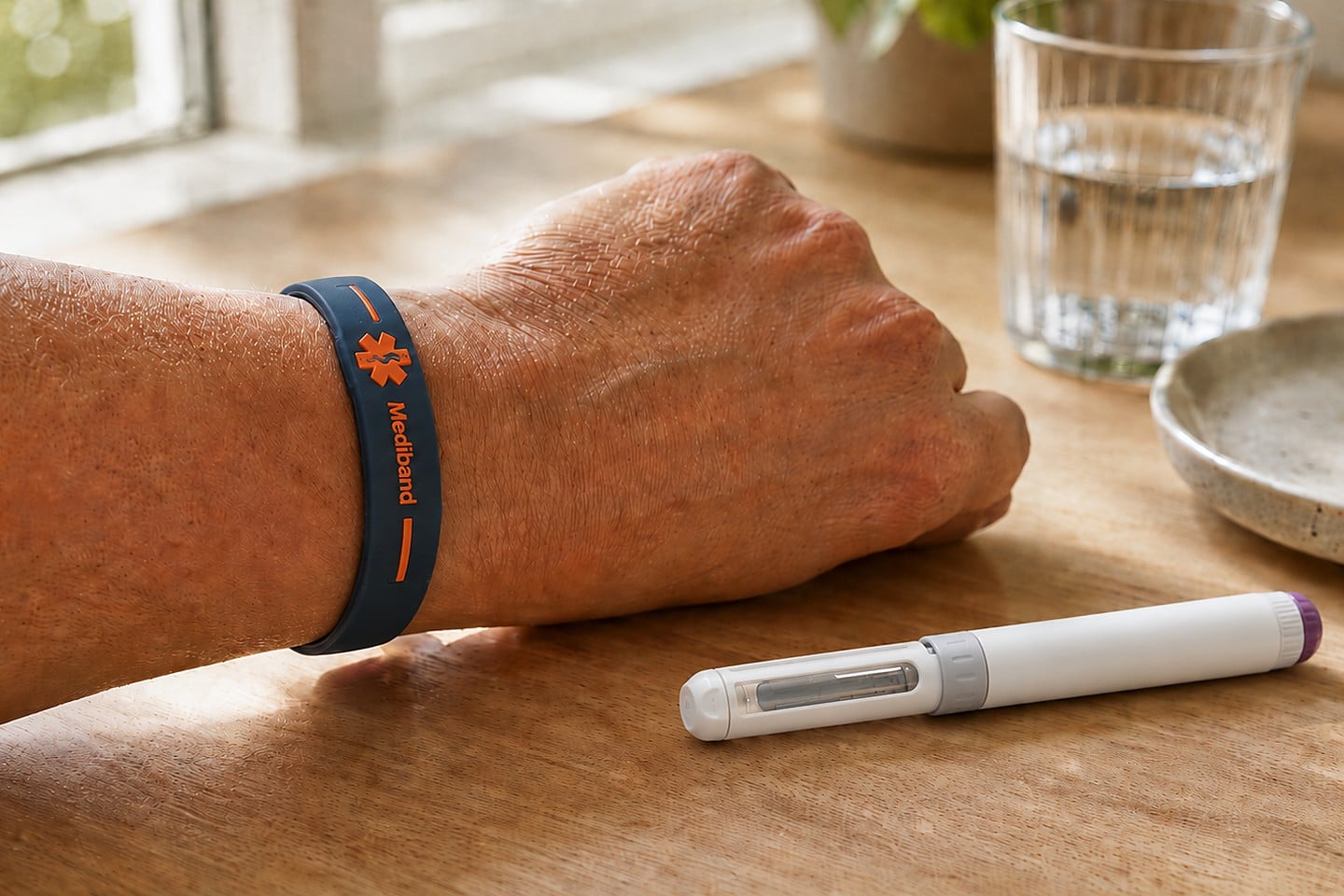
Medical IDs for GLP-1 therapy — Ozempic, Mounjaro, semaglutide and tirzepatide
Semaglutide (Ozempic, Wegovy), tirzepatide (Mounjaro), liraglutide (Victoza, Saxenda) and dulaglutide (Trulicity) all change how the stomach empties. That matters in an emergency. It matters even more before anaesthesia or sedation, where a delayed-emptying stomach raises the risk of pulmonary aspiration on induction. A medical ID lets anaesthetists, paramedics and emergency teams see the medication and the last-dose date in the first sixty seconds — before the wearer has to remember, or speak.
Shop GLP-1 medical ID bracelets →
Designed in Australia
Since 2004
ANZCA-aligned
Pre-anaesthesia disclosure
NDIS-registered
For eligible participants
10–14 business days
Expedited on application
When a medical ID matters for GLP-1 therapy
GLP-1 receptor agonists have moved from a small diabetes niche to one of Australia's fastest-growing prescription classes. Hundreds of thousands of Australians now take semaglutide, tirzepatide, dulaglutide or liraglutide either for type 2 diabetes or, more recently, for chronic weight management. The medication class shares one mechanism that matters in an emergency: it slows gastric emptying. That single fact drives four scenarios where a band on the wrist changes what the clinician does next.
Before anaesthesia or sedation. The Australian and New Zealand College of Anaesthetists (ANZCA) and the American Society of Anesthesiologists (ASA) have both issued guidance recommending that patients on GLP-1 medications disclose the medication and dose schedule before any procedure requiring sedation or general anaesthesia. Residual gastric contents raise the risk of regurgitation and pulmonary aspiration on induction. A medical ID makes the disclosure passive — the band is read on arrival regardless of whether the patient remembers, is pre-medicated, or arrives semi-conscious to ED.
In an unplanned emergency. Paramedics doing a primary survey check for medical alert devices as part of the secondary assessment (ANZCOR Guideline 2, April 2021). A band naming the active ingredient and the last-dose date gives a receiving team enough to plan airway management, fluid resuscitation, and any same-day surgery decision. Without it, the medication history can be missed entirely if a relative isn't on scene.
For dehydration, pancreatitis or hypoglycaemia. Nausea and vomiting are the most common GLP-1 side effects and they can precipitate dehydration severe enough to trigger a presentation. Acute pancreatitis is a rare but recognised adverse event. People who take a GLP-1 alongside insulin or a sulfonylurea also carry a real hypoglycaemia risk. In each case, the medication name on the wrist accelerates differential diagnosis.
For people travelling. Most semaglutide and tirzepatide injectors are weekly. A wearer who is six days into a long flight or who has had to delay a dose for a time-zone reason gives the local emergency team useful context if anything happens en route. International airport security questions about pre-filled pens become faster, too.
"Every patient on a GLP-1 agonist should disclose this to their anaesthetist before any procedure requiring sedation or anaesthesia." — alignment of ANZCA and ASA guidance on perioperative GLP-1 management, 2023–2024.
Who the band is for — quick reference
A GLP-1 band is read in two windows: the planned pre-anaesthesia interview, and the unplanned emergency. The right engraving depends on which window matters most for the wearer.
Type 2 diabetes on a GLP-1
The most common Australian profile. Engrave the GLP-1 active ingredient and dose frequency, plus any insulin or sulfonylurea, plus the primary contact. If the wearer is on multiple agents the wallet card carries the long list.
Weight management on a GLP-1
Tirzepatide, semaglutide for weight loss, or liraglutide weight-management dosing. The anaesthesia disclosure window dominates. A band saying "TIRZEPATIDE WEEKLY — LAST DOSE [day]" is enough to brief a surgical team.
Surgery booked in the next eight weeks
If a procedure is scheduled, the band is a backstop for the pre-op checklist. Engrave the medication and dosing pattern. Update the last-dose date in the lead-up so the band is current on arrival.
Insulin or sulfonylurea co-prescription
The hypoglycaemia risk profile is different. The band needs to name every glucose-lowering agent, not just the GLP-1, plus the primary contact.
Travelling internationally
The pre-filled pen plus a band naming the medication gives airport security and overseas clinicians enough to verify. Pair with a Mediband travel band in the destination language for non-English-speaking countries.
Recommended Mediband IDs
No pre-printed wristband exists for the GLP-1 medications — the active-ingredient name is what a clinician needs to read, and that has to be engraved. Custom-engraved silicone is the lead format. The other five tiles cover dress-wear, sport, and the wallet-card backstop for complex profiles.
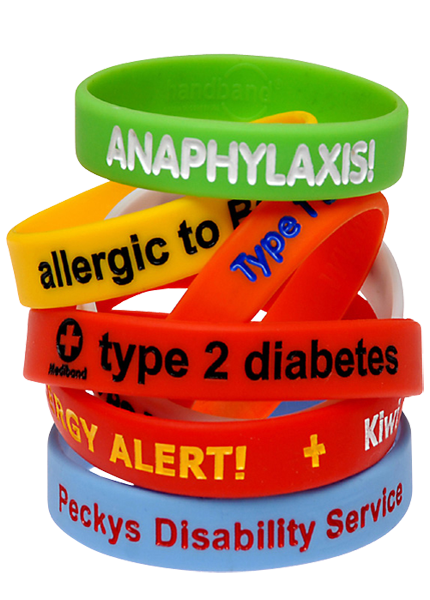
Custom-engraved silicone — the lead pick
Soft silicone strap, water-resistant, engraved to order with the active ingredient (semaglutide, tirzepatide, liraglutide, dulaglutide), dose frequency, last-dose date, and a primary contact. Choice of band colour and infill. The fastest format to update when a new dose date or medication change happens.
Best for: daily wear, swimming, sport, weekly dose updates.
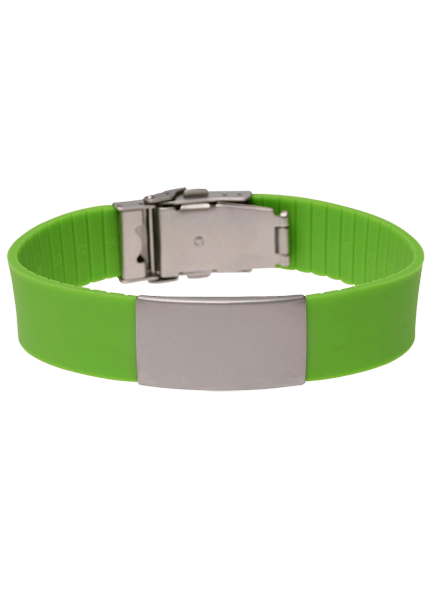
Active hybrid — watch-style daily wear
Engraved stainless steel plate on a silicone strap. Sits like a sport watch and doesn't read as medical at a glance. The plate carries the medication name plus the contact; the strap is comfortable enough for 24/7 wear.
Best for: wearers who don't want a band that looks medical, daily and dress wear.
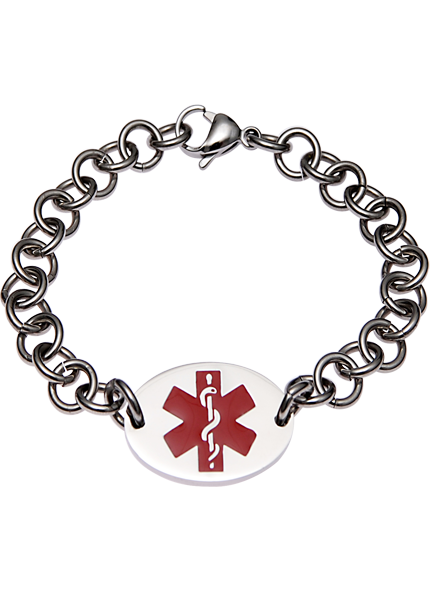
Custom stainless steel
Solid stainless steel band, engraved on the plate. Sits like a dress watch. Re-engravable if the medication changes — the band itself lasts indefinitely.
Best for: professional dress wear, long-term wearers on a stable regimen.
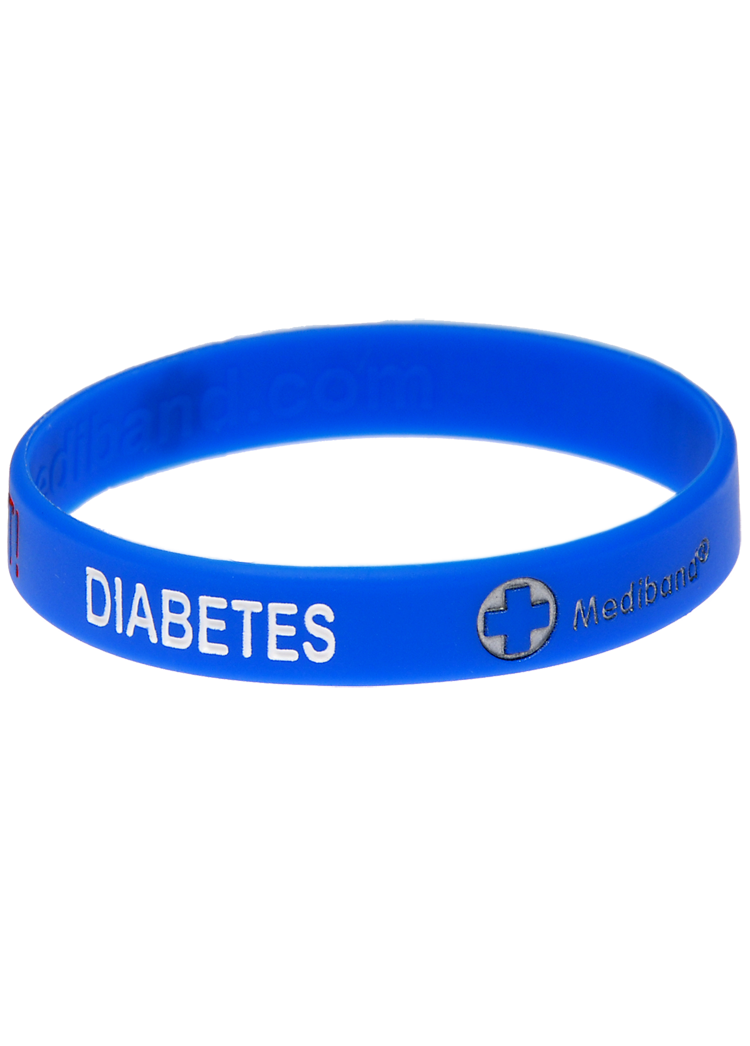
Pre-printed Diabetes silicone (type 2 crossover)
For wearers whose GLP-1 sits alongside type 2 diabetes, the by-condition diabetes range carries the condition flag on the outer face and the medication detail on the inside strip. The fastest band to get a condition flag on a wrist this week.
Best for: type 2 wearers who want a single band covering both diagnosis and medication.
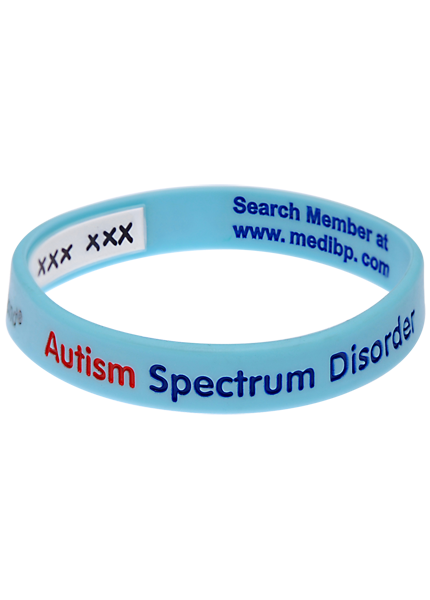
Active Classic Band
Engraved silicone band built for sport and swim. No metal to catch on equipment. Cheaper than the hybrid and easy to replace as part of a rotation.
Best for: gym and pool wear, second band in a rotation.
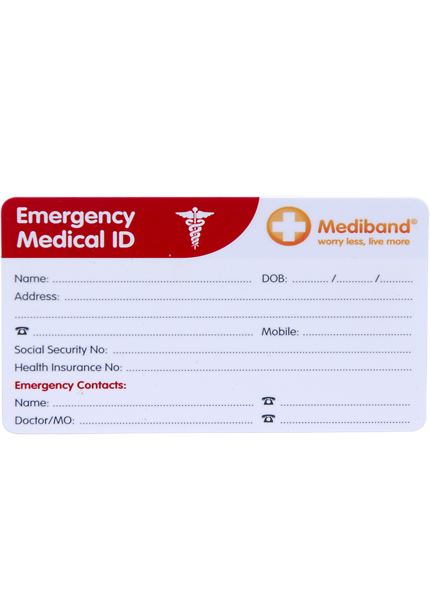
Wallet card — full profile
Carries the detail that doesn't fit on a wristband: every glucose-lowering agent and dose, the GLP-1 last-dose date and weekly schedule, GP and endocrinologist contacts, surgical history, and allergies. Pair with any band.
Best for: complex profiles, polypharmacy, planned surgery in the next eight weeks.
The practical combination for most GLP-1 wearers is custom-engraved silicone (for daily wear and easy re-engraving as the dose schedule changes) plus a wallet card (for the long medication list and the pre-op anaesthesia disclosure detail).
Prefer to talk it through first? Call 1300 796 401 during business hours AEST — or just shop the full range online →
What to engrave
Five fields cover most GLP-1 wearers: the active ingredient (semaglutide, tirzepatide, liraglutide, dulaglutide), the dose frequency (weekly, daily), the last-dose date (especially in the lead-up to surgery), any other glucose-lowering agents (insulin, sulfonylurea, metformin), and a primary contact. The "WEEKLY" or "DAILY" tag matters — it tells a clinician whether the medication is recent enough to affect a fasting decision.
Three engraving examples below cover the most common profiles.
Example 1 — type 2 diabetes on semaglutide
| Front | SARAH P TYPE 2 DIABETES SEMAGLUTIDE WEEKLY METFORMIN BD |
| Back | ICE MARK 0412 345 678 NKA |
Example 2 — weight management on tirzepatide
| Front | JAMES H TIRZEPATIDE WEEKLY 10MG |
| Back | ICE ANNA 0421 987 654 SEE WALLET CARD |
Example 3 — surgery booked, semaglutide held
| Front | PRIYA K SEMAGLUTIDE WEEKLY LAST DOSE 12 JUL |
| Back | ICE RAJ 0433 222 111 SURGERY 26 JUL ST V |
What NOT to engrave
- Don't engrave a full address. The band is read in public; it shouldn't tell a finder where the wearer lives.
- Don't engrave a Medicare or NDIS number. Those are identity details that don't help in the first 60 seconds of a response.
- Don't engrave the brand name without the active ingredient. "Ozempic" alone is recognisable but the clinical decision rests on "SEMAGLUTIDE". Engrave the active ingredient first; the brand can sit alongside if there's space.
- Don't list every dose change. Only the current dose belongs on the band. Dose-titration history lives on the wallet card.
- Don't list every clinician on the band. Only the primary carer or emergency contact goes on the wristband. GP, endocrinologist and surgeon contacts belong on the wallet card.
Pre-anaesthesia and pre-sedation disclosure

This is the highest-stakes window for a GLP-1 wearer. GLP-1 receptor agonists slow gastric emptying as part of their therapeutic action. Standard pre-operative fasting times were calibrated for stomachs that empty at a normal rate. With a GLP-1 on board, a "fasted" patient on the morning of surgery can still have meaningful gastric contents — raising the risk of regurgitation and pulmonary aspiration on induction of general anaesthesia.
In 2023, the American Society of Anesthesiologists issued specific guidance on perioperative management of GLP-1 receptor agonists. ANZCA followed in late 2023 and updated through 2024. Both bodies recommend that patients on GLP-1 medications disclose the medication and dose schedule before any procedure requiring sedation or general anaesthesia, so that the anaesthetic team can decide on a case-by-case basis whether to hold the medication ahead of the procedure, perform a gastric ultrasound, modify the airway management plan, or rearrange the procedure time.
In practice, weekly GLP-1 agonists (semaglutide, tirzepatide, dulaglutide) are often held for a week before elective procedures, and daily agonists (liraglutide, oral semaglutide) for a day. Emergency procedures cannot pause for that — which is exactly when the band on the wrist matters most. A wearer who arrives at ED unconscious, sedated, or simply unable to recall a medication name carries the disclosure on them.
This is not medical advice. Anaesthetic management decisions are clinical judgements made by the treating team using current ANZCA guidance and the individual case. The band's job is to make sure the team has the information to make the decision.
Other emergency considerations
Hypoglycaemia risk on combination therapy. A GLP-1 on its own carries a low hypoglycaemia risk. The risk rises when the GLP-1 sits alongside insulin or a sulfonylurea (glipizide, gliclazide, glimepiride). The Australian Medicines Handbook and the RACGP General Practice Management of Type 2 Diabetes both note this. For these wearers, the band needs to name every glucose-lowering agent, not just the GLP-1, so a responder finding the wearer altered or unconscious can reason about the cause.
Pancreatitis. Acute pancreatitis is a rare but recognised adverse event of the GLP-1 class. A wearer presenting with severe abdominal pain, vomiting and back pain may be diagnosed faster if the medication is visible on the wrist than if it has to be elicited.
Dehydration from nausea and vomiting. The most common side-effect cluster. A presentation for IV rehydration is more efficient when the medication is on the wrist — particularly in the first weeks of starting or dose-escalating.
Diabetic ketoacidosis on co-prescribed insulin. Wearers with type 2 diabetes on insulin alongside a GLP-1 retain the standard DKA risk. The medication list on the wrist (or via wallet card) is the fastest route to working through the differential.
Travel, surgery scheduling, and the pharmacy moment
Travel. The injectable pen and the band travel together. Airport security in most jurisdictions accepts pre-filled GLP-1 pens with a prescription label or pharmacy receipt. Overseas clinicians, however, may not recognise an AU brand name — engrave the active ingredient first ("SEMAGLUTIDE", "TIRZEPATIDE") and the brand can sit alongside. For travel to a non-English-speaking destination, pair the GLP-1 band with a Mediband destination-language band: see the travel medical ID hub.
Surgery scheduling. If a procedure is booked in the next eight weeks, the band is a backstop for the pre-op checklist. Engrave the medication and the typical dose schedule, and either re-engrave or write the last-dose date in the lead-up so it's accurate on the day. Custom silicone is the most practical format for this because re-ordering is fast and the cost is low enough to keep a pre-surgery band in addition to the daily band.
The pharmacy moment. Australian pharmacists dispensing semaglutide, tirzepatide and the GLP-1 class are well-placed to flag a medical ID at the same point. Mediband works with community pharmacies via a Pharmacy account programme (up to 25%* discount on band orders for the pharmacy or for direct hand to patients) and an affiliate program (up to 20%*) for pharmacies that prefer a referral arrangement. See the pharmacists hub for the full pathway.

Funding the band: out-of-pocket, private health and NDIS
Most GLP-1 wearers in Australia pay for the band out of pocket. Mediband bands start in the low double digits for pre-printed silicone and run to the low hundreds for custom stainless steel — a one-off cost set against years of wear.
Private health. Some Extras policies include a medical-aids or medical-appliances category that may partially reimburse a custom medical ID. The cover varies by fund and policy tier; ask your fund whether a "medical alert bracelet" or "medical appliance" line item applies.
NDIS. A GLP-1 prescription on its own does not establish NDIS eligibility — NDIS is for permanent and significant functional impairment, not metabolic medication. Where the GLP-1 sits alongside an existing NDIS-eligible condition (for example, type 2 diabetes with a complication-related disability, or weight management as part of an existing plan), the band can be claimed against the participant's Consumables budget. Mediband is an NDIS-registered supplier (provider 4050021192).
Already an NDIS participant?
If a medical ID is on your plan (Consumables or Assistive Technology Level 1), Mediband can invoice your plan manager or you can self-manage and claim back. The NDIS hub has the full ordering pathway.
Questions about funding pathways or pricing? Call 1300 796 401 (AEST).
When to update or replace the band
Update whenever the engraving stops reflecting the current situation — specifically when:
- The medication is changed (semaglutide to tirzepatide, weekly to daily, addition or removal of insulin or a sulfonylurea).
- The dose strength changes and you want the band to carry the current dose.
- A procedure is booked — the last-dose date and the procedure date are useful, and updatable on a custom silicone band cheaply.
- The wearer's primary contact changes (separation, bereavement, relocation).
- The medication is stopped — the band still needs to come off the wrist, or be re-engraved to reflect the new medication list.
As a baseline, review the engraving every 12 months. Custom silicone is rated for daily wear including water and sleep; replace it when the strap shows visible wear or the engraving becomes hard to read. Stainless steel and gold last indefinitely; only re-engraving is needed if the wearer's profile changes.
Customer reviews
★★★★★ 4.9 / 5 across 3,110+ verified reviews on mediband.com. The three quoted below are from long-term Mediband wearers across medication and drug-class disclosure profiles — the same band logic that applies to GLP-1.
★★★★★
10+ year customer.
"I've been a Mediband customer for over 10 years. The bands are well made and the engraving stays clear. I would not be without mine."
Michael S. — Pacemaker Recipient band — long-term Mediband customer
★★★★★
Peace of mind.
"Great product, peace of mind knowing my son has it on at all times in case of an emergency."
Cazza, Australia — Anaphylaxis band
★★★★★
Quick delivery.
"Easy to order and great service. Quick delivery to NZ."
Anonymous, New Zealand — Penicillin Allergy band
Reviews are verified via the Mediband reviews programme on the live product pages for the bands quoted. We publish first names and a band reference only; reviewer details beyond this are not retained on the public site.
Why Mediband
Mediband has been designing medical IDs in Australia since 2004. We supply NDIS participants, plan managers, support coordinators, hospitals, schools, peak bodies, and families across Australia, New Zealand, Ireland, the United Kingdom, and worldwide. Every band is engraved to order, drawing on more than 22 years of working alongside wearers, their carers, and the clinicians around them. Mediband products are used by hospital systems including Boston Children's Hospital and LA County Hospital.
Related condition bands
GLP-1 therapy commonly sits alongside type 2 diabetes, cardiovascular disease, and anticoagulant therapy. The Mediband condition hubs below cover the most common overlaps.
Diabetes hub
Type 1 and type 2 cover, insulin dosing, hypoglycaemia →
Pacemaker / ICD hub
Device-aware bands for cardiac comorbidity →
Travel hub
Multilingual bands and overseas medication labelling →
Frequently asked questions
Should I tell my anaesthetist I take Ozempic or Mounjaro before surgery?
Yes. ANZCA and ASA guidance both recommend disclosing any GLP-1 receptor agonist (semaglutide, tirzepatide, liraglutide, dulaglutide) before any procedure requiring sedation or general anaesthesia. The medication slows gastric emptying, which can affect airway management on induction. Tell the anaesthetic team the active ingredient, the dose, the dose frequency, and the date of your last dose. A medical ID makes the disclosure passive in case you can't deliver it verbally.
How long do I need to stop a GLP-1 before a procedure?
This is a clinical decision made by your anaesthetic team using current ANZCA guidance and your specific case. In general, weekly GLP-1 agonists are often held for a week before elective procedures, and daily agonists for a day, but the team may decide differently based on the procedure, your symptoms, and a pre-op gastric ultrasound. The band makes sure the team has the information to decide. It does not replace the pre-op consult.
Can a medical ID help paramedics if I have an emergency?
Yes. Paramedics check for medical alert devices as part of the secondary assessment under ANZCOR Guideline 2 (April 2021). A band naming the GLP-1 medication and the last-dose date helps the receiving team plan airway management, fluid resuscitation, and any same-day surgical decision. It is especially useful if you arrive unconscious, sedated, post-fall, or without a relative on scene.
Do I need a band if I'm only on a GLP-1 for weight management?
The anaesthesia disclosure framing is the same whether the GLP-1 is prescribed for type 2 diabetes or for chronic weight management. The mechanism that slows gastric emptying is the same. The band's primary value for weight-management wearers is the pre-anaesthesia window; the emergency window is narrower because hypoglycaemia risk is lower without co-prescribed insulin or a sulfonylurea, but pancreatitis and severe dehydration remain on the differential.
What should I engrave if I take both insulin and a GLP-1?
Name both. The hypoglycaemia risk profile of insulin plus a GLP-1 is meaningfully different from a GLP-1 alone, and a paramedic finding you altered or unconscious will reason about the cause differently. Example front: "INSULIN BD SEMAGLUTIDE WEEKLY TYPE 2 DIABETES". Pair with a wallet card for the dose strengths and the full medication list.
Is GLP-1 medication covered by NDIS?
No — NDIS is for permanent and significant functional impairment, not metabolic medication on its own. The medication itself is dispensed through the standard PBS or private-script pathway. The medical ID band can be claimed against your Consumables budget if a medical ID is on your plan and the underlying condition is NDIS-eligible. Mediband is NDIS-registered (provider 4050021192). See the NDIS hub for the full ordering pathway.
How quickly can I get the band engraved?
Standard production is 10–14 business days. If you have a procedure booked sooner, quicker and expedited turnarounds are available on application — call 1300 796 401 (AEST) and reference the procedure date. We can usually accommodate pre-op deadlines if there is at least a week's notice.
Ready to order?
Six formats covering daily wear, sport, dress, type 2 crossover, and the wallet-card backstop. Designed and engraved in Australia. Standard 10–14 business days, quicker turnarounds on application.
Order a custom-engraved silicone band →
Prefer to talk? Call 1300 796 401 — business hours AEST.
About this page: Mediband has been designing medical IDs in Australia since 2004. We are an NDIS-registered supplier (provider 4050021192). The engraving examples on this page reflect common practice. They are not medical advice and should not replace guidance from the wearer's GP, endocrinologist, anaesthetist or surgical team. ANZCA and ASA references are summarised in plain language; the binding guidance is the current ANZCA Professional Document and the surgical team's clinical judgement.