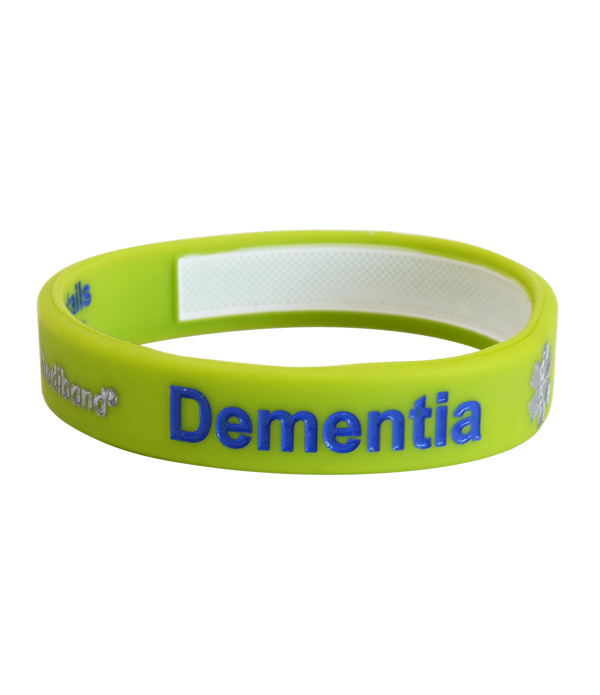
Dementia Alert Medical ID Write On Bracelet
US$ 11,33
SKU
W2677
Secure checkout
VISA
Mastercard
Apple Pay
Google Pay
+5 more
Also accepted
AMEX
Afterpay
Zip
Klarna
PayPal
Enjoy life more knowing that you - or your loved one - can get immediate and appropriate treatment should the unexpected happen.
4.9 · 10 reviews
Since 2004
New: see the Dementia Bracelet hub for the full guide — carer-as-buyer framing, what-to-write examples for early through mid-stage, wandering scenarios, funding pathways and answers to the questions most families ask before they buy.
Dementia alert medical ID — write-on design
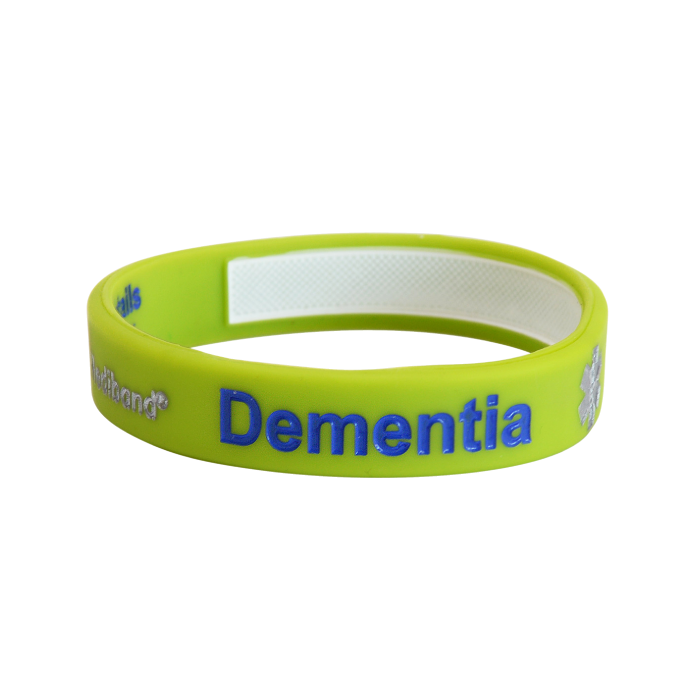
A neon green silicone band with Dementia moulded into the outer face in blue beside the Star of Life, and a smooth white write-on panel on the inside where you add the details that matter: a first name, a carer's mobile number, anything else a stranger would need.
It is bought almost entirely by carers, for someone else. Everything below is written with that in mind.
Healthdirect lists an identification bracelet by name
In its guide to caring for someone with dementia at home, Healthdirect answers the question “what should I do if they wander or try to leave?” with a list of practical measures. One of them is to make the home environment safer — “such as installing sound and motion detectors and giving them an identification bracelet”.
So this is not a product category looking for a justification. Australia's national health information service names it alongside motion sensors as part of what you put in place.
What Healthdirect says about wandering
Healthdirect is direct about it: it is common for people with dementia to wander away, and they may try to leave a place because they do not understand why they are there. It can be unsafe, especially if they get lost or forget to eat and drink.
The rest of its advice is worth reading in full, but two points shape how a band gets used. First, the times of higher risk are specific — Healthdirect suggests staying close and supervising especially in the late afternoon and evening, when the person is restless or confused, or when they are somewhere unfamiliar. Second, reducing triggers such as noisy or busy environments comes before any device does. The band is what covers the attempt that gets past all of that.
Why write-on, and not engraved
Dementia is progressive, and the details on a medical ID move with it. A carer's mobile number changes. A second condition is diagnosed. The person moves from home into residential care, and the address on the band is suddenly wrong — which is worse than having no address at all, because it sends a helpful stranger to the wrong door.
What you can change, and when
You write on the inner panel with a permanent marker and seal it with the clear sticker included. When something changes, you clean the panel, write it again and reseal. The band itself stays.
- The carer's mobile number as it changes, or when a different family member takes over
- New conditions as they are diagnosed — heart conditions, diabetes, falls risk
- A move between home, respite and residential care
- A facility name and ward, where that is the quickest route back
An engraved metal ID is the better choice for a diagnosis that will not change. For dementia, the ability to rewrite it is the whole point. If you do want something permanent alongside it, our Custom ID range covers engraved steel and silicone.
What to write on it
Space is limited, and what you leave off matters as much as what you put on.
| Field | Worth the space? | Why |
|---|---|---|
| Carer's mobile number | Essential | The single field that resolves the situation; everything else is secondary |
| Wearer's first name | Yes | Lets a stranger speak to them calmly by name, which de-escalates |
| “Memory loss — please call” | Yes, if room | Tells a finder what to do, not just what is wrong |
| Full home address | Usually no | Goes stale, and a phone call gets a better outcome than a lift home |
| Medication list | No | Belongs on a wallet card, not a wristband |
A second number is worth adding if the primary carer is ever unreachable. Our guide to medical ID abbreviations covers shorthand that reads reliably, and the dementia bracelet hub has worked examples for early through to mid-stage.
What it does when someone is found
The neon colour is doing a job here. It is loud enough to be noticed on a wrist by a shopkeeper, a bus driver or a neighbour — people who are not looking for a medical ID and would not spot a discreet one.
The misreading it prevents
Confusion, disorientation and unsteadiness are routinely misread as intoxication, particularly in an older person out alone at an odd hour. A wrist that says Dementia changes that judgement before it is made, and turns “someone who should be moved along” into “someone whose family should be called”. Checking wrists and neck for medical identification is also part of a standard primary survey — see do paramedics check medical ID.
Who it suits
- Anyone with a diagnosis of dementia, Alzheimer's disease, vascular, Lewy body or frontotemporal dementia
- People with cognitive change after a stroke
- Someone with significant memory loss living independently or semi-independently
- Someone in residential care who goes out, or who has left unaccompanied before
- Someone attending respite or day programmes away from their usual surroundings
Falls risk commonly sits alongside dementia, and it is a separate fact worth carrying — the falls risk band covers it, and many people wear one on each wrist. The wider range is under other conditions and all medical alert bracelets.
Fit, wear and care
Getting the size right
Small, medium, large and extra large. Measure around the wrist and compare against our wrist measurement guide. With dementia specifically, err toward comfortable rather than tight: a band that irritates gets picked at and removed, and a band that is removed protects nobody. Check the fit again if the wearer loses weight, which is common as dementia progresses.
Wearing it around the clock
It is soft silicone with no clasp and no metal, so it can stay on overnight, in the shower and in the pool, and it raises no question in an imaging suite. For someone who resists anything unfamiliar, putting it on as part of an existing morning routine tends to work better than introducing it as a new step — Healthdirect's broader advice on keeping to a familiar routine applies here too.
Keeping the panel legible
Check the written panel every few weeks. Sunscreen, hand sanitiser and repeated washing all wear a sticker down, and a smudged phone number is the one failure that matters. Rewriting it takes a minute; keeping a spare band already written is better still.
Funding and ordering for services
Medical ID can be funded under NDIS plans, and there is aged care funding information for older people. If you are buying for a residential facility, a day programme, a memory clinic or a community service, tell us quantities and sizes and we will come back with pricing and a date.
Frequently asked questions
What if they take it off?
This is the most common problem, and it is usually about comfort or unfamiliarity rather than refusal. Try a looser size, put it on during an established routine, and avoid drawing attention to it. Some families have better luck once the person has seen a relative wearing one. If it keeps coming off, a band in a bag or a wallet card in a coat pocket is a partial fallback.
Should I put our home address on it?
Usually not. An address goes out of date the moment care arrangements change, and a wrong address actively misdirects. A mobile number reaches you wherever you are, and lets you tell the finder what to do.
Can the writing be rewritten later?
Yes — that is the point of the design. Clean the panel, write with a permanent marker and seal it with a clear sticker. Replace the sticker whenever the details change rather than buying a new band.
Is it safe to leave on overnight?
Yes. Soft silicone, no clasp, no metal. Night and early-morning disorientation is exactly when someone is likely to leave the house, so overnight is when it earns its place.
Does it track or locate them?
No. It has no electronics, no GPS and nothing to charge or pair. It tells whoever finds the person who to call. If you need location tracking, that is a separate device, and Healthdirect's advice on sound and motion detectors at home is worth reading alongside it.
We are already using sensors at home. Is this still worth it?
Yes, and the two do different jobs. Sensors tell you someone has left. The band tells a stranger three suburbs away what to do about it. Healthdirect lists both in the same breath for that reason.
SKU W2677Manufacturer Mediband
| SKU | W2677 |
|---|---|
| Manufacturer | Mediband |
Shipping
In-stock orders are dispatched the same business day when placed before 12pm AEST, Monday to Friday (excluding public holidays). Orders placed after 12pm AEST, or on weekends and public holidays, are dispatched the next business day.
Express, Regular and Courier delivery estimates are shown at checkout and apply from the dispatch date.
More information about shipment and delivery times can be found on our shipping page.
Returns & guarantee
100% Quality Guarantee. Your satisfaction is our priority. If there is a confirmed quality issue, return the item to us in its original condition and packaging within 14 days of receipt and we will issue a full refund (excluding the original delivery charge) or replace the item.
In-stock items may be exchanged for a different size or colour, provided they are returned as new, unworn and in their original packaging within 14 days of receipt.
Custom and made-to-order items are produced to your specification, so we do not accept returns or exchanges for change of mind, size or colour. Please check your size, colour, spelling and details carefully before ordering. First Aid Kits and Defibrillator Supplies also cannot be returned or exchanged except for a confirmed quality issue.
Please view terms and conditions for further information.
Loading reviews…
Frequently Asked Questions
Quick answers from the Mediband team
What is a dementia bracelet?
A neon green medical alert bracelet written with 'Dementia' and the carer's mobile number. It tells anyone who finds the wearer — paramedics, police, neighbours, strangers — that they may be confused or lost and who to call for help.
Why write-on instead of engraved metal?
Dementia is progressive — contact numbers, carers, addresses and medications change over the course of the illness. Write-on silicone lets you update details anytime by replacing the protective sticker. Permanent metal engraving locks information that needs to stay current.
What should I write on a dementia bracelet?
Keep it simple: 'Dementia' or 'Alzheimer's', the wearer's first name, and the primary carer's mobile number. That single phone number is the most important field — anyone calling it reaches help fast.
Will it stay on if my parent tries to remove it?
The Mediband bracelet has a snap clasp designed to stay closed during daily wear but remove safely if pulled hard — balancing security with safety. For more determined wanderers, some carers also use a discreet GPS tracker or hospital-style wristband that needs scissors to remove.
Is the bracelet visible enough at night?
Neon green silicone is highly visible day and night. For wanderers prone to nighttime wandering, you can add a small reflective sticker to the bracelet for extra visibility under streetlights or car headlights.
Based on this product