Ear Thermometer Vs Forehead Thermometer In Real-Life Settings
March 28, 2026
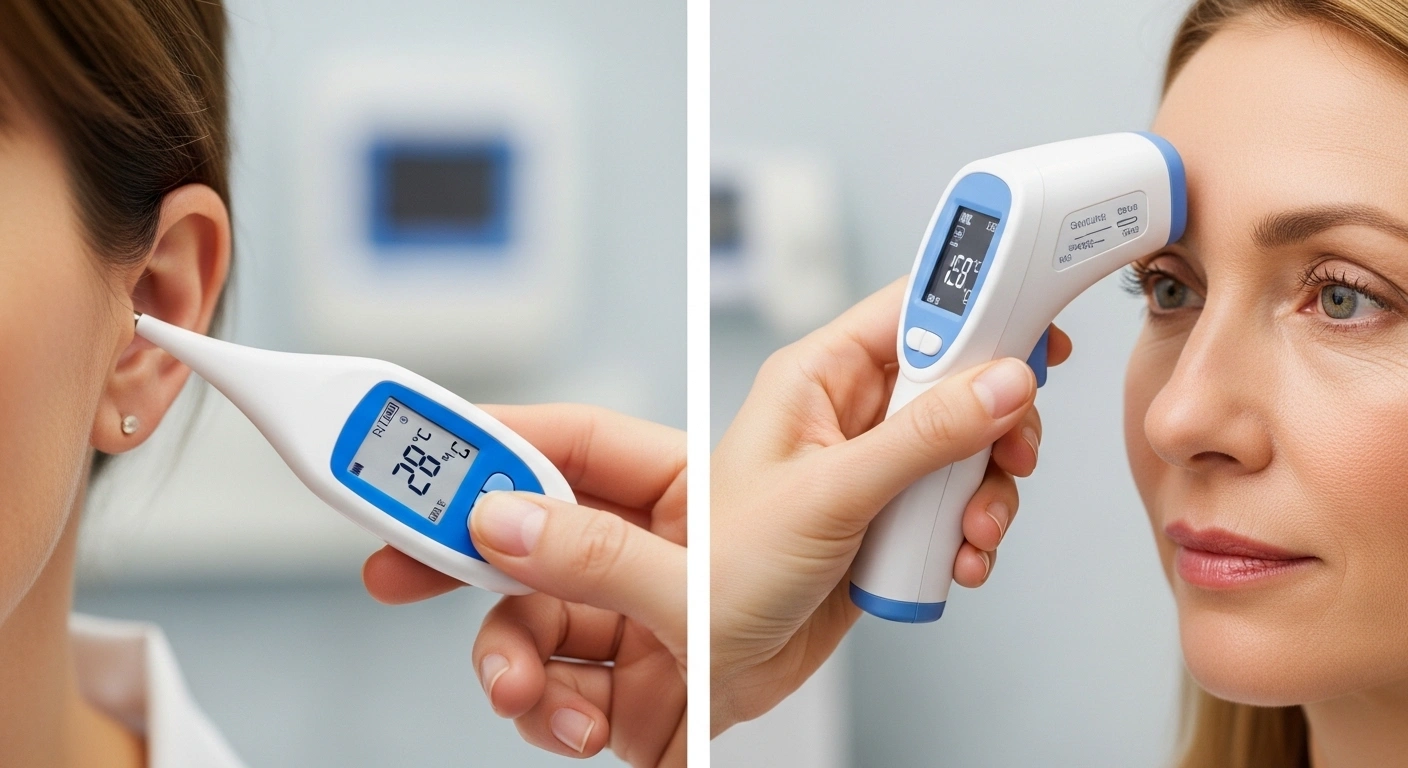
When it comes to ear thermometer vs forehead thermometer, ear thermometers (tympanic) tend to deliver more accurate core temperature readings, particularly for children and in clinical environments, provided they are used correctly.
Forehead thermometers (temporal artery) are more convenient and non-invasive, making them a solid choice for quick checks and mass screenings, though they can be affected by environmental conditions like sweat, drafts, or direct sunlight. Neither device is universally superior - the right choice depends on who you're measuring, where you are, and what level of accuracy the situation demands.
With that said, both thermometer types have carved out clear roles in everyday home care and professional healthcare. Understanding how each one works, where it performs well, and where it can let you down is what this article is all about.
The Rise of Non-Invasive Thermometers in Home and Healthcare Settings
Not too long ago, taking someone's temperature meant placing a glass thermometer under the tongue, waiting several minutes, and hoping for a clean reading. Today, that experience looks completely different. Infrared technology has made temperature checks faster, safer, and far less stressful - whether you're dealing with a squirming toddler at 2 a.m. or screening a waiting room full of patients.
Among the most widely used options are ear (tympanic) and forehead (temporal artery) thermometers. Both have become staples in homes, pediatric clinics, emergency rooms, and elderly care facilities. And yet, one question keeps coming up: which one is actually better? That's what this article sets out to explore - not in a vacuum, but in the real-life situations where these tools are used every single day.
How Ear Thermometers And Forehead Thermometers Work
Before comparing performance, it helps to understand what's happening under the hood with each device.
Ear Thermometers - How They Measure Temperature
Ear thermometers, also called tympanic thermometers, work by inserting a small probe gently into the ear canal. An infrared sensor inside the probe detects the heat emitted by the eardrum and the surrounding tissue. Because the eardrum shares blood supply with the hypothalamus - the part of the brain that regulates body temperature - readings from this location are considered a strong proxy for core body temperature.
The whole process takes only a second or two. The probe tip is placed snugly inside the ear, the button is pressed, and a digital reading appears almost instantly. The keyword here is "snugly" - proper placement is critical. If the probe doesn't seal well against the ear canal, or if there's excessive earwax or fluid present, the reading can come out lower than the actual temperature.
Forehead Thermometers - Measuring At The Skin's Surface
Forehead thermometers use infrared sensors to detect heat radiating from the temporal artery, which runs just beneath the skin on the forehead. Some models require a gentle swipe across the forehead, while others work from a short distance of about 1 to 2 centimeters without any contact at all.
This non-contact design makes forehead thermometers particularly appealing in situations where hygiene matters - think school screenings, hospital waiting areas, or checking on a child without waking them. The tradeoff is that forehead readings are more exposed to outside influences. Sweat, a cold draft, direct sunlight, or even a headband worn shortly before the measurement can all pull the number in the wrong direction.
Real-Life Scenarios: When To Use Ear Thermometers Vs Forehead Thermometers
Knowing how each thermometer works is one thing - knowing when to reach for which one is where the real-world value shows up. The ear thermometer vs forehead thermometer debate often comes down to context.
Home Use: Quick Temperature Checks for Children
For most parents, speed and ease of use are the top priorities when a child feels warm in the middle of the night. Forehead thermometers shine here - they're quick, require no cooperation from the child, and don't disturb sleep. A simple scan across the forehead can give a reasonable reading in seconds.
That said, if a child is sweating or has been bundled under blankets, a forehead reading may not tell the full story. In that case, an ear thermometer is the better call - it's still fast and relatively easy to use, and it gives a reading that's closer to true core temperature. Ear thermometers are suitable for children over about 6 months old, once the ear canal is wide enough to accommodate the probe.
Key tips for home use with children:
For ear readings, gently pull the ear back and up (for toddlers) to straighten the ear canal before inserting the probe.
For forehead readings, make sure the skin is clean, dry, and free from hair before scanning.
Avoid taking a reading right after the child has come in from cold weather - wait at least 15 minutes.
Professional Use: Medical Facilities and Clinics
In clinical settings, the standards are higher. A borderline reading that could be dismissed at home could lead to a missed diagnosis in a hospital. This is where the forehead thermometer vs ear thermometer comparison gets serious.
Medical staff often favor ear thermometers in one-on-one patient assessments because they offer a closer read on core temperature. However, forehead thermometers remain common in triage areas and urgent care facilities, where the goal is to screen many patients in a short period. In these mass-screening situations, the slight loss in precision is considered acceptable in exchange for speed and contactless hygiene.
It's also worth noting that ear thermometers can be used on uncooperative or comatose patients - something that oral thermometers simply cannot manage - which adds to their clinical utility.
Elderly Care: Monitoring Health Without Disturbance
Older adults, particularly those in care facilities or recovering from illness, often need regular temperature monitoring without disruption to their rest or routine. Both thermometer types have a role here, but each has specific limitations to keep in mind.
Forehead thermometers work well for contactless spot checks during sleep. However, clinical guidance - including recommendations from the Mayo Clinic - generally advises against using forehead thermometers for adults aged 65 and older, as accuracy can be less reliable in this group. Ear thermometers are the preferred option, as long as the patient doesn't have an ear infection or significant earwax buildup.
Ear Thermometer Accuracy Vs Forehead Thermometer Accuracy
This is where the comparison really matters - especially for anyone making decisions about a child's health or a patient's care. When weighing ear thermometer accuracy vs forehead thermometer results, the research consistently points in one direction.
The Science Behind the Accuracy
A cross-sectional clinical study by Mogensen et al., published in BMC Pediatrics, compared tympanic and temporal artery thermometers against rectal temperature in 995 children aged 0 to 18 years. The ear thermometer showed a significantly greater ability to detect fever than the forehead device. The authors concluded that forehead measurement fell outside clinically safe limits of agreement, while the ear thermometer remained useful for screening.
A separate study testing multiple thermometer types under controlled body temperature changes found that the Braun tympanic ear thermometer had the smallest limits of agreement across all test conditions - meaning it stayed closest to the true core temperature. Forehead devices in the same study tended to overestimate temperature and were slower to register actual changes.
Factors That Affect Accuracy in Both Types
No thermometer is foolproof - not even the best ear or forehead device on the market. Here's what can throw off readings for each:
Factors that affect ear thermometer readings:
- Earwax buildup or ear fluid - blocks the infrared sensor from reaching the eardrum properly.
- Improper probe placement - if the probe isn't fully seated in the canal, the reading drops.
- Ear infections - inflammation or fluid in the middle ear can produce inconsistent results.
Factors that affect forehead thermometer readings:
- Sweat or moisture on the skin - evaporation cools the surface and lowers the reading.
- Environmental temperature - drafts, direct sunlight, or a cold room can skew the result.
- Incorrect distance - holding the device too far from the forehead causes inaccurate readings.
Which Thermometer Is Better for Specific Situations?
There's no single winner in the ear thermometer accuracy vs forehead debate. The better choice truly depends on who you're measuring and what circumstances you're dealing with. Here's how each one performs across three key user groups.
For Parents of Young Children
Parents tend to get the most mileage out of having both types on hand. A forehead thermometer is great for a fast, non-disruptive check on a sleeping child. But if the reading is borderline - say, 99.5°F when you're trying to figure out if school is off the table - an ear thermometer gives a more reliable confirmation.
For babies under 6 months, neither type is recommended as the first-line option - rectal thermometers remain the clinical standard for that age group. Once a child reaches 6 months, an ear thermometer used correctly is generally more dependable than a forehead scan for confirming a true fever.
For Healthcare Professionals
In clinical and hospital settings, the preferred tool often depends on the purpose of the measurement. For individual patient assessment - where accuracy is critical - ear thermometers are generally favored. They can be used even when a patient is unresponsive, and when placed correctly, they provide a solid proxy for core temperature.
Forehead thermometers have a firm place in mass-screening scenarios: airport checks, emergency room triage, or public health events. Their contactless operation and high throughput make them practical - but clinicians are trained to treat any elevated forehead reading as a flag for further confirmation rather than a definitive diagnosis. This is exactly the distinction the 2018 Mogensen clinical study highlighted when it concluded that the forehead thermometer is acceptable for screening but not a reliable substitute for ear or rectal measurement in clinical use.
For Elderly or Hospitalized Patients
For older adults and hospital patients, comfort and accuracy both matter. Forehead thermometers offer a gentle, touchless option that doesn't disturb rest - useful for routine monitoring. However, given the Mayo Clinic's guidance advising against forehead thermometers for adults 65 and older, and the consensus that ear readings are more reliable in this population, ear thermometers should be the go-to when an accurate reading is needed.
Staff in nursing homes and long-term care settings often default to ear thermometers for exactly this reason - the forehead thermometer vs ear thermometer decision, in this context, leans clearly toward the ear device for anything beyond a quick screening check.
So, Which One Should You Actually Use?
When you look at the full picture, both thermometer types have earned their place - but they serve different purposes. Ear thermometers offer stronger accuracy, particularly for children, in clinical settings, and for older adults. When used properly, they deliver readings that are meaningfully closer to true core temperature, and the research backs that up.
Forehead thermometers bring real value where convenience and hygiene take priority - quick home checks, large-scale screenings, and situations where contact-free measurement matters. They're less precise, but they're fast, clean, and easy for almost anyone to use. If you're looking at the ear thermometer vs forehead thermometer choice for your household or care setting, the best approach is to match the tool to the task. For confirmation of fever and clinical accuracy, the ear wins. For speed and comfort in everyday use, the forehead model is hard to beat.

Share on Facebook

Share on X

Share on Pinterest
Comment(s)
Recent Posts

The Risk Of Not Wearing An Allergy Medical Alert Bracelet
March 23, 2026