
Medical IDs for Physicians

GPs, specialists and hospital clinicians shape what the patient carries on the wrist for the rest of their care journey. The diagnosis moment — new Type 1 diabetes, first seizure presentation, atrial fibrillation requiring anticoagulation, pacemaker implant, anaphylaxis confirmed on serial testing — is the natural moment to recommend a medical ID alongside the script, the action plan and the specialist referral. This page covers when to recommend, what to recommend, and how to set your practice up with Mediband — affiliate program, bulk orders for in-practice display, and hospital purchase orders.
Apply for the Mediband Affiliate Program — up to 20%* →
Designed in Australia
Since 2004
NDIS-registered
Provider 4050021192
Affiliate program
Up to 20%* commission
Hospital PO accepted
Net-30 terms on approval
Why a medical ID matters at the diagnosis moment
The clinician who confirms a new diagnosis is the first person to set the patient's mental model of what they now carry. A printed action plan goes in the drawer at home; a script goes into the pharmacy queue. A band on the wrist travels with the patient to the gym, the playground, the conference, the next-of-kin's spare room. Recommending a medical ID at the moment of diagnosis closes the loop between the clinical finding and what's visible to the ED clinician or paramedic who later meets the patient at their worst moment.
Australian and New Zealand resuscitation guidelines specifically direct rescuers to check for physical alert devices — including alert jewellery — during assessment of a collapsed or injured person (ANZCOR Guideline 2, April 2021). Australian peak bodies including Allergy & Anaphylaxis Australia, Diabetes WA, Epilepsy Action Australia, Dementia Australia and ASCIA recommend medical identification jewellery for people living with the conditions they support.
New Type 1 diabetes diagnosis. The endocrinology team confirms autoantibodies, the paediatrician hands the family a glucose meter, and within 48 hours the patient is on multiple daily injections or a pump. The diabetes team is the natural recommender of a "Type 1 — Insulin Pump" or "Type 1 — Insulin" band before the family leaves the clinic.
Anaphylaxis confirmed on testing. The allergy/immunology clinic that confirms the trigger and issues the ASCIA Action Plan is the natural recommender of an anaphylaxis band that names the allergen and points to the action plan on file. ASCIA explicitly recommends a medical identification emblem alongside the adrenaline device and the printed plan.
New AF + anticoagulation. The cardiologist or GP who starts apixaban, rivaroxaban, dabigatran or warfarin is the natural recommender of a "Blood Thinners — High Risk of Bleeding" band. Unscheduled surgery, a fall, a road crash — the receiving ED needs the drug name before the patient arrives.
Pacemaker, ICD or CRT-D implant. The implanting EP team and the discharge planner are the natural recommenders of a pre-printed pacemaker band. The device needs to be visible in three places at once — external defibrillation pad placement, MRI screening, and rate-control prescribing. The patient walks out of the cath lab and into the rest of their life carrying the band.
New epilepsy diagnosis. The paediatric or adult neurology team that initiates an antiseizure medication (lamotrigine, levetiracetam, sodium valproate, perampanel) is the natural recommender of an epilepsy band. The school nurse, the gym buddy, the partner at the cinema — all of them benefit from the band's headline. The wallet card carries the rescue medication detail.
Cognitive decline diagnosed. The geriatrician or memory clinic that confirms a dementia diagnosis is the natural recommender of a Dementia Alert band with the wearer's name and primary carer mobile. Around 8.4% of Australians aged 65 and over — rising to 29.2% of those aged 85 and over — live with dementia. For the wanderer on a winter morning, the band is the difference between a phone call and a missing-person report.
Where Mediband fits in current clinical scope
Four common practice touchpoints carry the strongest recommendation case for a medical ID.
GP Chronic Conditions Management Plan
From 1 July 2025, the GPCCMP replaced the GPMP/TCA model. The annual review for a patient with diabetes, COPD, cardiovascular disease or other chronic condition is the natural moment to surface a band recommendation — the diagnosis is established, the medication regimen is settled, and the patient is being primed to self-manage between visits.
Home Medicines Review (HMR) referral
The GP refers, a credentialed pharmacist conducts. From 31 December 2025, credentialing must be via an APC-accredited MMR pathway. The HMR report comes back to the GP with medication-list changes and patient-safety flags — the cleanest moment to add a band recommendation to the action plan.
Specialist clinic follow-up
Cardiology, endocrinology, neurology, immunology and oncology clinics see the patient at the most clinically literate point in their care. The endocrinologist confirming a CGM start, the EP team booking a generator change, the immunologist updating an ASCIA Action Plan — each visit is a recommendation moment.
Hospital discharge
The discharge planner, the pharmacist conducting medication reconciliation, and the consultant signing the discharge summary all see the patient at the point where outpatient and community care begins. Post-MI, post-PCI, post-PE, post-pacemaker, post-stroke patients all carry medication regimens that benefit from being visible on the wrist.
What to recommend at the consult
The five formats below cover the most common clinical recommendations. Pre-printed bands ship same business day from Australian stock when ordered before midday AEST; custom-engraved bands are made to order in Australia and ship in 10–14 business days.
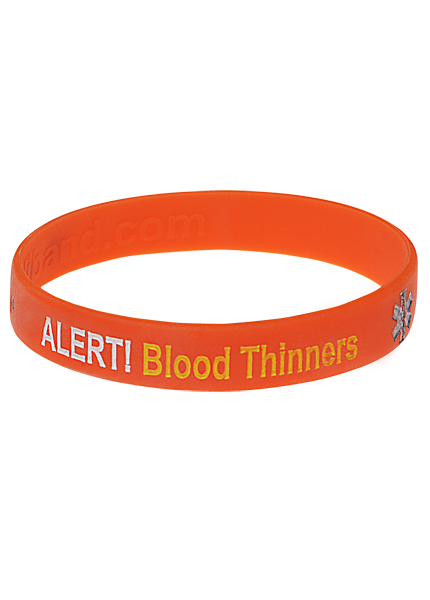
Blood Thinners write-on (B1792)
Pre-printed "BLOOD THINNERS — HIGH RISK OF BLEEDING" outer with a write-on strip on the inside for the drug name (warfarin, apixaban, dabigatran, rivaroxaban) and an emergency contact. Orange silicone, Australian stock. The fastest band to add to a new AF prescription, a post-PE follow-up or a bridging-therapy plan.
Recommend at: new AF on DOAC, mechanical valve patient, post-PE, surgical bridging therapy.
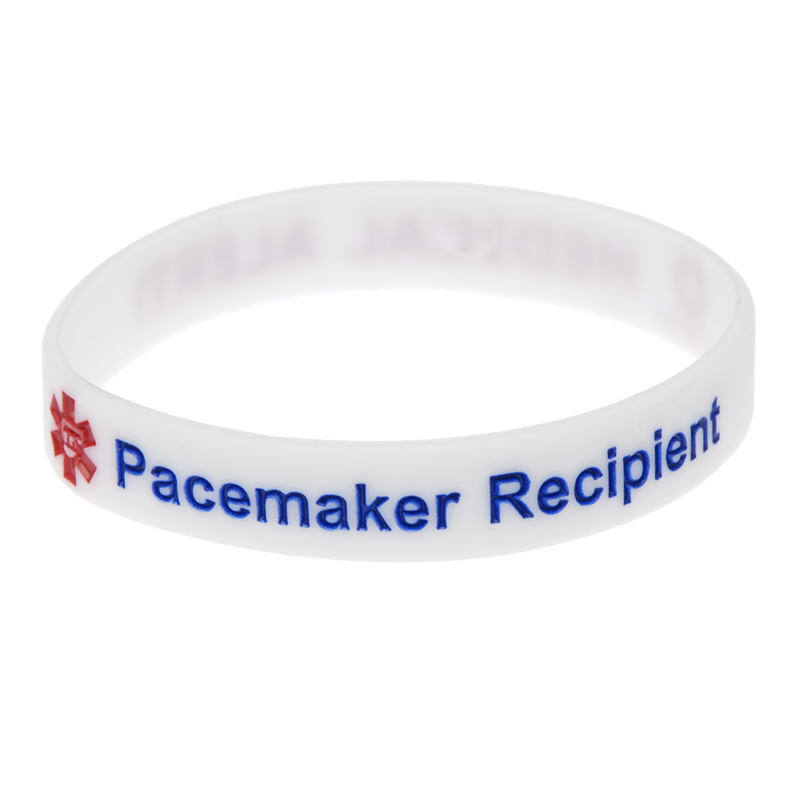
Pacemaker write-on (B2099)
Pre-printed "PACEMAKER RECIPIENT" outer with a write-on inside strip for device type, MRI-conditional status and emergency contact. White silicone, Australian stock. Reads in three places at once — defibrillation pad placement, MRI screening, and rate-control prescribing.
Recommend at: pacemaker / ICD / CRT-D implant, generator change, MRI-conditional confirmation.
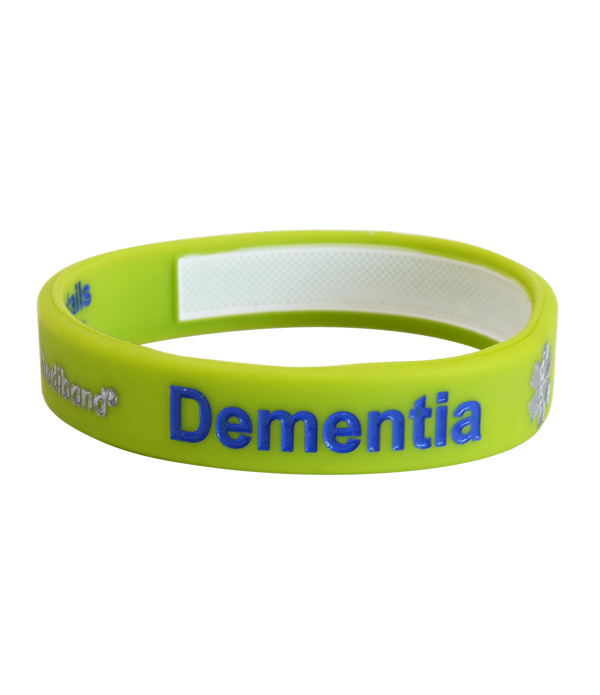
Dementia Alert write-on (W2677)
Pre-printed "DEMENTIA ALERT" outer in high-visibility neon green with an inside write-on strip for the wearer's name and primary carer mobile. Set the inside writing with hot water and it stays put. Recommend at memory clinic confirmation, post-diagnosis follow-up, or transition into residential aged care.
Recommend at: memory clinic diagnosis confirmation, carer support clinic, RACF admission.
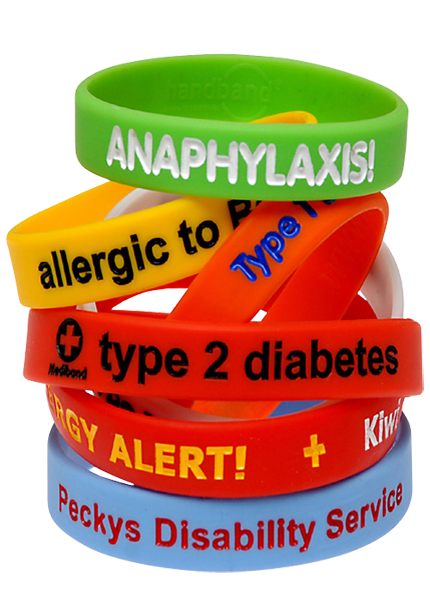
Custom-engraved silicone
Soft food-grade silicone — latex-free, generally well-tolerated on skin — engraved to order with conditions, medications and primary contact. Holds more characters than the pre-printed range; useful for multimorbid patients or patients on multiple high-stakes medications.
Recommend at: GPCCMP annual review with multimorbidity, HMR outcome, paediatric patients, oncology treatment intervals.
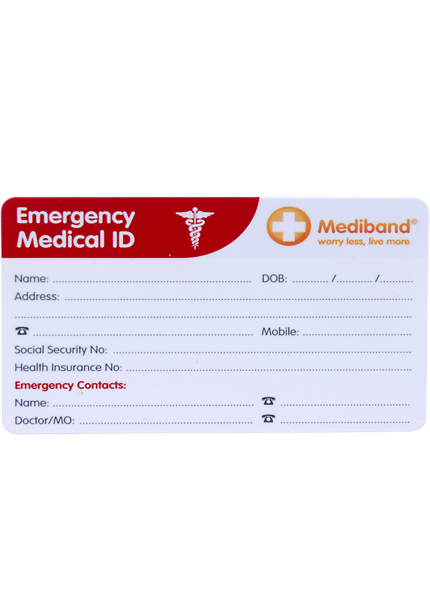
Wallet card — full profile
Carries what doesn't fit on a wristband: full medication list, treating GP and specialist team, allergies, ASCIA Action Plan or Advance Care Directive pointer, and a backup contact. The natural pair-up at the end of a GPCCMP review or an HMR — band carries the headline, card carries the file.
Recommend at: any patient on three or more medications, post-discharge, ACD on file, complex specialist team.
For most adult patients with a single dominant new diagnosis, the practical recommendation is one pre-printed band (B1792 anticoagulant, B2099 pacemaker, W2677 dementia, or the equivalent anaphylaxis or epilepsy band) paired with a wallet card. For multimorbid patients identified through GPCCMP review or HMR as having three or more medications or two-plus chronic conditions, lean on the custom-engraved silicone — it holds more characters across multiple lines.
How clinicians work with Mediband
Three pathways — affiliate program, in-practice display, hospital purchase orders. Pick one or run them in combination. The affiliate program is the most common starting point for individual GPs and specialists who want to recommend without carrying stock.
Affiliate program
Up to 20%* commission on referred sales
For individual clinicians and practices that recommend a band but don't want to carry stock or process the sale. Apply to the Mediband Affiliate Program, share a tracked link or display a recommendation card with your patient handout, and earn commission on each referred sale that converts. Reporting and payouts handled through the affiliate dashboard.
In-practice display
Counter or shelf display, supplied to order
Mediband supplies a practice display stocked with the most-recommended bands — B1792 anticoagulant, B2099 pacemaker, W2677 dementia, plus the anaphylaxis and epilepsy range. Supplied to order alongside your first stock order. Bulk pricing tiers apply to mixed orders of pre-printed bands; ABN-flagged accounts and net-30 terms available on request.
Hospital purchase orders
Net-30 terms, NDIS-compliant invoicing
Mediband bands are supplied to hospital systems including Boston Children's Hospital, LA County Hospital, St Vincent's Health and NSW Health. Purchase orders accepted on net-30 terms with an approved supplier registration. NDIS-compliant invoices available for participants on plan management. Bulk pricing tiers and consolidated billing available for institutional orders.
*Affiliate commission rates are tier-based and subject to verification of program eligibility. Commission tiers depend on referred-sale volume and program standing. See affiliate program terms for details.
What to recommend the patient engraves
A medical ID should carry five pieces of information: the highest-stakes condition (or up to three if more than one applies), any anticoagulant or device flag, the patient's name, a primary carer or treating-clinician contact in international format (+61 4XX XXX XXX), and an NOK backup. Three worked examples below cover the most common clinician-facing recommendations.
Example — new T1D diagnosis, paediatric, insulin pump
| Front | TYPE 1 DIABETES | INSULIN PUMP | OMNIPOD |
| Back | OLIVIA CHEN | Parent +61 412 345 678 | Endo +61 2 9XXX XXXX |
Example — new pacemaker recipient with chronic AF on apixaban
| Front | PACEMAKER | APIXABAN | MRI CONDITIONAL |
| Back | JOHN MURPHY | ICE Wife +61 412 345 678 | Cardio +61 2 9XXX XXXX |
Example — complex GPCCMP patient: T2DM, COPD, warfarin, ACD on file
| Front | WARFARIN | TYPE 2 DIABETES | COPD — SEE WALLET CARD |
| Back | JEAN HARRIS | ICE Daughter +61 412 345 678 | GP +61 2 9XXX XXXX | ACD ON FILE |
What NOT to recommend engraving
- Don't engrave a full address. The band is read in public; it shouldn't tell a finder where the patient lives.
- Don't engrave a Medicare or NDIS number. Identity numbers don't help in the first 60 seconds of a response.
- Don't engrave every medication. Only the highest-stakes ones (anticoagulant, insulin, opioid patch, clozapine). The wallet card carries the full list.
- Don't engrave "DNR" without a documented ACD cross-reference. "DNR" on a band alone is not a legally enforceable instruction in Australia. The correct engraving is "ACD ON FILE — GP" or a similar pointer.
What patients say
★★★★★ Three verified Mediband customer reviews from patients in situations a treating clinician will recognise — a drug-allergy identification mid-presentation, an anaphylaxis recognised by the band, and a 10+ year wearer of a pacemaker recipient band reading the band's effect on his own clinical care.
★★★★★
Saved my life.
"Saved my life. I passed out one night and woke up in hospital — the medical staff saw the band and didn't give me anything Penicillin based."
Anonymous — Penicillin Allergy Medical Bracelet — New Zealand
★★★★★
Emergency Services know.
"My husband had an anaphylactic reaction to Penicillin — he collapsed and almost died. The Mediband lets Emergency Services know, if he's unconscious, what the problem is."
Cazza — Anaphylaxis Alert Camouflage Medical ID
★★★★★
Speak for me when I can't.
"100 percent of the medical personnel I've come in contact with have noticed this bracelet. I wear it 24/7 to speak for me when I can't speak for myself."
Michael S. — Pacemaker Recipient Bracelet — USA — 10+ year customer
Why Mediband for clinicians
Mediband has been designing medical IDs in Australia since 2004 — more than 22 years working alongside clinicians, carers and patients. We are an NDIS-registered supplier (provider 4050021192). Mediband bands are used by hospital systems including Boston Children's Hospital, LA County Hospital, St Vincent's Health and NSW Health. We are stocked by Diabetes Australia for resale to its members. Every band is engraved to order in Australia; the B-series and W-series pre-printed bands ship same business day from Australian stock when ordered before midday AEST.
For clinicians specifically: apply for the Mediband Affiliate Program and earn up to 20%* commission on referred sales without carrying stock. Or open a bulk-orders account for an in-practice display or hospital purchase order. NDIS-compliant invoices are available for patients on plan management. Hospital purchase orders accepted on net-30 terms with an approved supplier registration.
Related condition hubs
The four hubs below cover the conditions a treating clinician recommends a Mediband for most often, each with engraving rules, product mix and the funding pathways relevant to that patient population.
Anaphylaxis
Food, insect, drug and latex allergy →
Diabetes
Type 1, Type 2 and pump users →
Epilepsy
Seizure disorders, AED medications →
Pacemaker, ICD & CRT-D
MRI-conditional flags, AED placement →
Frequently asked questions
Can my practice become a Mediband affiliate?
Yes. The Mediband Affiliate Program is the right fit for individual clinicians and practices that recommend a band but don't want to carry stock or process the sale. Apply at /au/affiliate/, share a tracked link or recommendation card with your patient handout, and earn up to 20%* commission on each referred sale that converts. Reporting and payouts handled through the affiliate dashboard.
How do I set up a hospital purchase order?
Email [email protected] with your hospital name, ABN, billing address and the contact for supplier registration. Mediband supplies major hospital systems including Boston Children's Hospital, LA County Hospital, St Vincent's Health and NSW Health on net-30 terms with an approved supplier registration. Bulk pricing tiers and consolidated billing available for institutional orders.
Can a clinician order a band on behalf of a patient?
Yes. Either order against the patient's engraving specification using a practice bulk-orders account, or refer the patient via your affiliate link so they place the order direct. For NDIS participants on plan management, the Mediband invoice is plan-manager compliant and the band can be supplied against the participant's plan.
How quickly can I get a band on a patient post-discharge?
Pre-printed B-series and W-series bands — B1792 Blood Thinners, B2099 Pacemaker, W2677 Dementia Alert, plus the pre-printed allergy and epilepsy range — ship from Australian stock the same business day when ordered before midday AEST. Custom-engraved bands are made to order in Australia and ship within 10–14 business days. For an urgent post-discharge supply, call 1300 796 401 during business hours AEST. Expedited turnarounds available on application.
Are Mediband bands safe for patients with skin sensitivity?
Mediband silicone bands are made from food-grade silicone — latex-free and generally well-tolerated on skin during repeated cleaning. For patients with a known reaction to stainless steel or with significant skin sensitivity, silicone is the usual recommendation. Patients with a documented sensitivity history should follow their treating clinician's advice.
Does Mediband supply NDIS participants?
Yes. Mediband is an NDIS-registered supplier (provider 4050021192). NDIS-compliant invoices are issued by default; plan-managed and self-managed participants can purchase against their plan. For agency-managed participants, contact the plan management team to set up Mediband as an approved supplier.
Set your practice up with Mediband
Apply to the Mediband Affiliate Program and earn up to 20%* commission on referred sales. Or open a bulk-orders account for an in-practice display or a hospital purchase order. NDIS-registered (provider 4050021192), supplying hospital systems, and stocked by Diabetes Australia for member resale.
Apply for the affiliate program → Open a bulk-orders account →
Hospital purchase orders or NDIS plan-managed orders? Call 1300 796 401 — business hours AEST — or email [email protected].
About this page: Mediband has been designing medical IDs in Australia since 2004. We are an NDIS-registered supplier (provider 4050021192). Australian peak-body references on this page are: Allergy & Anaphylaxis Australia, Diabetes WA, Epilepsy Action Australia, Dementia Australia and ASCIA — each of which publishes guidance recommending medical identification jewellery for people living with the conditions they support. Resuscitation reference: ANZCOR Guideline 2 (Managing an Emergency, April 2021). Clinical scope-of-practice references: Department of Health and Aged Care, GPCCMP (in effect from 1 July 2025), Home Medicines Review (HMR, APC-accredited MMR pathway from 31 December 2025). *Affiliate commission rates are tier-based and subject to verification of program eligibility. Engraving examples reflect common practice; they are not a substitute for the patient's treating clinician and should be reviewed against the current diagnosis and medication chart before engraving.
Who already trusts Mediband?
Bristol-Myers Squibb, Boston Children's Hospital, LA County Hospital, St Vincent's Health, Bupa Aged Care, NSW Health, Diabetes Australia, Epilepsy Action, Allergy UK, Medlab, The King's School Parramatta — plus thousands of households across five countries. See the full list.