
Medical ID bracelets for autism

A medical ID bracelet for autism does two jobs in an emergency: it identifies the wearer and it tells a stranger or first-responder how to communicate with them. For roughly half of children on the spectrum, a wandering or elopement episode happens at least once between the ages of four and ten. The band exists for those moments — and for the everyday situations where the wearer can't or doesn't want to explain themselves to a stranger.
Shop autism medical ID bracelets →
Designed in Australia
Since 2004
NDIS-registered
For eligible participants
Trusted by millions
Customers worldwide
22+ years
Designing medical IDs
When a medical ID matters
Around 380,000 Australians are on the autism spectrum, and autism is the single largest primary disability across the NDIS — roughly 36% of all active participants. The reasons families and individuals reach for a medical ID vary, but four patterns come up again and again.
Wandering and elopement. A 2012 American Academy of Pediatrics study (Anderson et al.) found that around 49% of children on the spectrum aged four to ten had attempted to leave a safe environment at least once, with around a quarter of those episodes lasting long enough to cause genuine concern. Australian data follows the same pattern. A band with the wearer's name, the autism flag, and a primary carer's mobile in international format gives a passer-by, shopkeeper or police officer everything they need to interrupt the episode and call home before it becomes an emergency.
Communication differences in a crisis. Some wearers are non-speaking. Some are situationally non-speaking — verbal at home but unable to talk to a stranger or first-responder. Some communicate using AAC (Augmentative and Alternative Communication) devices that aren't immediately to hand in a stressful moment. A clear "AUTISM — NON-VERBAL" or "AUTISM — AAC USER" engraving prevents the default reading of silence as defiance, intoxication, or mental-health crisis.
Sensory triggers and meltdowns. A meltdown is a neurological response to sensory or cognitive overload — not a tantrum, not a behavioural issue. To a stranger it can look like distress, aggression, or a medical emergency. A band engraved with "AUTISM — SENSORY OVERLOAD — QUIET SPACE NEEDED" turns an interaction that often goes wrong (raised voices, restraint, police involvement) into the right one (low stimulus, time, contact the carer).
Comorbid conditions. Wearers on the spectrum have higher rates of epilepsy, anxiety, ADHD, gastrointestinal conditions, and (in some populations) intellectual disability than the general public. The band is the most reliable place to surface the combination — "AUTISM — EPILEPSY — MIDAZOLAM" tells a first-responder both why the wearer isn't speaking and that the seizure they're watching is a medical event with a rescue plan.
"Sometimes, simple understanding is all that's required for empathy from those around you." — Mediband Autism Reversible Write-On product description, on the Mediband AU site since 2014.
Who the band is for — quick reference
There is no single autism audience. The right engraving depends on the wearer's age, communication profile, comorbidities, and the situations the band needs to cover. The five groups below describe the most common Mediband customers.
School-age — mainstream classroom
Verbal or partly verbal, supported in a regular classroom with an SLSO or aide. Engraving priority: autism flag, primary carer contact, any allergies, brief sensory note. Elopement is a real risk through to mid-primary school.
School-age — SSP or support unit
May be non-speaking or use AAC. Engraving priority: autism flag, communication profile (non-verbal / AAC user), primary carer contact, school contact as backup. High elopement risk in some learners.
Adolescent
Often independent enough to travel, but still benefits from the band for situations where a stranger has to make a call about why the wearer isn't responding. Engraving priority: autism flag, parent contact, any rescue medication or comorbidity flag.
Adult — living independently
Lives alone or with a partner. Band carries autism flag and emergency contact for situations where the wearer goes non-speaking under stress (medical emergency, road accident, panic). Often paired with a discreet metal band.
Adult — supported living
SIL, group home, or family-supported. May be non-speaking or have intellectual disability. Engraving priority: autism flag, support coordinator or carer phone, any health-condition flags. Higher-likelihood elopement profile than the general adult audience.
Recommended Mediband IDs
Mediband's pre-printed autism write-on bracelet (SKU W2668) is the simplest starting point — ships from Australian stock and has been a Mediband-listed product since 2014. For wearers whose engraving needs go beyond what the W2668 write-on strip can hold, custom-engraved silicone is the next step up. The six formats below cover the most common purchases, plus the Emotion Bracelet for wearers who need a communication tool alongside the medical ID.
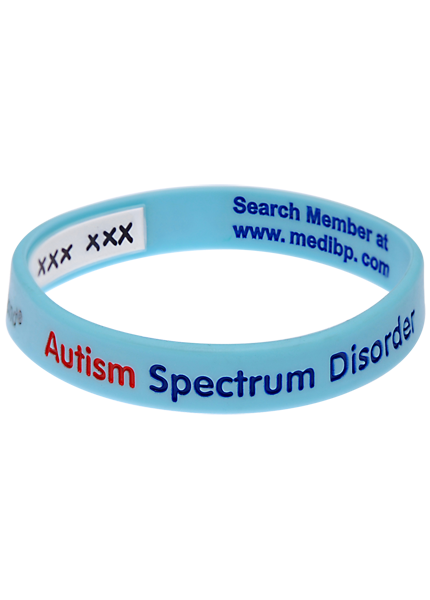
Autism Reversible Write-On (W2668)
Pre-printed "Autism Spectrum Disorder" outer (Mediband Logo, Star of Life), write-on strip on the inside for member ID, medical details and emergency contact. Aqua silicone with blue, red and silver infill. Set the inside writing with hot water and it stays put. The fastest, cheapest band to get the autism flag on a wrist this week. 6 verified five-star reviews.
Best for: first-band purchases, school spares, fast turnaround.
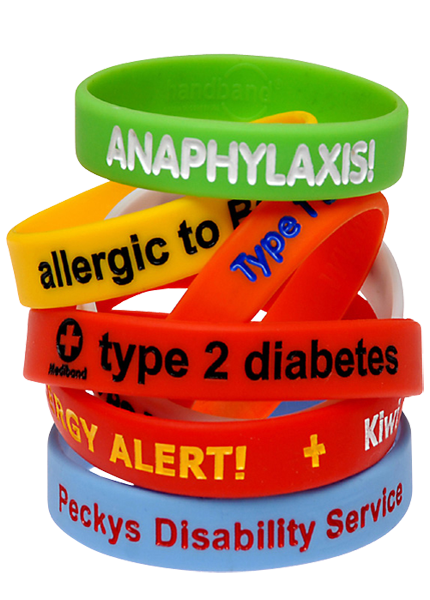
Custom-engraved silicone
Soft silicone strap engraved with autism flag, communication profile, carer contact and any comorbidities. Hypoallergenic, water-resistant, low sensory load. Holds more characters across multiple lines than the W2668 write-on strip — useful when "AUTISM", "NON-VERBAL", a rescue medication and a carer phone all need to fit. Hardest band for a child to lose or remove accidentally.
Best for: complex engraving needs, non-speaking wearers, all-day wear including sleep, sensory-sensitive wearers.
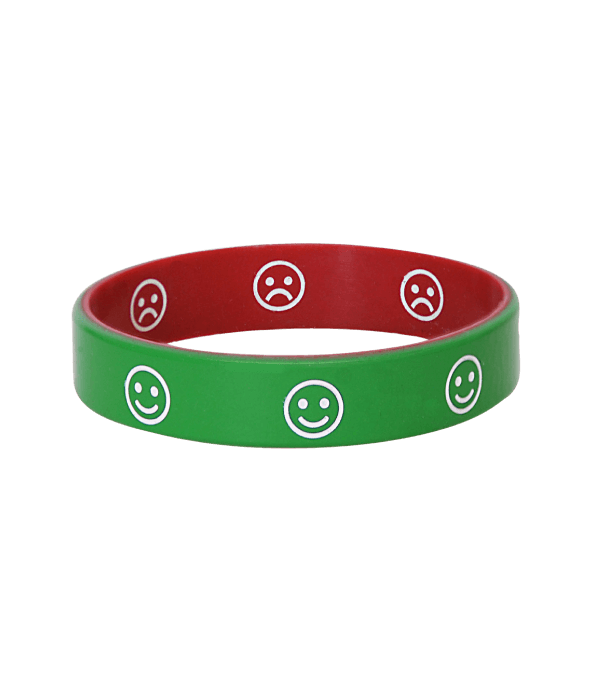
Emotion Bracelet — communication tool
Reversible silicone band with a smiling green face on one side and a frowning red face on the other. Worn on the same wrist as the medical ID, the Emotion Bracelet gives a wearer who can't or doesn't want to use words a way to signal "I'm open to being approached" or "I need quiet space and time". Useful at school, in therapy, and on public transport. Not a medical ID on its own — pair with the W2668 or a custom band.
Best for: classroom communication, OT and speech sessions, sensory regulation, kids who go non-verbal under stress.
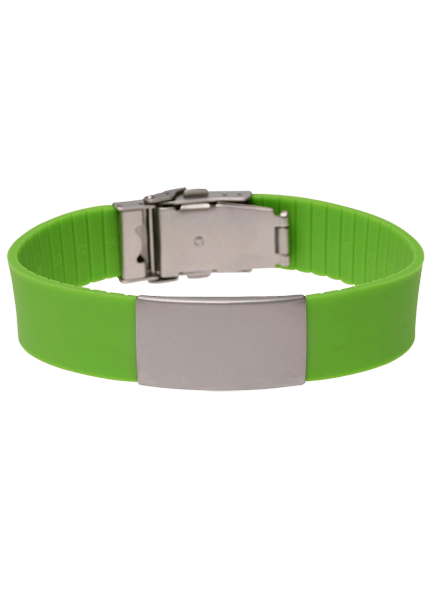
Active hybrid
Engraved stainless plate on a silicone strap. Water-resistant for swimming, hydrotherapy, sport. More watch-like in profile — popular with adolescents and adults who don't want a band that "looks medical".
Best for: adolescents, adults wanting a discreet daily band, swimmers, sport.
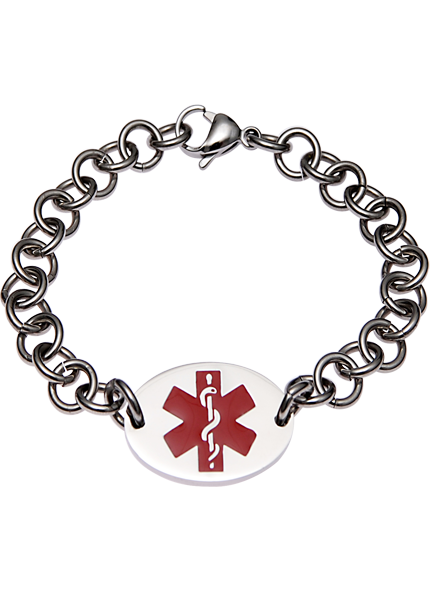
Custom stainless steel
Engraved stainless plate, subtle for professional and dress wear, sturdy for daily life. Holds the core details — autism flag, carer contact, primary comorbidity — in a watch-like profile. For longer engravings or sensory-sensitive wearers, custom silicone is the better choice.
Best for: adults in office, professional, or dress contexts.
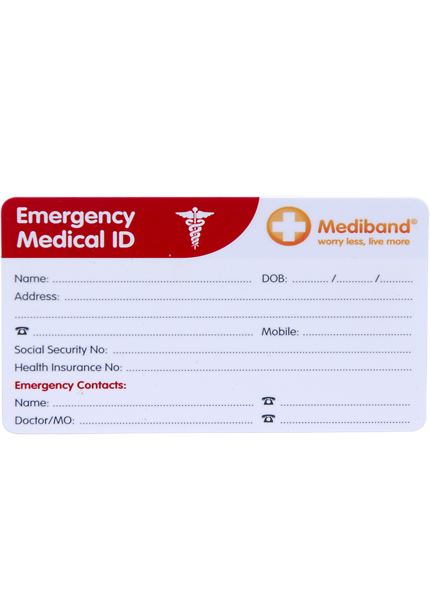
Wallet card — full profile
Carries the detail that doesn't fit on a wristband: full communication profile, AAC device make and model, sensory triggers, medications and doses, support coordinator contact, GP and paediatrician. Pair with any band.
Best for: complex profiles, supported-living adults, transitions between paediatric and adult care.
For most families, the practical combination is the W2668 Autism Reversible Write-On (or custom-engraved silicone for complex profiles) plus a wallet card — the band reads instantly to a stranger or first-responder, the card holds the AAC make/model, sensory profile and support coordinator. For wearers who go non-verbal under stress, add the Emotion Bracelet on the same wrist as a communication tool.
Prefer to talk it through first? Call 1300 796 401 during business hours AEST — or just shop the full range online →
What to engrave
Every autism medical ID should carry five pieces of information: the autism flag, the wearer's name, a primary carer contact in international format (+61 4XX XXX XXX), a communication note if the wearer is non-speaking or uses AAC, and any comorbidity flag that changes the emergency response (epilepsy with rescue medication, severe allergy, diabetes).
Three engraving examples below cover the most common Mediband customer profiles.
Example — school-age wearer, mainstream classroom
| Front | AUTISM | NAME: HARPER J |
| Back | ICE Mum +61 412 345 678 | School 02 9XXX XXXX |
Example — non-speaking adolescent, AAC user, support unit
| Front | AUTISM | NON-VERBAL | AAC USER |
| Back | NAME: SAM L | ICE Dad +61 412 345 678 |
Example — adult with autism + epilepsy comorbidity
| Front | AUTISM | EPILEPSY | TONIC-CLONIC |
| Back | Alex Pham +61 412 345 678 | Buccal Midazolam if >5 min |
What NOT to engrave
- Don't engrave a full address. The band is read in public; it shouldn't tell a finder where the wearer lives.
- Don't engrave a Medicare or NDIS number. Those are identity details that don't help in the first 60 seconds of a response.
- Don't engrave "low-functioning" or "high-functioning". The labels are imprecise, divisive in the community, and don't tell a first-responder anything useful. Engrave the communication profile instead ("NON-VERBAL", "AAC USER", "SITUATIONAL MUTISM").
- Don't engrave behavioural descriptors that read as warnings ("aggressive", "violent"). They invite the wrong response from police and bystanders. If a meltdown profile needs to be flagged, "SENSORY OVERLOAD — QUIET SPACE" is the engraving that gets the right response.
- Don't list every clinician on the band. Only the primary carer or emergency contact goes on the wristband. GP, paediatrician, OT, speech pathologist and support coordinator belong on the wallet card.
Communication needs and sensory profile
Communication is the field that most often gets the band's response right or wrong. The terms below are the ones first-responders, teachers and bystanders recognise.
NON-VERBAL. The wearer doesn't speak. A first-responder reading this knows not to expect a verbal answer and to contact the carer or look for a written/AAC alternative.
AAC USER. The wearer communicates with a device or paper-based system (LAMP, Proloquo2Go, PECS, communication board). If the device is missing, the wearer effectively can't communicate. The band tells a first-responder to look for the device or call the carer.
SITUATIONAL MUTISM. The wearer is verbal in safe contexts but goes non-speaking under stress, with strangers, or in unfamiliar environments. Common in children and adolescents on the spectrum. The band stops a paramedic or police officer from treating silence as deliberate non-cooperation.
SENSORY OVERLOAD — QUIET SPACE NEEDED. The wearer is in or near a meltdown driven by sensory input (noise, light, crowding, smell). The band asks for low stimulus, time, and contact with the carer. The wrong response — raised voices, physical restraint, bright torches — extends the episode and can escalate it.
Most wearers fit one or two of these labels. The band needs the most relevant; the wallet card carries the full sensory profile (specific triggers, calming strategies, the carer's preferred contact method).
Wandering and elopement — the central use case
For families with a young wearer, the band's most common reason for being is the elopement episode: the wearer leaves the house, the school grounds, the supermarket aisle or the park boundary unannounced and without a clear destination.
The pattern varies. Some wearers elope toward a specific interest (water bodies, transport, particular shops). Some elope away from a specific stressor (noise, crowding, an unfamiliar adult). Some episodes are quiet and brief — the wearer is found in the next room. Others escalate quickly — a child reaches a main road, a body of water, or simply gets out of sight in a built-up area.
The medical ID does not prevent elopement — physical safety measures (yard fencing, door alarms, GPS trackers, swimming proficiency) do that. What the band does is shorten the time between "a stranger notices this child is on their own" and "the carer's phone rings". Anecdotally, families report that figure in minutes rather than hours.
Three practical engraving notes for the elopement use case:
- Put the carer's mobile in international format. +61 4XX XXX XXX works for any phone, anywhere. A local format like 0412 345 678 doesn't help an out-of-state or overseas finder.
- Include the autism flag prominently. A stranger seeing "AUTISM" knows to expect a child who may not respond to their name, may avoid eye contact, and may run further if approached the wrong way.
- Add a communication note if relevant. "NON-VERBAL" tells the finder not to ask the child for their address — just call the number on the back.
For school-age wearers with a known elopement history, the practical combination is a custom-engraved silicone band the wearer keeps on continuously, plus an inside-uniform fabric label with the same information as a redundant layer for the days the band comes off.
School, support worker and community considerations
Schools, daycares, OT clinics, and SIL providers in Australia generally maintain a written profile for any student or resident on the spectrum — covering communication, sensory triggers, behaviour-of-concern responses, and elopement risk. The medical ID does not replace that profile, but it surfaces the essentials instantly when the profile isn't in reach.
For a school-age wearer, the practical combination is:
- A W2668 Autism Reversible Write-On or custom-engraved silicone band visible to every adult in the room.
- A written Communication Plan and Behaviour Support Plan held by the front office and the homeroom teacher.
- A wallet card or back-of-bag pocket with the AAC device make/model and support coordinator contact.
- An Emotion Bracelet on the same wrist for in-class communication when the wearer goes non-verbal under stress.
- An inside-uniform fabric label for redundancy on the days the band is off (sport, swimming).
For adults in supported independent living, the band typically pairs with:
- A support coordinator's contact as the primary number on the band.
- A wallet card with GP, psychiatrist, and SIL provider details.
- Any comorbidity engraving (epilepsy, allergy, diabetes) prominent on the front of the band.
For adults living independently, the band is a quiet daily presence. The Active hybrid and custom stainless steel both read as a watch or a fashion piece in most contexts; the autism flag is on the back, available to a paramedic or police officer but not on display to a colleague or stranger in the lift.
NDIS and out-of-pocket funding
Autism is the single largest primary disability across the NDIS — roughly 36% of all active participants as at the latest published quarterly data. Medical IDs typically sit under Assistive Technology or Consumables in an autism plan; speak to your support coordinator, LAC, or plan manager before assuming coverage. Mediband is an NDIS-registered supplier (provider 4050021192) and can invoice the NDIA directly or work through your plan manager.
For wearers not on the NDIS — including many adults whose autism was diagnosed late or who don't meet the NDIS access requirements — out-of-pocket purchase is the standard route. Custom-engraved bands are made to order in Australia within 10–14 business days; the W2668 ships from Australian stock same business day when ordered before midday AEST.
NDIS participant?
See how Mediband works under the NDIS, including plan-manager invoicing, three-tier turnaround for in-stock and engraved items, and a step-by-step access process.
Questions about ordering or eligibility? Call 1300 796 401 (AEST).
When to update or replace the band
Update whenever the engraving stops reflecting the current situation — specifically when:
- The communication profile changes (a wearer who was non-speaking starts using a device; an AAC user transitions to a different system).
- A new comorbidity is diagnosed (epilepsy, anaphylaxis, diabetes) and needs to appear on the band.
- The primary carer or support coordinator changes.
- The wearer moves between life stages — primary to high school, school to supported employment, family home to SIL.
- The wearer reaches an age where they prefer a less obvious format (the move from silicone to Active hybrid in adolescence is the most common request).
As a baseline, review the engraving every 12 months even if nothing has changed. Custom silicone is rated for daily wear including water and sleep; replace it when the strap shows visible wear or the engraving becomes hard to read. Stainless steel and gold last indefinitely; only re-engraving is needed if the wearer's profile changes.
Customer reviews
★★★★★ 5.0 / 5 from verified reviews of the Mediband Autism Reversible Write-On (SKU W2668).
★★★★★
Brilliant idea.
"I bought this band for my adult son to wear while we are overseas for extra security for him and peace of mind for us."
Deb — Autism Reversible Write-On (W2668) — 4 Aug 2017
★★★★★
Autism Medical Bracelet.
"Perfect for my autistic son."
Anonymous, Australia — Autism Reversible Write-On (W2668) — 21 Feb 2020
★★★★★
Autism.
"Great for kid who has bracelet."
Pamela G., Australia — Autism Reversible Write-On (W2668) — 22 Nov 2024
Reviews verified via the Mediband reviews programme on the live W2668 product page. We publish first names and a band reference only; reviewer details beyond this are not retained on the public site.
Why Mediband
Mediband has been designing medical IDs in Australia since 2004. We supply NDIS participants, plan managers, support coordinators, hospitals, schools, autism peak bodies, and families across Australia, New Zealand, Ireland, the United Kingdom, and worldwide. Every band is engraved to order, drawing on more than 22 years of working alongside wearers, their carers, and the clinicians around them. Mediband products are used by hospital systems including Boston Children's Hospital and LA County Hospital.
Related condition bands
Wearers on the spectrum have higher rates of several conditions than the general population — epilepsy and anaphylaxis in particular. If any of these apply, the band can carry both flags, or pair a primary band with a wallet card holding the full list.
Epilepsy
Seizure type, rescue medication, VNS device, photosensitive flag →
Anaphylaxis
Food, insect, drug and latex allergy →
Diabetes
Type 1, Type 2 and pump users →
Frequently asked questions
What should I engrave on an autism medical ID?
At minimum: the autism flag, the wearer's name, and a primary carer or emergency contact in international format (+61 4XX XXX XXX). Add a communication note if the wearer is non-speaking or uses AAC ("NON-VERBAL", "AAC USER"). Add a comorbidity flag if the wearer has epilepsy, anaphylaxis, or another condition that changes the emergency response. Don't engrave full addresses, Medicare numbers, or "high-functioning" / "low-functioning" labels — they don't help a first-responder.
My child can't tolerate anything on their wrist — what are the alternatives?
Sensory aversion to wrist-worn items is common. The practical alternatives are an engraved shoe tag attached to school shoes, a backpack clip on the school bag, or a fabric ID label sewn or ironed into the inside of school uniforms. The information is the same; the location moves to suit the wearer. Some families also use temporary skin-safe tattoos as a backup for outings.
What's the difference between the W2668 and a custom-engraved silicone band?
The W2668 (Autism Reversible Write-On) is pre-printed on the outside with "Autism Spectrum Disorder" and has a write-on strip on the inside that you fill in with a permanent marker, then set with hot water. It ships from Australian stock and costs around $12.82. Custom-engraved silicone is laser-engraved to order with whatever combination of autism flag, communication profile, carer contact and comorbidity flags you need. The W2668 is faster and cheaper; custom silicone holds more information and is permanent.
How does the Emotion Bracelet fit with the medical ID?
The Emotion Bracelet is a communication tool, not a medical ID on its own. It's a reversible silicone band with a green smiling face on one side and a red frowning face on the other — the wearer flips it to signal whether they're open to being approached or need quiet space and time. Many families wear it on the same wrist as the W2668 or a custom-engraved band: the medical ID handles the emergency identification, the Emotion Bracelet handles the in-the-moment communication.
Are autism medical IDs covered by the NDIS?
Autism is the single largest primary disability across the NDIS (roughly 36% of active participants). Medical IDs typically sit under Assistive Technology or Consumables in an autism plan. Speak to your support coordinator, LAC, or plan manager before assuming coverage. Mediband is an NDIS-registered supplier (provider 4050021192) and can invoice the NDIA directly or work through your plan manager.
My adult son is non-speaking and lives in SIL — who should the band's emergency contact be?
In most SIL contexts the primary contact on the band should be the support coordinator or the SIL provider's after-hours line — the people who know the wearer's current support plan and can respond around the clock. Family contact can go second on the band, or on the paired wallet card. Discuss the choice with the SIL provider so the plan matches the band.
How quickly can I get the band?
The W2668 Autism Reversible Write-On ships from Australian stock same business day when ordered before midday AEST. Custom-engraved bands are made to order in Australia and ship within 10–14 business days. In-stock alternative formats — Active hybrid, stainless steel, gold — vary by configuration; check the product page for current despatch. Need it faster? Call 1300 796 401 during business hours AEST and we'll talk you through the quickest path.
Ready to order?
Browse Mediband's full autism range — the W2668 Autism Reversible Write-On, custom-engraved silicone, the Emotion Bracelet, Active hybrid, custom stainless steel, and wallet cards. Designed and engraved in Australia.
Prefer to talk? Call 1300 796 401 — business hours AEST.
About this page: Mediband has been designing medical IDs in Australia since 2004. We are an NDIS-registered supplier (provider 4050021192). The engraving examples on this page reflect common practice — they are not medical advice and should not replace guidance from the wearer's paediatrician, psychiatrist, support coordinator, or treating clinician.