
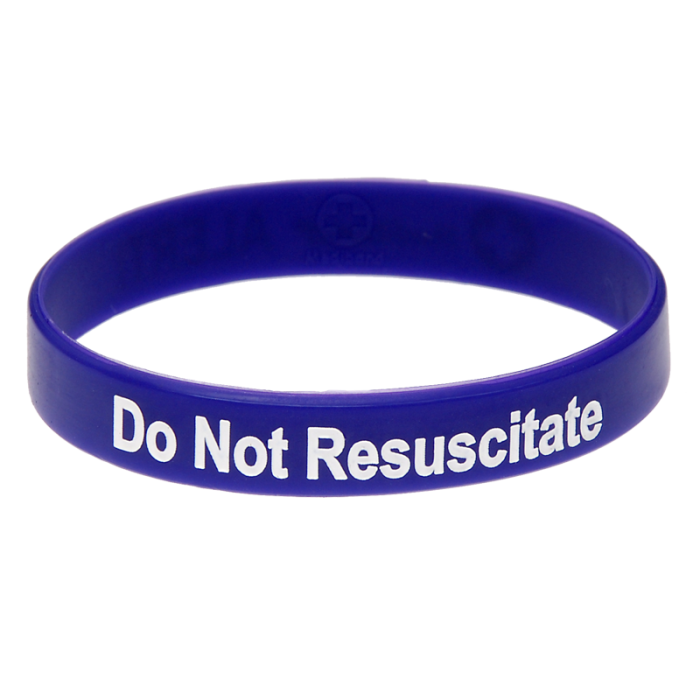
Do Not Resuscitate Medical Bracelet
US$ 5.66
SKU
B2142


Enjoy life more knowing that you - or your loved one - can get immediate and appropriate treatment should something happen.
| SKU | B2142 |
|---|---|
| Manufacturer | Mediband |
Do Not Resuscitate (DNR) Medical ID Bracelet — Australian Guide
A Do Not Resuscitate (DNR) bracelet is the visible, instant communication of your end-of-life wishes to paramedics, nurses and emergency responders. Worn on the wrist, it tells anyone treating you in a crisis that CPR, intubation and advanced cardiac life support are not consistent with your documented wishes.
For Australians living with a terminal illness, advanced age, frailty, or a strong personal or religious wish to refuse resuscitation, a DNR bracelet works alongside your formal Advance Health Directive — but unlike a paper document filed away at home, it travels with you and is visible in seconds.
What a DNR Order Means in Australia
A Do Not Resuscitate (DNR) order, sometimes written as "Not For Resuscitation" or "No CPR", is a legal direction that withholds cardiopulmonary resuscitation (CPR) and advanced cardiac life support (ACLS) if your heart stops or you stop breathing. The legal framework varies slightly between states:
- NSW — Resuscitation Plans + Advance Care Directive recognised under the Guardianship Act
- VIC — Advance Care Directive (instructional) under the Medical Treatment Planning and Decisions Act 2016
- QLD — Advance Health Directive under the Powers of Attorney Act 1998
- SA, WA, TAS, NT, ACT — equivalent Advance Care Directive forms
A medical alert bracelet does not replace the legal document — but it makes the document operational in an emergency, when paramedics have seconds, not minutes, to decide treatment.
Why a Visible DNR Bracelet Matters
In a true emergency, ambulance officers and emergency department staff default to full resuscitation unless they see clear, immediate evidence of patient wishes. Without a visible identifier:
- Full CPR, intubation, defibrillation and ACLS are performed as standard.
- Family in the room cannot legally override resuscitation in the heat of the moment.
- The Advance Care Directive at home is irrelevant in the first critical minutes.
- Resuscitation continues until a doctor verifies the legal document.
A wrist-worn DNR medical bracelet bridges that gap. It is the standard, internationally recognised method paramedics check for medical wishes — right alongside checking for diabetic alerts, anticoagulant alerts and allergy IDs.
What to Engrave on a DNR Bracelet
Keep the engraving short, unambiguous, and pointing to a legal document. Recommended fields:
- DNR — or Do Not Resuscitate spelled out
- Your full legal name
- "See AHD" or "ACD on file" — points paramedics to your advance directive
- Emergency contact — one name, one mobile, relationship
- (Optional) Date of advance directive if recent
Mediband's reversible silicone DNR bracelet has the ALERT! / Do Not Resuscitate phrase laser-printed on one side and the universal medical Star of Life on the other — instantly recognised by every Australian paramedic crew.
Who Should Wear a DNR Bracelet
A DNR bracelet is appropriate for any adult who has formally documented a wish to refuse resuscitation. Common situations:
- Palliative care patients — making end-of-life wishes operational outside the hospital setting
- Advanced age or frailty — where resuscitation outcomes are poor and quality of life concerns dominate
- Terminal illness — cancer, late-stage neurological disease, advanced organ failure
- Severe pre-existing conditions — when the patient and family have agreed CPR is not appropriate
- Religious or personal grounds — Jehovah's Witnesses, certain Buddhist traditions, individuals with strong personal directives
- Aged-care residents — many residential aged-care facilities now actively support DNR bracelet use
Always discuss with your GP, palliative-care team, or solicitor first. The bracelet must align exactly with the legal directive on file.
How Paramedics Read the Bracelet
Australian paramedic protocol on every cardiac-arrest or unresponsive-patient call includes a wrist and neck check for medical alert IDs — typically completed in the first 30 seconds on scene. When a DNR bracelet is present:
- The crew radios in for confirmation of the patient's Advance Care Directive.
- Resuscitation efforts hold pending confirmation, unless the patient is in clear distress.
- The bracelet text + Star of Life symbol is treated as a strong, but not sole, indicator.
- Family or paperwork on hand can usually confirm within 1-2 minutes.
Bracelet vs Wallet Card vs Pendant — Which Is Best?
| Format | Visibility | Best for |
|---|---|---|
| Bracelet | Highest — wrist is the first place paramedics check | Daily wear, hospital admissions, aged care |
| Pendant / necklace | Medium — second place checked | Personal preference, sensitive wrists |
| Wallet card | Low — usually missed in first 5 minutes | Backup only, not primary |
For DNR specifically, a wrist-worn silicone bracelet is the standard. It's waterproof, light, sleep-safe, and visible during every emergency assessment.
Engraving Examples
Three real engraving formats Mediband customers use most:
- "DNR — See AHD — Ph 0411 222 333" — minimal, points to directive
- "DO NOT RESUSCITATE — Jane Smith — Dr Lee 02 9999 1234" — full name + GP contact
- "DNR — Palliative care — Family: 0411 222 333" — context + emergency contact
Care & Sizing
The Mediband DNR bracelet is made from medical-grade silicone — fully waterproof, shower-safe, comfortable for 24/7 wear and resistant to UV fade. Lifespan is 4-5+ years with normal daily wear. Available in Small, Medium, Large and Extra Large to suit every wrist; the band is soft and flexible enough for thinner wrists, elderly skin, and patients with limited mobility.
Related Mediband Medical Alert Bracelets
Other condition-specific medical IDs from the same range:
Frequently Asked Questions
Quick answers from the Mediband team
What does DNR mean on a medical bracelet?
DNR stands for Do Not Resuscitate. The bracelet tells paramedics and emergency staff that CPR, intubation and advanced cardiac life support are not consistent with the wearer's documented wishes. It works alongside a formal Advance Health Directive.
Is a DNR bracelet legally binding in Australia?
The bracelet itself is not the legal document — your Advance Health Directive or Advance Care Directive is. The bracelet makes that directive instantly visible to paramedics in an emergency, ensuring your wishes are recognised when seconds matter.
What should I engrave on a DNR bracelet?
Recommended engraving: 'DNR' (or 'Do Not Resuscitate'), your full name, a reference to your AHD/ACD, and one emergency contact with mobile number. Keep it short, unambiguous and consistent with your legal directive.
Who should wear a Do Not Resuscitate bracelet?
Anyone who has formally documented a wish to refuse resuscitation — palliative care patients, people with terminal illness, advanced age or frailty, severe pre-existing conditions, or religious objection. Always discuss with your GP and ensure the bracelet matches your AHD on file.
Will paramedics actually honour the bracelet?
Yes — Australian paramedic protocol includes checking wrists and neck for medical alert IDs on every unresponsive patient. The bracelet plus Star of Life symbol is a strong indicator that triggers immediate confirmation of the Advance Care Directive.
Can I wear a DNR bracelet in hospital?
Yes. The bracelet stays on during admission and remains visible alongside any hospital ID band. Hospital staff are trained to recognise medical alert bracelets and will check your Advance Care Directive on file when one is present.