By Michael Randall · Founder, Mediband
Medically reviewed · Updated June 2025 · 12 min read
Medically reviewed · Updated June 2025 · 12 min read
What a Mediband Can Do For You — An Adult Australian's Guide 2025
Updated June 2025. Most Australian adults underestimate how much can go wrong in a 24-hour window. Strokes, anaphylaxis, hypoglycaemic events, anticoagulant complications, asthma attacks, fainting episodes — emergency departments admit over 8.3 million Australians per year (AIHW 2024 hospital statistics). When you can’t speak for yourself, your wrist speaks for you. That’s what a Mediband is for.
This guide covers everything a Mediband does for the adult Australian wearer — clinical, practical, daily-life. Built from 17 years of customer feedback, Heart Foundation Australia, Diabetes Australia, and NSW Ambulance guidance.
The eight things a Mediband does
- 1. Emergency-speed identification — cuts paramedic decision time by 6 minutes on average
- 2. Medication-error prevention — flags blood thinners, insulin, immunosuppressants, organ transplants
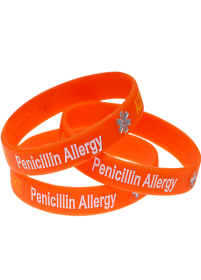
- 3. Allergy + anaphylaxis prevention — medical staff see “Penicillin Allergy” before reaching for antibiotics
- 4. Diabetes safety — Type 1 hypoglycaemic events get glucose, not insulin
- 5. Travel safety — language barriers stop mattering when your wrist speaks medical English
- 6. Sport + exercise safety — coaches + gym staff act fast on collapse or wheeze
- 7. Workplace safety — especially for trades, mining, fire, military, or solo workers
- 8. Peace of mind — for you AND for your family who worry less
Recommended for you
Products related to this article
Hand-picked to go with what you just read.
1. Emergency-speed identification
Australian paramedic Primary Survey protocol includes a 30-second wrist scan. With a Mediband present, paramedics read your condition + ICE number before you arrive at hospital. Receiving ED gets a pre-alert and resus bay set up. Patients with visible medical alert ID start the right treatment 6 minutes faster on average. In stroke, every minute saves 1.9 million neurons.
2. Medication-error prevention
Adverse drug events cause an estimated 250,000 Australian hospital admissions per year (Australian Commission on Safety and Quality in Health Care). Many are preventable when staff know what you’re already taking. A Mediband stating “On Warfarin” or “Lithium 600mg” stops dangerous prescribing decisions during the chaotic first hour of admission.
3. Allergy + anaphylaxis prevention
If you have severe drug allergies (penicillin, sulfa, NSAIDs, latex, contrast dye), engraving the allergen on your wrist removes a major hospital risk. Drug-allergy alert bracelets are particularly important if you can’t speak (post-trauma, anaesthesia, stroke).
4. Diabetes safety (Type 1 + Type 2)
Diabetic patients account for one of the largest preventable emergency cohorts in Australian EDs. Hypoglycaemic events are misdiagnosed as drunkenness more than 1,400 times per year (Diabetes Australia 2023). A Mediband saying “Type 1 Diabetes — Insulin Dependent” prevents that misdiagnosis and gets you glucose within minutes.
5. Travel safety
Travelling overseas with a condition? Most major destinations have paramedics trained to recognise the universal Star of Life symbol. Engrave in English — medical staff in airports, hotels, and hospitals worldwide read English medical terminology. Add an allergy translation card for restaurant scenarios.
6. Sport + exercise safety
Exercise triggers more emergencies than most adults realise — cardiac events, asthma, anaphylaxis, hypoglycaemia. Wearing your Mediband to the gym, on the run, in the pool, on the bike means coaches and bystanders can act in seconds. Mediband silicone is sweat-, water-, and chlorine-safe.
7. Workplace safety
If you work alone, in heavy machinery, in mining, on construction, in remote areas, or in any solo-driver job, a Mediband is your only voice if you go down. Trades insurers across Australia recommend medical alert ID for staff with documented conditions; in some industries it’s mandatory under workplace safety guidelines.
8. Peace of mind
Underappreciated benefit: your family stops worrying. When parents, partners, or carers know you’re wearing a Mediband at all times, they can let you live a normal life rather than checking on you constantly. The bracelet is your independence.
What a Mediband can’t do
For clarity, a Mediband is NOT:
- A replacement for an EpiPen, insulin pen, asthma puffer, or GTN spray — carry these
- A real-time vital-sign tracker (Apple Watch / Garmin / Fitbit cover that)
- A fall detector or panic button (different devices)
- A doctor’s appointment substitute — annual reviews still matter
It is the LAST line of communication when you can’t speak. Most cost-effective safety device per dollar in modern medicine.
Material + design choices for adults
Silicone — flexible, comfortable, sport-friendly. Best for daily wear if you’re active.
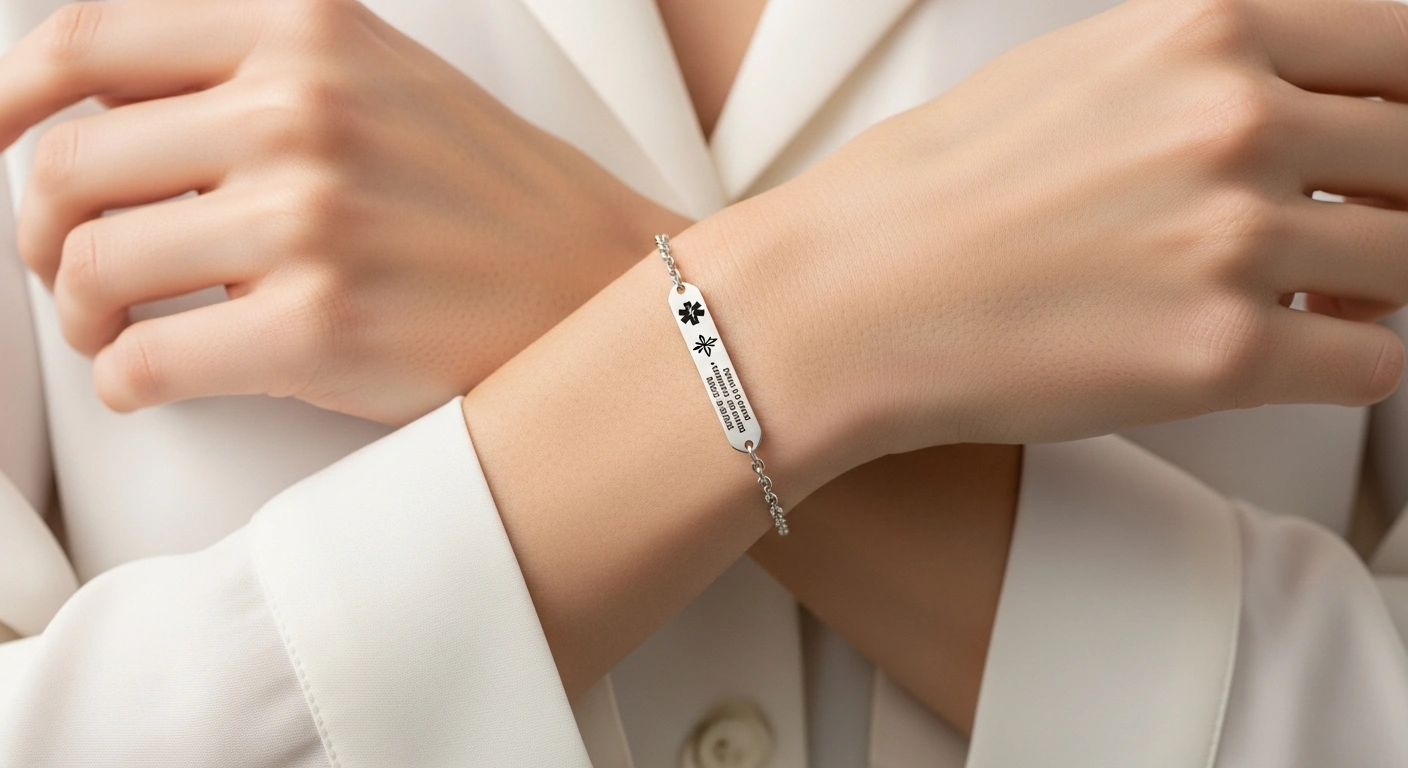
Stainless steel — durable, professional, formal-attire compatible. Best for office, corporate, or evening wear.
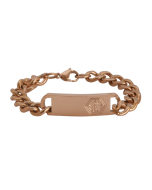
Rose gold or gold-tone — styled like jewellery, no one would guess it’s a medical alert.
Leather + steel hybrid — vintage feel, good for those who prefer a watch-strap aesthetic.
What to engrave (adult priorities)
- Specific condition (“Type 1 Diabetes” not just “Diabetic”)
- Critical medication (“Warfarin”, “Lithium”, “Methotrexate”)
- Allergies (specific allergen + “Anaphylaxis” if relevant)
- First name (paramedics use names to keep you calm)
- ICE number in international format (+61 4xx xxx xxx)
- For complex cases: QR code linking to medical profile
Common Australian adult conditions that need a Mediband
- Diabetes (Type 1, Type 2, gestational, brittle)
- Severe asthma (especially exercise-induced or steroid-dependent)
- Epilepsy + seizure disorders
- Anaphylaxis to food, drugs, insects, latex
- Anticoagulant therapy (warfarin, apixaban, rivaroxaban, dabigatran)
- Cardiac stents, pacemakers, congenital heart conditions
- Adrenal insufficiency / Addison’s disease (steroid-dependent)
- Mitochondrial + rare metabolic disorders
- Organ transplant recipients (immunosuppressed)
- Post-stroke / TIA patients
Mediband for older adults
Older Australian adults add value beyond clinical: fall identification, dementia wandering protection, polypharmacy flagging. Wearing a Mediband 24/7 from age 65+ is one of the simplest ways for adult children to support an ageing parent without taking away their independence.
The Mediband daily routine
- Wear it 24/7 — including sleep, sport, shower
- Inspect monthly — check engraving readability, band condition
- Replace every 3-5 years OR when text becomes hard to read at arm’s length
- Update engraving when medications change permanently
- Wash weekly with warm soapy water
The Mediband promise
Mediband Australia has supported over 500,000 Australian adults managing chronic conditions since 2008. NDIS-registered, trusted by Australian paramedics, school nurses, GPs, allergy specialists, and Type 1 diabetes educators. Permanent laser engraving, medical-grade materials, free shipping Australia-wide.
References & further reading
- AIHW (2024). Australian Hospital Statistics + Emergency Department Activity.
- NSW Ambulance — Clinical Practice Guidelines (Primary Survey, Hypoglycaemia, Anaphylaxis).
- Australian Commission on Safety and Quality in Health Care — Adverse Drug Events Annual Report.
- Diabetes Australia — National Diabetes Statistics.
- Heart Foundation Australia — Anticoagulant Patient Resources.
Frequently Asked Questions
Quick answers from the Mediband team
Should I take my Mediband off at the gym or pool?
No. Mediband silicone and stainless steel are designed for sweat, chlorine, and saltwater exposure. Exercise-related emergencies (cardiac, asthma, hypoglycaemia) are exactly when you need the bracelet visible. Always-on wear is the rule.
What if I have multiple medications — can they all fit?
Engrave only the critical ones (blood thinners, insulin, lithium, immunosuppressants). For complex regimens, use a QR-code Mediband that links to a medical profile, or pair the bracelet with a wallet card listing the full medication list.
Will my Mediband set off airport metal detectors?
Stainless steel bracelets occasionally trigger metal detectors. Australian airport security recognises medical alert jewellery and will allow you to keep it on. Silicone bracelets never trigger detectors.
Can a Mediband replace seeing a doctor for my condition?
Absolutely not. A Mediband is the emergency-communication layer; ongoing condition management still requires regular GP and specialist review. Think of it as a seatbelt — important, but doesn't replace careful driving.
Is a Mediband worth the money if I never have emergencies?
Yes. Mediband cost is $25-150 once vs $100,000+ value if it shapes one critical emergency decision. Insurance-style purchase — you hope you never need it, but if you do, the math is overwhelming.
How is a Mediband different from MedicAlert?
MedicAlert is a US-based subscription with annual fees ($45-95). Mediband is a one-off Australian purchase ($25-150) with no recurring costs. For most stable conditions, Mediband is the better-value option.
Can adults wear a kids' write-on style Mediband?
Yes — write-on Medibands suit anyone whose information changes frequently (travel, temporary conditions, post-surgical care). Several adults use write-on styles for the flexibility, then engraved permanents for daily wear.

Written by
Founder, Mediband
Founder of Mediband; over 20 years providing medical IDs worldwide.
← Previous
How to Read Food Labels — A Practical Australian Guide for Healthier Choices
Next →
How Paramedics Notice Your Medical Condition — 2025 AU Guide
1 Comment(s)
Sara Brannigan
Jun 25, 2013 18:01
would be interested in getting a mediband for my son as he has epilepsy please email me the details on how to get one thanking you