
Dementia bracelets — medical IDs for people living with dementia in Australia
A dementia bracelet does two jobs: it identifies the wearer to a stranger, paramedic or police officer when the wearer can’t, and it surfaces the carer’s phone number and address so someone can call you the moment your parent, partner or client is found. For families managing wandering risk, communication changes, or a mix of dementia plus other conditions like anticoagulant therapy or diabetes, the band is the most reliable place to put what an emergency contact needs to know first.
Shop the W2677 Dementia Alert bracelet →

|
✓ Designed in Australia Since 2004 |
◎ NDIS-registered Provider 4050021192 |
★ Seniors Card 15% off* Code SENIORS, all year. *Terms |
⏱ 22+ years Designing medical IDs |
When a dementia bracelet matters
Around 472,000 Australians are living with dementia (Dementia Australia, 2024 estimate), and that figure is projected to rise to over 800,000 by 2058. The majority are over 65 and live at home with a partner, adult child or formal carer as the day-to-day support person. About one in three will experience wandering or going missing at some stage — sometimes briefly, sometimes for hours, occasionally with serious safety consequences. A medical ID bracelet doesn’t prevent wandering, but it changes what happens next: the moment a stranger, shopkeeper, paramedic or police officer notices the wearer is alone and disoriented, the band gives them the wearer’s name and your phone number in seconds.
The bands here are designed for three distinct moments:
- Early stage — the wearer can read the band, knows their carer’s name and number, and uses it as backup for the rare confused moment.
- Mid stage — the wearer can’t reliably recall the carer’s phone number, may leave the house without notice, and the band becomes the primary way a stranger or police officer reaches you.
- Mixed presentation — dementia plus anticoagulant therapy, a pacemaker, diabetes or another condition. The band carries the most safety-critical flags for paramedics on arrival.
Dementia bracelet formats — what to pick
Four formats cover the dementia audience. The W2677 Dementia Alert write-on is the most popular — the diagnosis is pre-printed on the outside in high-visibility neon green so a stranger reads it instantly, and there’s a write-on strip on the inside for the wearer’s name and your phone number. The custom-engraved silicone and custom stainless options give you more space for multi-condition flags or a non-medical-looking band for daily wear.
W2677 Dementia Alert write-on
Best for: the most common dementia ID need — pre-printed Dementia flag outside, name + carer mobile inside.
High-visibility neon green silicone. “DEMENTIA ALERT” pre-printed on the outside; write-on strip on the inside for the wearer’s name, your mobile and any rescue medication. Soft, hypoallergenic medical-grade silicone — gentle on thin or fragile older skin, no latex, no metal clasp to catch or irritate. Ships from Australian stock same business day when ordered before midday AEST.
Custom-engraved silicone
Best for: dementia plus a second condition flag (anticoagulant, diabetes, pacemaker) on the same band.
Soft silicone strap, custom-engraved on the outside. Carries the dementia flag plus an anticoagulant warning, the wearer’s name, your mobile and an address line for “If found, please return to” engraving. Made to order in Australia in 10–14 business days; expedited turnarounds available on application.
Custom stainless steel
Best for: wearers who want a band that doesn’t read as “medical” on first glance.
Engraved stainless plate on a leather, mesh or silicone strap. Looks like a watch or dress bracelet from across the room; the engraving is only legible up close. Useful for early-stage wearers who feel self-conscious about wearing a visibly medical band day-to-day.
Emergency Medical Wallet Card
Best for: a companion to any of the above — carries the full picture for paramedics.
Pocket-format card with full medication list, GP and specialist contacts, advance care plan reference, allergy notes. Lives in the wearer’s wallet alongside the band. Many of our dementia customers order one for the wearer and one for the primary carer’s wallet.
Three engraving examples
Real engraving patterns from Mediband dementia customers, normalised for privacy. The pattern that works depends on the wearer’s stage and whether they have other conditions.
Early-stage — carer phone
DEMENTIA
MARGARET BENNETT
DAUGHTER 0412 345 678
The wearer can still recall their daughter’s name and recognises the number. The band is backup for the occasional confused moment in a shopping centre or appointment.
Mid-stage — wandering risk
DEMENTIA
JOHN WALSH 12 OAK ST CHATSWOOD
IF FOUND PLEASE CALL 0411 222 333
Wandering is a real risk. The band carries the wearer’s name, home address and a clear instruction to anyone who finds him. The carer’s phone is the primary way the wearer gets home safely.
Mixed — dementia + anticoagulant
DEMENTIA
APIXABAN 5MG BD
NO ASPIRIN
SON 0413 456 789
Many older adults with dementia are also on anticoagulant therapy for atrial fibrillation. Paramedics arriving at a fall or head injury need to know the wearer is on apixaban (or warfarin, rivaroxaban, dabigatran) before they administer aspirin or proceed with imaging decisions.
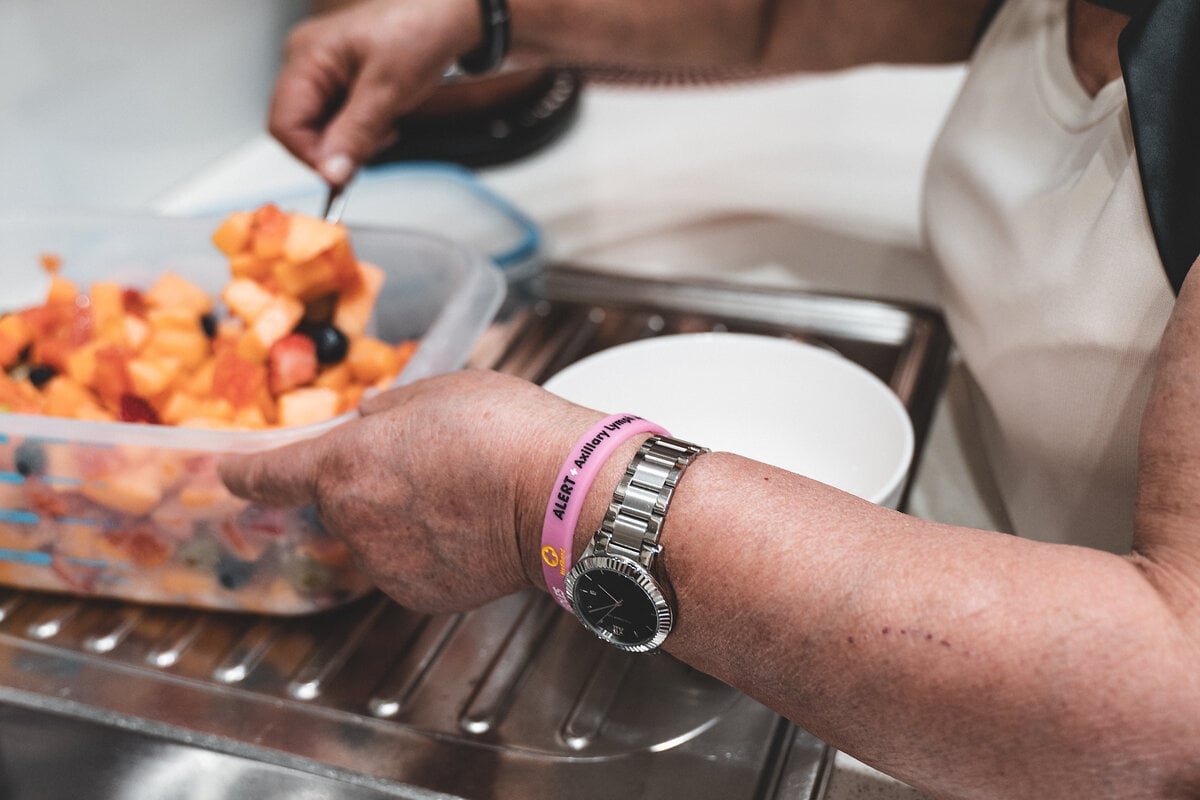
Wandering and lost-person scenarios — what the band actually does
The most common reason families buy a dementia bracelet is not the diagnosis itself but the moment when wandering became a realistic risk. Dementia Australia estimates that around six in ten Australians living with dementia will go missing at some point. Most cases resolve within hours through informal channels: a neighbour spots the wearer, a shopkeeper calls a contact, a passer-by stops to check. The band’s job is to make that informal channel work reliably the first time, every time.
From the customer reviews on the W2677 page (read them below), a few patterns recur:
- Travel and unfamiliar environments — airports, hotels, family visits interstate — are when families feel the band’s value most, because the usual neighbourhood awareness isn’t there.
- The band is often bought BEFORE the first wandering incident, by a carer who has noticed early signs and wants the safety net in place.
- Wearers accept the band more readily when it’s framed as part of their daily “getting dressed” routine rather than introduced after a frightening incident.
Dementia plus other conditions — what to flag
Most older Australians living with dementia have at least one other condition. The band has limited surface area — pick the flags most relevant to a first-responder decision in the first sixty seconds:
- Anticoagulants — warfarin, apixaban, rivaroxaban, dabigatran. Flag the drug name; paramedics adjust head-injury, fall and imaging decisions on the spot.
- Pacemaker, ICD or CRT-D — relevant to defibrillator placement and MRI decisions. See the pacemaker hub for the full engraving pattern.
- Diabetes — particularly insulin-dependent. See the diabetes hub.
- Anaphylaxis — flag the trigger (peanut, bee, drug) and rescue medication. See the anaphylaxis hub.
Funding — Aged Care, NDIS younger-onset, Seniors Card and out-of-pocket
Older Australians fund dementia bracelets through several pathways. The right one depends on the wearer’s age and the support program they’re already on.
Aged Care — Support at Home + CHSP. Most over-65 wearers fund through everyday support pathways. Medical IDs are generally an out-of-pocket purchase rather than a listed item under the Assistive Technology and Home Modifications (AT-HM) scheme, but some Support at Home plans flex for safety items — ask your provider or care partner. See Aged Care funding for medical IDs → for the full pathway.
NDIS (younger-onset dementia). Australians diagnosed with dementia under 65 can access the NDIS. The band typically sits under Consumables or Low-Cost Assistive Technology in the plan. Mediband is an NDIS-registered supplier (provider 4050021192).
Seniors Card 15% off*. Mediband offers Seniors Card holders a 15% discount on all products — enter SENIORS at checkout. The discount applies year-round to custom-engraved bands, pre-printed bands, stainless steel, gold, and accessories. It stacks with the out-of-pocket pathway but does not stack with NDIS-funded orders or with the pharmacy or affiliate program discounts. Full terms →
Out-of-pocket. The standard route when no funding programme applies. Custom-engraved bands ship in 10–14 business days standard, expedited on application. Pre-printed W2677 ships from Australian stock same business day when ordered before midday AEST.
Caring for a parent on Support at Home or CHSP?
See how Mediband fits with the Support at Home program (which replaced Home Care Packages from 1 November 2025), including what Support at Home covers, how to ask your provider, and the out-of-pocket fallback when the plan doesn’t.
Frequently asked questions
Can a person with dementia consent to wearing a bracelet?
For most wearers, especially in early to mid stage, yes — the conversation goes well when the band is framed as part of staying independent and getting home safely rather than as a medical device. Where capacity to consent is genuinely impaired, the decision sits with the person under an Enduring Power of Attorney for personal matters or guardianship arrangements. Practical tip from our customers: the band is more readily accepted when introduced as part of the daily “getting dressed” routine and the wearer chooses the colour or style.
What should be engraved if my parent wanders?
If wandering is a real risk, engrave: (1) DEMENTIA on the front so a stranger reads the diagnosis at first glance; (2) the wearer’s name; (3) the home address or suburb; (4) the carer’s mobile phone number with the words IF FOUND PLEASE CALL. The address line matters because most wandering resolutions happen via a neighbour, shopkeeper or passer-by, not via emergency services. See Section 3 above for three real engraving patterns from our dementia customers.
Will the bracelet prevent my parent from wandering?
No — the bracelet doesn’t prevent wandering. It changes what happens after wandering starts. The moment a stranger, shopkeeper, paramedic or police officer notices your parent is alone and disoriented, the band gives them your name and phone number so they can call you. Australian families report this is usually how a wandering episode resolves: an attentive person finds the wearer and the band gets them home.
Does the dementia bracelet have a GPS?
No, the Mediband range does not include GPS. We make ID bands that surface the wearer’s name, condition and a carer’s contact number to anyone who finds them. GPS tracking is a separate technology category. Many of our dementia customers use both — a Mediband for instant identification and a separate GPS device or tracker for location data. The band has no battery to charge and no signal to maintain, so it always works.
Can my parent take the bracelet off easily?
The W2677 silicone band has a standard clasp that any wearer can release. Mediband does not design tamper-resistant or restraint-style products — restricting the wearer’s ability to remove a band raises consent and restrictive-practice concerns that sit outside what an ID bracelet is meant to do. In practice, most dementia wearers settle into the band quickly once it becomes part of their daily routine, especially if introduced early when they still have a strong sense of choice. If band-removal is a persistent problem, your care team is the right place to discuss it.
Is the silicone bracelet comfortable for someone with thin or sensitive skin?
Yes. The W2677 Dementia Alert band uses soft, hypoallergenic medical-grade silicone — the same compound used in medical devices that sit on skin all day. It’s latex-free, gentle on the thin and sometimes fragile skin of older wearers, and the strap has no metal clasp or buckle to catch, pinch or irritate. The wearer can shower, wash hands, sleep and bathe without removing it. If skin irritation or pressure sores are a known concern, the custom-engraved silicone option uses the same material in a wider strap that distributes pressure more evenly.
How does the Seniors Card discount work for a dementia bracelet?
Seniors Card holders get an unlimited 15% discount on all Mediband products year-round — enter the code SENIORS at checkout. The carer’s Seniors Card works just as well as the wearer’s. State-equivalent cards (NSW, Queensland, Victorian, WA, SA, Tasmanian, NT, ACT Seniors Cards) qualify on the same basis. The 15% discount stacks with the out-of-pocket pathway. It does not stack with NDIS-funded orders (where the NDIA pays the full price and the discount doesn’t apply). It does not stack with the pharmacy discount or the affiliate program discount.
How quickly can I get the bracelet?
The W2677 Dementia Alert pre-printed band ships from Australian stock the same business day when ordered before midday AEST. Custom-engraved silicone and custom stainless bands are made to order in Australia and ship within 10–14 business days standard. Need it faster for an upcoming hospital admission, family trip or aged-care move-in? Call 1300 796 401 during business hours AEST and we’ll work out the quickest path — expedited turnarounds are available on application.
Customer reviews
★★★★★ Three verified customer reviews from the live W2677 Dementia Alert bracelet product page — each from a carer buying for a family member with dementia.
★★★★★
Great product
“Item arrived quickly even. Product as described. Filling in information on the inside of the band was very ease and so far, it has held up well. My husband has dementia, and his understanding had decreased quickly in the last year. We have been traveling recently through airports and staying in different hotels. Having him wear the band has given me peace of mind in case we get separated and he gets lost. People will know what his disease is, and they will have my contact information.”
— Anonymous, 7 August 2025 (W2677 Dementia Alert bracelet)
★★★★★
Easy to wear
“I bought this recently for my father who has dementia. He wears it constantly and it gives our family piece of mind if he gets lost.”
— Astrid M., 6 January 2025 (W2677 Dementia Alert bracelet)
★★★★★
Dementia bracelet
“The website was user-friendly, delivery was timely, bracelet had been described exactly on the website, recipient has been happy to wear it, and as carer, I am happy in the knowledge other persons have a means of contacting me if the wearer is injured or lost.”
— Anonymous, 4 October 2021 (W2677 Dementia Alert bracelet)
Related hubs
Dementia often sits alongside other conditions. Each of these hubs covers a parallel pattern from the same range:
Medical IDs for seniors
The full range for older Australians, including multi-condition flags.
Aged Care funding
Support at Home, CHSP, residential, NDIS younger-onset, Seniors Card.
Pacemaker / ICD
If the wearer also has a cardiac device. Includes anticoagulant guidance.
Diabetes
If the wearer is insulin-dependent or on oral diabetes medication.
Anaphylaxis
Severe allergy — food, drug, insect, latex triggers and rescue meds.
NDIS pathway
Younger-onset dementia funding via Consumables or Low-Cost AT.
Seniors Card 15% discount — terms
The 15% Seniors Card discount applies year-round to all products and stacks with the out-of-pocket pathway. It does not stack with NDIS-funded orders (where the NDIA pays the full price and the discount does not apply). For Support at Home wearers paying out-of-pocket because the band isn’t covered by the AT-HM scheme, the Seniors Card discount applies normally. It does not stack with the pharmacy discount or the affiliate program discount. Enter code SENIORS at checkout.
Ready to get a dementia bracelet for your family?
The W2677 Dementia Alert ships from Australian stock today when ordered before midday AEST. Custom-engraved options are made to order in 10–14 business days. Seniors Card 15% off* with code SENIORS year-round.
Shop the W2677 → Customise your own →
Prefer to talk? Call 1300 796 401 — business hours AEST.
About this page: Mediband has been designing medical IDs in Australia since 2004. We are an NDIS-registered supplier (provider 4050021192). Statistics on this page are sourced from Dementia Australia, the Australian Institute of Health and Welfare, and the Australian Bureau of Statistics — full citations available on request. The engraving examples are normalised versions of patterns from real Mediband customers (names and numbers changed). The three customer reviews are verbatim from the live W2677 Dementia Alert product page. The Seniors Card discount terms reflect the policy in force at the publish date. Page built 28 May 2026 against Ahrefs AU keyword baseline "dementia bracelet" (90/mo, KD 0).