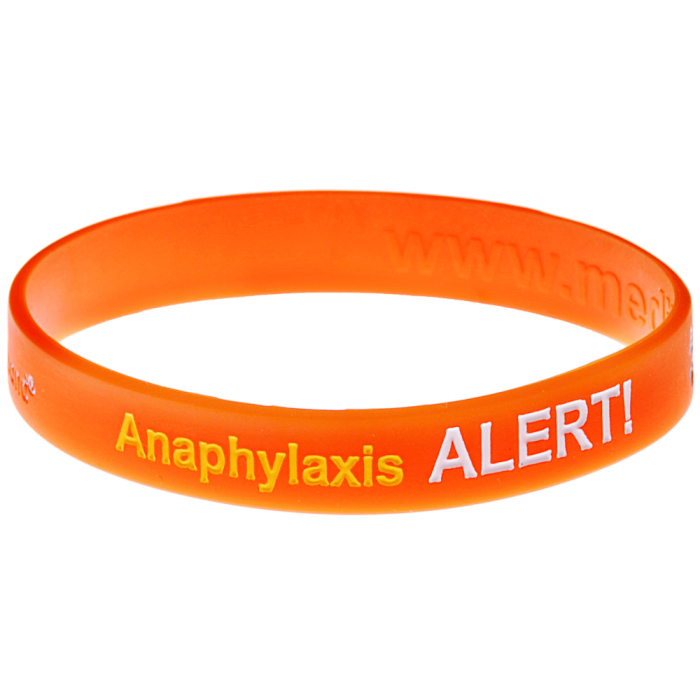
Anaphylaxis Alert Medical Bracelet
€4.82
SKU
B3414
Secure checkout
VISA
Mastercard
Apple Pay
Google Pay
+5 more
Also accepted
AMEX
Afterpay
Zip
Klarna
PayPal
Enjoy life more knowing that you - or your loved one - can get immediate and appropriate treatment should something happen.
4.9 · 31 reviews
Since 2004
Looking for the full anaphylaxis & severe allergy guide?
The Anaphylaxis hub covers EpiPen/Anapen guidance, ASCIA Action Plans, school and travel scenarios, NDIS funding, and the full Mediband allergy product range — pre-printed to custom-engraved.
Protect yourself or a loved one
Enjoy life more knowing that you - or your loved one - can get immediate and appropriate treatment should something happen.
Phrase 1: Alert! Anaphylaxis
Phrase 2: Alert! Anaphylaxis
Colour: Orange
Colour Infill: Yellow & White
What the band says, and why that matters in the first minute
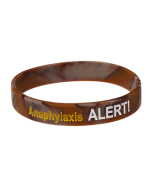
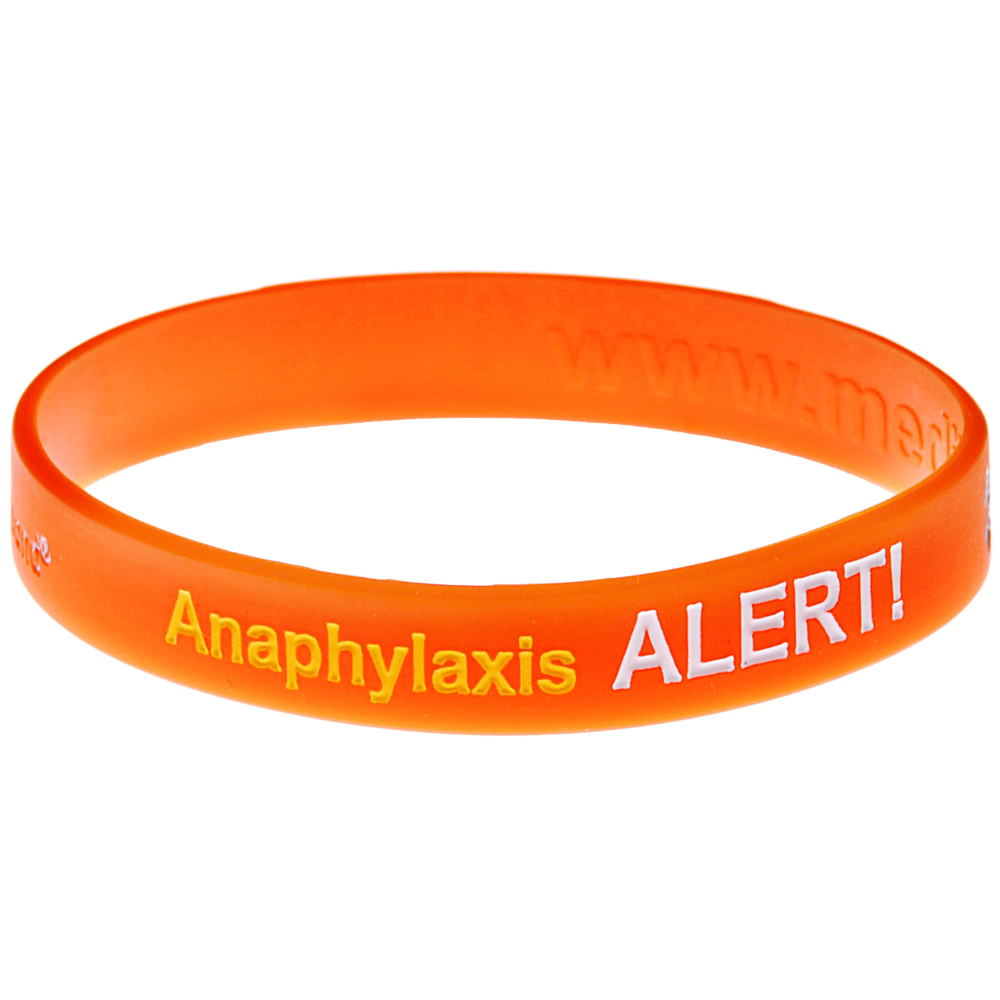
This is a one-piece orange silicone band with the words Anaphylaxis and ALERT! moulded into the surface and colour-filled in yellow and white, so the wording reads against the orange from arm's length rather than needing to be held and squinted at. There is no clasp to undo, no plate to turn over and nothing to scan. Someone who has never seen a medical ID before can read it.
That is the whole design argument. In the first minute of a severe reaction the useful information is not a medical history — it is the single word that tells a bystander, a teacher or a paramedic which emergency they are looking at and therefore which medicine to go looking for. A band that says anaphylaxis moves someone straight to the adrenaline autoinjector in the bag.
Anaphylaxis is a medical emergency — what responders are looking for
The Australasian Society of Clinical Immunology and Allergy (ASCIA) describes anaphylaxis as the most severe type of allergic reaction, states that it should always be treated as a medical emergency, and that it requires immediate treatment with adrenaline — delayed treatment can result in fatal anaphylaxis.
Signs ASCIA lists as potentially life-threatening
- Difficult or noisy breathing
- Swelling of the tongue, or swelling and tightness in the throat
- Wheeze or persistent cough
- Difficulty talking, or a hoarse voice
- Persistent dizziness or collapse
- Pale and floppy, in young children
Any one of those is enough. Several of them — collapse, difficulty talking, an altered voice — are precisely the situations in which the person can no longer explain their own allergy, which is when the band starts doing the work.
What this band does, and what it does not
It signals the emergency. It does not replace an ASCIA Action Plan, a prescribed autoinjector, or a trained adult who knows where that autoinjector is kept. Think of it as the first layer: it buys recognition, and recognition buys the minutes that the plan and the medication then use. If you are weighing up which device the plan calls for, our guide to Anapen versus EpiPen walks through the practical differences.
Which anaphylaxis band is right for you
We make several, and they are not interchangeable — the difference is mostly about whether the wearer will keep it on.
| Band | Wording | Why you would pick it |
|---|---|---|
| This band — orange alert | Fixed: Anaphylaxis ALERT! | Maximum visibility, lowest cost, simplest to replace |
| Camouflage anaphylaxis band | Fixed | Older children and teenagers who will not wear bright orange |
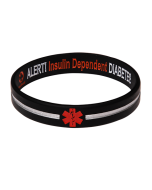
| Reversible write-on band | Fixed one side, writable the other | Adding the specific trigger, a contact number or a dose |
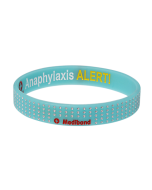
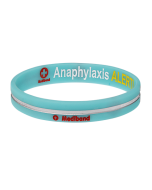
| Designer anaphylaxis band | Fixed | Adults who want it to read as a bracelet, not as equipment |
Pick the one that will actually be worn
The honest advice: the band that gets worn every day beats the band with more information on it that lives in a drawer. If a child is refusing the orange one, change the band rather than arguing about it. If the allergy is to a specific trigger that responders would benefit from knowing — a particular medicine, say — the write-on version earns its place. And if the allergy is to something other than food or stings, the broader allergy-specific range may word it more precisely.
Sizing and fit
Fit is not cosmetic here. A band that slides over the hand gets lost; a band that is tight gets taken off. You want it snug enough to stay above the wrist bone and loose enough to rotate freely and slip a fingertip underneath.
Measure around the wrist with a tape or a strip of paper and compare against our wrist measurement guide, which gives the size bands by circumference. For a growing child, measure again at the start of each school year rather than assuming last year's size still fits — an outgrown band is one of the more common reasons an ID stops being worn.
School, sport and travel
At school, the band works alongside the paperwork rather than instead of it. The action plan and autoinjector live where staff can reach them; the band is what a relief teacher, a canteen volunteer or a parent helper on an excursion can see without having been briefed. That is exactly the gap it is meant to cover — the adult who is present but has not read the file.
In the pool and on the field
For sport and swimming the band is an advantage over an engraved metal ID: it is silicone, so it goes in the pool and the shower and comes out again. Nothing to catch, nothing to corrode, nothing to take off before a game.
Travelling, keep in mind that the word anaphylaxis is recognisable to clinicians in most countries while an abbreviation may not be. If you are heading somewhere a translation would help, a write-on band carrying the trigger in the local language can be worn on the other wrist.
Care and replacement
Wash with warm water and mild soap. Rinse after chlorine, salt water, sunscreen or insect repellent, all of which will dull the colour-fill over time. Let it air dry rather than putting it on a radiator or in a dryer, and keep it away from solvents.
When to replace it
Replace the band when the colour-fill has worn back far enough that the wording no longer reads at a glance, or when the fit has gone loose. These are deliberately inexpensive so that replacing one is a non-decision — most families keep a spare in the bag or the glovebox, and schools that issue them usually hold a few in the sick bay.
Ordering for a school, clinic or group
Single bands can be ordered from this page. If you need a set for a class, a camp, a clinic display or a community programme, tell us roughly how many and what mix of sizes and we will come back with pricing and a date.
Frequently asked questions
Will paramedics actually look at a wristband?
Checking the wrists and neck for medical identification is standard practice in a primary survey, and a band that states the condition in a single word is faster to act on than one that has to be unclipped and read. It is not a guarantee of anything — nothing is — but it costs nothing to be visible.
Can I have my own wording or a phone number on it?
Not on this band — the wording is moulded in and fixed. For a contact number, the specific trigger or a dose, use the reversible write-on version, which has a writable panel on the reverse.
Is it safe for a child with sensitive skin?
It is silicone, with no metal clasp and no nickel. Skin reactions to silicone are uncommon, but if any wristband leaves a mark, take it off, let the skin recover and ask your GP or pharmacist before putting it back on — moisture trapped under a band that is worn too tight is a more frequent cause of irritation than the material itself.
Which wrist should it go on?
Either. What matters more is consistency — pick one wrist and keep it there, so the band goes back on after swimming or sport without anyone having to think about it.
Do we still need the action plan if they are wearing this?
Yes. The band says which emergency; the ASCIA Action Plan says what to do about it, and that is the document a school or workplace is working from. The band is there for the moments before anyone reaches the paperwork.
How long does one last?
With daily wear, most people replace a band when the colour-fill has faded rather than because the silicone has failed. How quickly that happens depends mostly on sun, chlorine and sunscreen. Check it every few months and judge it on whether the word still reads from a metre away.
SKU B3414Manufacturer Mediband
| SKU | B3414 |
|---|---|
| Manufacturer | Mediband |
Shipping
In-stock orders are dispatched the same business day when placed before 12pm AEST, Monday to Friday (excluding public holidays). Orders placed after 12pm AEST, or on weekends and public holidays, are dispatched the next business day.
Express, Regular and Courier delivery estimates are shown at checkout and apply from the dispatch date.
More information about shipment and delivery times can be found on our shipping page.
Returns & guarantee
100% Quality Guarantee. Your satisfaction is our priority. If there is a confirmed quality issue, return the item to us in its original condition and packaging within 14 days of receipt and we will issue a full refund (excluding the original delivery charge) or replace the item.
In-stock items may be exchanged for a different size or colour, provided they are returned as new, unworn and in their original packaging within 14 days of receipt.
Custom and made-to-order items are produced to your specification, so we do not accept returns or exchanges for change of mind, size or colour. Please check your size, colour, spelling and details carefully before ordering. First Aid Kits and Defibrillator Supplies also cannot be returned or exchanged except for a confirmed quality issue.
Please view terms and conditions for further information.
Loading reviews…
Complete your order