
Medical ID bracelets for schools — anaphylaxis, diabetes, epilepsy and autism
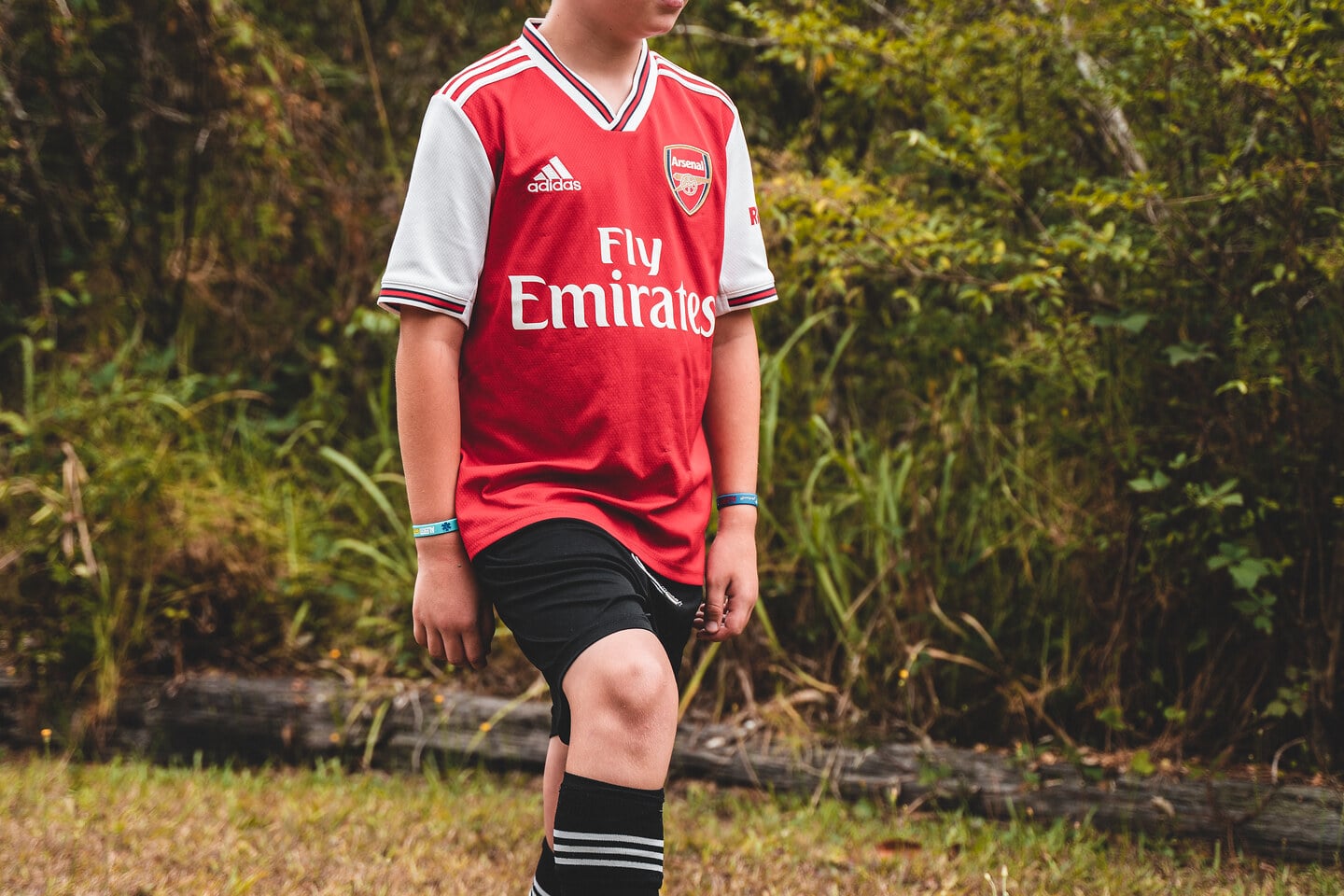
A medical ID for a school student does one job: it surfaces the condition, the rescue medication, and the carer contact in the moments before a teacher, sport coach, or paramedic reaches the student's Action Plan. For a school day that spans classroom, playground, sport, and excursion, the band is the most reliable place to put what an adult on duty needs to know first.
Shop medical ID bracelets for school students →
Designed in Australia
Since 2004
Bulk pricing
For 50+ student orders
Trusted by schools
Across Australia since 2004
22+ years
Designing medical IDs
When a medical ID matters in the school day
Australia has 9,653 schools and 4.1 million enrolled students. Most schools don't have a dedicated nurse on site — an academic estimate puts the national school-nurse workforce at around 1,500. The teachers, SLSOs, sport coaches, and excursion supervisors on duty are the people who see a medical event first. The band's job is to give them the information that turns the next thirty seconds into the right response.
Anaphylaxis. Around 1 in 10 Australian infants and around 1 in 20 children aged 10–14 have a food allergy — the highest reported childhood food-allergy rates in the world. Hospital admissions for severe food-allergy anaphylaxis have risen more than 350% in the past two decades. NSW and Victoria mandate the ASCIA Action Plan for any student at risk of anaphylaxis; QLD has its own procedure requiring the same plan. The band on the student's wrist reads instantly to a stranger, supervising parent on an excursion, or sport coach who doesn't carry the Action Plan in their pocket.
Type 1 diabetes. Around 6,500 Australian children aged 0–14 live with type 1 diabetes, with rates rising sharply across the school years (the 10–14 prevalence is roughly 11 times the 0–4 rate). For students on insulin pumps or CGM, hypoglycaemia at school is the most common medical event — the band's "TYPE 1 DIABETES — INSULIN PUMP" engraving prevents a teacher from missing the cue when the student goes quiet.
Epilepsy. Around 1 in 200 Australian children aged 0–12 lives with epilepsy. A seizure in the playground, lunch hall or on an excursion looks alarming to staff who haven't trained in seizure response. The band's seizure-type flag plus rescue medication note ("EPILEPSY — TONIC-CLONIC — BUCCAL MIDAZOLAM") turns an emergency into a managed event.
Autism and communication differences. A student on the autism spectrum who goes non-speaking under stress, or who elopes from the school grounds, is a common emergency pattern. The W2668 Autism Reversible Write-On band carries the autism flag on the outside and the student's name plus carer contact on a write-on strip on the inside. Around half of school-age children on the spectrum have an elopement history.
"My husband had an anaphylactic reaction to Penicillin — he collapsed and almost died. The Mediband lets Emergency Services know, if he's unconscious, what the problem is." — Cazza, Anaphylaxis Alert Medical ID. The same principle applies in a school playground when a teacher reaches a collapsed student.
Which school situation fits
The right engraving and the right band depend less on the student's diagnosis and more on the situations the band needs to cover. The five groups below describe the most common Mediband school purchases.
Classroom and playground
Daily wear under uniform or visible on the wrist. Lightweight, comfortable, durable for falls and roughhousing. Soft silicone or the W2668 write-on is the practical choice. Engraving priority: condition flag, student name, school class, carer mobile in international format.
Sport and PE
Straight silicone is the right pick — no metal. The custom-engraved silicone, B0777, W2668 and the wider pre-printed silicone range are soft, water-resistant for swimming and hydrotherapy, safe in contact sport, and won't catch on jerseys, ropes or playground equipment. Cricket umpires, swimming coaches and excursion supervisors aren't on the school medical roster — the band has to read for them.
Excursions and incursions
Victorian DET requires schools to send 2 backup adrenaline auto-injectors and the ASCIA Action Plan with any anaphylaxis student on an excursion. The band travels with the student so a relief teacher, museum host, or volunteer parent supervisor has the information in front of them.
Before-school and OSHC
Before-school and after-hours care services operate with different staff to the school day. The band carries the same medical information into a setting where the OSHC staff may not have access to the school's enrolment file. Pre-printed bands (B1792, B2099, W2668, W2677) read instantly without needing a paper handover.
School camps and overnight
Overnight camps add the night-time response layer. The band stays on through sleep — soft silicone or W2668 is the right format. Camp staff are typically external; the band is the link between the student and the home school's medical paperwork.
Recommended Mediband IDs for school students
The six formats below cover the most common purchases for school students — from pre-printed write-on bands for anaphylaxis, diabetes and autism through to bulk packs for whole-class first-aid kits. The right product depends on the student's condition and the situations the band needs to cover.
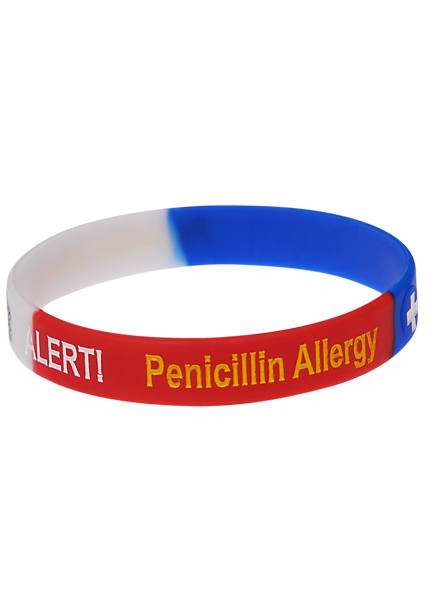
Penicillin Allergy stripe (B0777)
Pre-printed "PENICILLIN ALLERGY" outer with a write-on inside strip for the student's name, class and carer mobile. Red, white and blue silicone, ships from Australian stock. The fastest band to get the allergy flag on a student's wrist before the next excursion or sport day.
Best for: penicillin and drug allergies, first-band school purchases, sport-day spares.
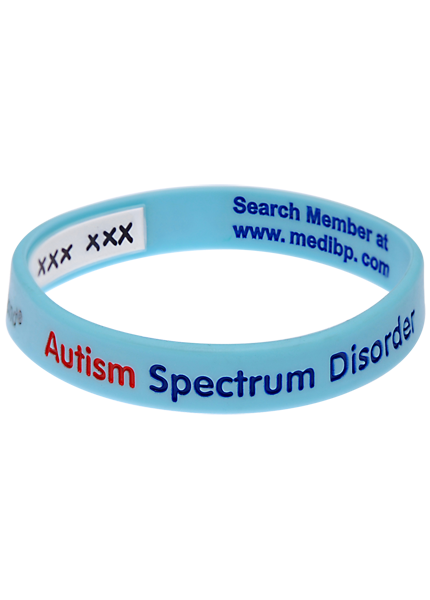
Autism Reversible Write-On (W2668)
Pre-printed "Autism Spectrum Disorder" outer with a write-on inside strip for the student's name, class and carer contact. Aqua silicone, set the inside writing with hot water and it stays put. The default Mediband for students on the autism spectrum at risk of elopement or who go non-speaking under stress.
Best for: students on the autism spectrum, mainstream classroom + SSP, school camps, OSHC.
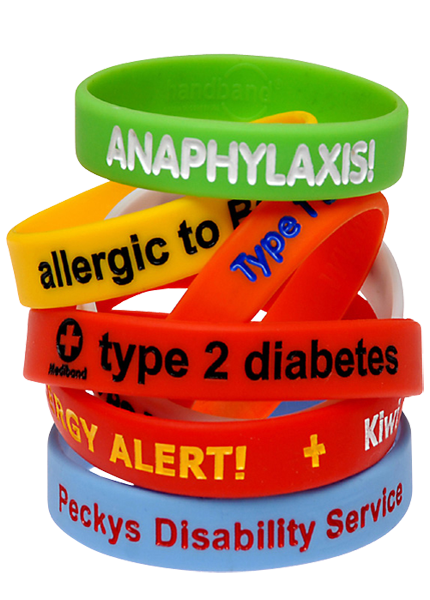
Custom-engraved silicone
Soft silicone strap engraved with the student's condition, any rescue medication, and the carer's mobile in international format. Holds more characters across multiple lines than pre-printed bands — useful when "EPILEPSY", "MIDAZOLAM" and a carer phone all need to fit. Hypoallergenic, comfortable for all-day wear including sleep.
Best for: complex profiles (epilepsy + rescue meds, multi-allergy, T1D + pump), sensory-sensitive wearers, students with two conditions to flag.
Active hybrid
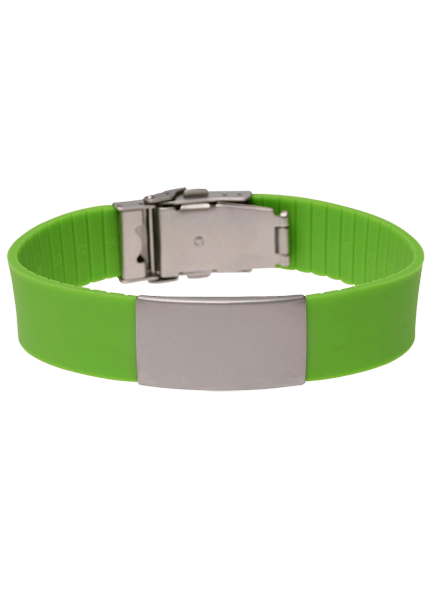
Engraved stainless plate on a silicone strap. A watch-style profile for high-school students who don't want a band that "looks medical" — the stainless plate sits on the wrist like a wearable. Best worn as the daily-wear band off the sport field. For PE, sport and contact games, switch to a straight silicone band — metal doesn't belong in sport.
Best for: high-school students who want a discreet daily band, students transitioning from primary-school silicone to a more wearable-style ID. Pair with a straight silicone band for sport days.
Emotion Bracelet — classroom tool
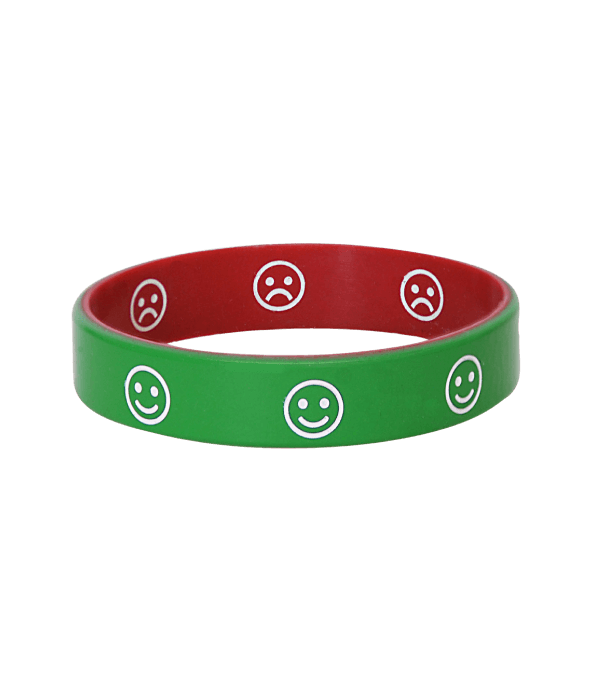
Reversible silicone band with a green smiling face on one side and a red frowning face on the other. Worn on the same wrist as the medical ID, the Emotion Bracelet gives a student who can't or doesn't want to use words a way to signal to a teacher whether they need a quiet space. Especially useful for students on the autism spectrum, students managing anxiety, and any student who goes non-verbal under stress.
Best for: classroom communication, OT and speech sessions, students who pair a medical band with a sensory regulation aid.
Wallet card — for the school file
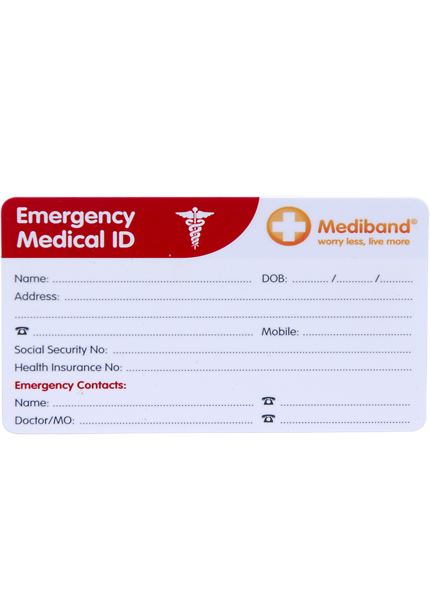
Carries the detail that doesn't fit on a wristband: the student's full Action Plan summary, rescue medication and dose, GP and paediatrician, parent and backup contacts. Lives in the front office's student health file plus an additional copy in the excursion go-bag. Pair with any band.
Best for: the school health file, excursion go-bags, OSHC staff handover, school camp medical packs.
For most schools, the practical combination is a pre-printed or custom-engraved band on the student's wrist (matching their primary condition) plus a wallet card in the school health file plus a duplicate in the excursion go-bag. For students on the autism spectrum or who go non-verbal under stress, add the Emotion Bracelet on the same wrist.
Buying for more than one student? See bulk pricing for 50+ orders, or call 1300 796 401 (AEST).
What to engrave
Every student's medical ID should carry five pieces of information: the primary condition flag, any rescue medication, the student's name and class, a primary carer's mobile in international format (+61 4XX XXX XXX), and (where space allows) the school office number as a secondary. Three engraving examples below cover the most common Mediband customer profiles in this audience.
Example — student at risk of anaphylaxis (peanut + tree nut)
| Front | ANAPHYLAXIS | PEANUT TREE NUT | EPIPEN |
| Back | NAME: AVA P, 5B | ICE Mum +61 412 345 678 |
Example — student with type 1 diabetes on an insulin pump
| Front | TYPE 1 DIABETES | INSULIN PUMP |
| Back | NAME: JACK W, 7A | ICE Dad +61 412 345 678 |
Example — student with epilepsy and rescue midazolam protocol
| Front | EPILEPSY | TONIC-CLONIC | MIDAZOLAM >5 MIN |
| Back | NAME: ISLA C, 3K | ICE Mum +61 412 345 678 |
What NOT to engrave
- Don't engrave a home address. The band is read in public — school playgrounds, sport carnivals, excursions — and it shouldn't tell a finder where the student lives.
- Don't engrave a Medicare number or school student ID number. Those are identity details that don't help in the first 60 seconds of a response.
- Don't engrave "low-functioning" / "high-functioning" labels. The labels are imprecise, divisive in the community, and don't tell a teacher anything useful. Engrave the communication profile instead ("NON-VERBAL", "AAC USER", "SITUATIONAL MUTISM").
- Don't engrave behavioural descriptors that read as warnings ("aggressive", "violent"). They invite the wrong response from staff. For a sensory overload meltdown, "SENSORY OVERLOAD — QUIET SPACE" gets the right response.
- Don't list every clinician on the band. Only the primary carer or emergency contact. GP, paediatrician, OT, speech pathologist belong on the wallet card in the school health file.
Action Plans, policy and procedure
The medical ID supports the Action Plan; it does not replace it. For students at risk of anaphylaxis, the ASCIA Action Plan is the medical document — mandated for any at-risk student in NSW (DEC procedure PD-2004-0034-05) and Victoria (Ministerial Order No. 706), and required in Queensland under the state Department of Education procedure. Schools must obtain a current Action Plan signed by the student's treating medical practitioner before the student attends.
For diabetes, the school typically holds a Diabetes Management Plan from the student's diabetes team (paediatric endocrinologist or diabetes educator). For epilepsy, an Epilepsy Action Plan from the treating neurologist. For asthma, the National Asthma Council Asthma Action Plan.
The National Allergy Council's Best Practice Guidelines for Anaphylaxis Prevention and Management in Schools (updated 2025) is the national framework distributed to over 3,000 Australian schools and CECS services. The Guidelines list seven recommendations: an allergy-aware approach, written policy and individual plans, documentation, emergency response training, staff training, community education, and post-incident management.
The medical ID is the layer that travels with the student: classroom to playground to sport day to excursion. The Action Plan stays in the school health file; the wallet card carries a summary into the excursion go-bag.
Excursions, camps and off-site activities
Off-site activities multiply the medical-ID's value. The relief teacher, the museum host, the volunteer parent supervisor, the camp cook — none of them have access to the school's enrolment file. Victorian DET requires schools to send at least two backup adrenaline auto-injectors and a copy of the ASCIA Action Plan on any excursion involving a student at risk of anaphylaxis; the wider Australian school practice mirrors this.
For a school camp, the band stays on through swimming, sleep, and night-time bathroom trips. Soft silicone (W2668, B0777, custom) is the right material; stainless steel doesn't suit overnight wear for younger children.
For sport carnivals and inter-school competition, straight silicone is the right material — soft, water-resistant for swimming, safe in contact games, and no metal to catch on jerseys, ropes or playground equipment. The custom-engraved silicone holds the condition flag and rescue medication on multiple lines; pre-printed silicone (W2668, B0777, W2677) suits class-wide ordering for known conditions.
Three practical engraving notes for off-site activities:
- Put the carer's mobile in international format. +61 4XX XXX XXX works from any phone, including the school's landline when the school office is calling from interstate or overseas on a camp.
- Include the rescue medication. "EPIPEN" or "BUCCAL MIDAZOLAM" tells a museum first-aid officer where to look in the student's go-bag.
- Add the school office number on the back if space allows. A second contact prevents a response stalling on a single uncontactable carer phone.
Bulk ordering for school first-aid kits and class packs
Schools, P&C federations, before- and after-school care services, OSHC programmes, and sport associations order Mediband bands in bulk for several reasons:
- Class-wide ordering for a year level where multiple students share a condition (anaphylaxis, T1D, epilepsy).
- First-aid kit stocking — classrooms and excursion kits hold spare blank write-on bands for newly diagnosed students or temporary replacement bands.
- Sport-day and carnival packs — bands worn during sport carnivals, swimming carnivals, and inter-school athletics events where the at-risk student may be among hundreds.
- Awareness and fundraising — P&C federations and school charity events often pair the medical-ID range with a school-branded awareness wristband.
For schools ordering 50+ bands, Mediband offers tiered bulk pricing on pre-printed silicone (W2668, B0777, W2677), custom-engraved silicone, and write-on bands. See the bulk orders hub for tier breakdowns and quote requests, or call 1300 796 401 (AEST).
Customer reviews
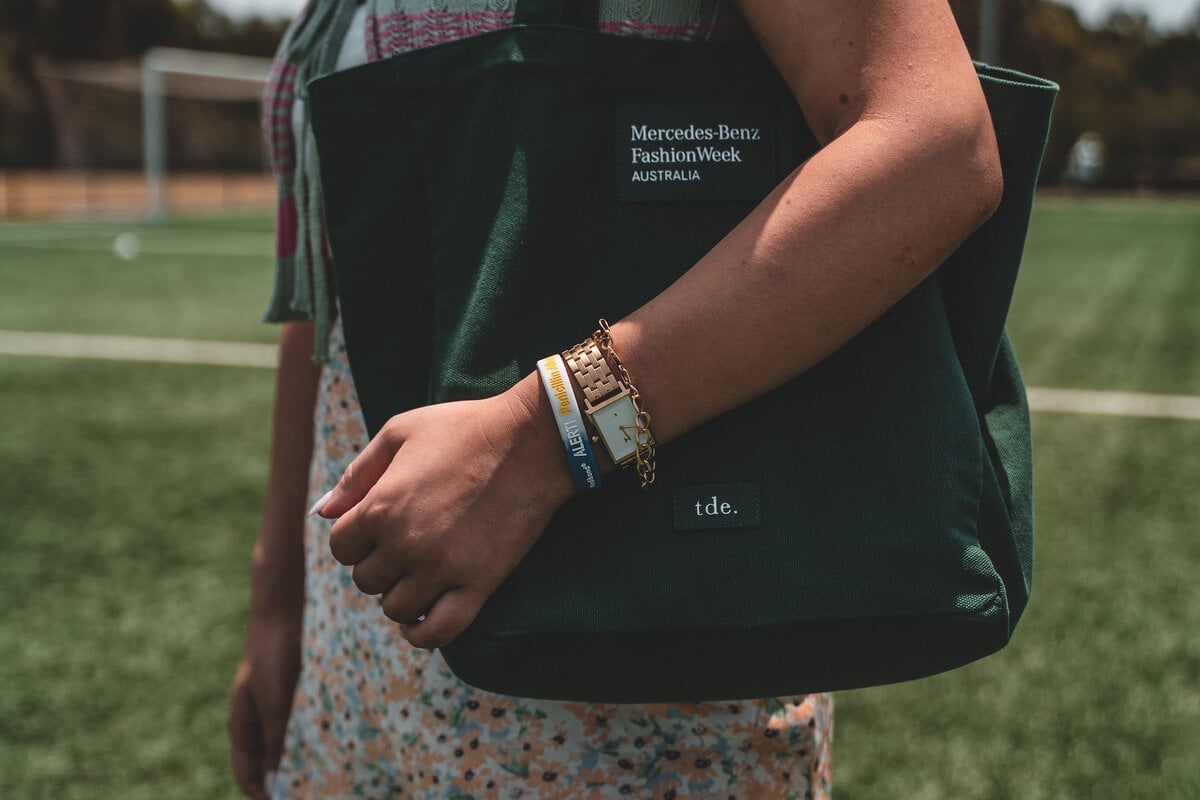
★★★★★ Three verified reviews from Mediband customers managing the situations this hub covers — an emergency identification by hospital staff, an anaphylaxis event in a partner, and a daily school-age purchase.
★★★★★
Saved my life.
"Saved my life. I passed out one night and woke up in hospital — the medical staff saw the band and didn't give me anything Penicillin based."
Anonymous — Penicillin Allergy Medical Bracelet — New Zealand
★★★★★
Emergency Services know.
"My husband had an anaphylactic reaction to Penicillin — he collapsed and almost died. The Mediband lets Emergency Services know, if he's unconscious, what the problem is."
Cazza — Anaphylaxis Alert Camouflage Medical ID
★★★★★
Autism.
"Great for kid who has bracelet."
Pamela G., Australia — Autism Reversible Write-On (W2668) — 22 Nov 2024
Reviews verified via the Mediband reviews programme on live product pages. We publish first names and a band reference only; reviewer details beyond this are not retained on the public site.
Why Mediband for schools
Mediband has been designing medical IDs in Australia since 2004. We supply schools, P&C federations, OSHC providers, sport associations, peak bodies and families across Australia, New Zealand, Ireland, the United Kingdom, and worldwide. Every band is engraved to order, drawing on more than 22 years of working alongside students, their carers, and the clinicians around them. Mediband products are used by hospital systems including Boston Children's Hospital and LA County Hospital.
Related condition hubs
School students arrive with a wide range of conditions. The hubs below cover each in depth, including the engraving rules, the funding pathways, and the cross-condition considerations relevant to the school day.
Anaphylaxis
Food, insect, drug and latex allergy →
Diabetes
Type 1, Type 2 and pump users →
Epilepsy
Seizure type, rescue medication, VNS device →
Autism
Wandering, communication, sensory profile →
Frequently asked questions
Does the medical ID replace the school's ASCIA Action Plan?
No. The ASCIA Action Plan for Anaphylaxis is the medical document that schools in NSW, Victoria and Queensland are required to obtain for any student at risk of anaphylaxis — signed by the student's treating medical practitioner. The medical ID supports the Action Plan by surfacing the essential information on the student's wrist for situations where the Action Plan isn't in reach — playground, sport, excursion, OSHC.
My school wants to order bands for 30 students — what's the process?
For 50+ band orders Mediband offers tiered bulk pricing on pre-printed silicone (W2668, B0777, W2677), custom-engraved silicone, and write-on bands. The process: tell us the breakdown (e.g. 15 x B0777 Penicillin Allergy, 8 x W2668 Autism, 7 x custom-engraved with student-specific engraving), the despatch deadline, and the school address. We confirm the quote, you raise a purchase order, we ship from Australian stock or made-to-order Australia within 10–14 business days. See the bulk orders hub or call 1300 796 401 (AEST).
What if the student takes the band off?
For younger primary students, fabric ID labels sewn or ironed into the inside of school uniforms provide redundancy on the days the band is off (sport carnivals, swimming days, PE). For students with sensory aversion to wrist-worn items, an engraved shoe tag or backpack clip works. Mediband supplies fabric labels, shoe tags, and backpack clips alongside the wristband range — the information stays the same, the location moves to suit the student.
Are the bands waterproof for swimming carnivals?
Yes. Straight silicone bands (W2668, W2677, B0777, B1792, custom-engraved silicone) are the recommended sport and PE format — water-resistant for swimming and hydrotherapy, safe in contact sport, no metal to catch on jerseys, ropes or playground equipment. We don't recommend metal on the wrist during PE, sport or swimming carnivals. The Active hybrid (stainless plate on a silicone strap) is rated for daily water exposure but is a daily-wear band rather than a sport-day band; switch to a straight silicone band for sport days.
Can the P&C order the bands as a group purchase?
Yes. P&C federations, individual school P&C associations, and sport association committees regularly group-order bands for students at risk of anaphylaxis, T1D, or epilepsy, or for whole-class awareness purposes. The order goes via the P&C as the purchasing entity; the individual student engravings come back to the school office for distribution. Bulk pricing applies for 50+ band orders.
How quickly can the bands be delivered before a school camp or sport day?
Pre-printed bands (W2668 Autism, B0777 Penicillin, W2677 Dementia, B1792 Blood Thinners and the wider allergy range) ship from Australian stock same business day when ordered before midday AEST. Custom-engraved bands — with student-specific name, class and rescue medication — are made to order in Australia and ship within 10–14 business days. Need it faster for a camp or excursion deadline? Call 1300 796 401 during business hours AEST and we'll work the quickest path.
Is there guidance for OSHC and before-school care staff on the medical ID?
OSHC and before-school care operate with different staffing to the school day. The band carries the same information into a setting where OSHC staff may not have access to the school's enrolment file. Pre-printed bands (W2668, B0777, W2677, B1792) read instantly without needing a paper handover. The wallet card travels in the OSHC daily go-bag. Many OSHC services have adopted Mediband bands as standard issue for enrolled children with documented conditions.
Set up your school
Order single bands for individual students or bulk packs of 50+ for class-wide, OSHC, or sport-day stocking. Custom-engraved silicone, stainless steel, Active hybrid, the W2668 Autism write-on, B0777 Penicillin Allergy, W2677 Dementia Alert, and wallet cards — with bulk pricing on volume orders.
Or call 1300 796 401 — business hours AEST.
About this page: Mediband has been designing medical IDs in Australia since 2004. Statistics on this page are sourced from ACARA (National Report on Schooling 2024), ASCIA, AIHW, the National Allergy Council Best Practice Guidelines 2025, Victorian DET, and NSW DEC policy documents — full citations available on request. Policy references reflect the position at May 2026. The engraving examples reflect common practice; they are not medical advice and should not replace guidance from the student's treating clinician or the school's medical practitioner.