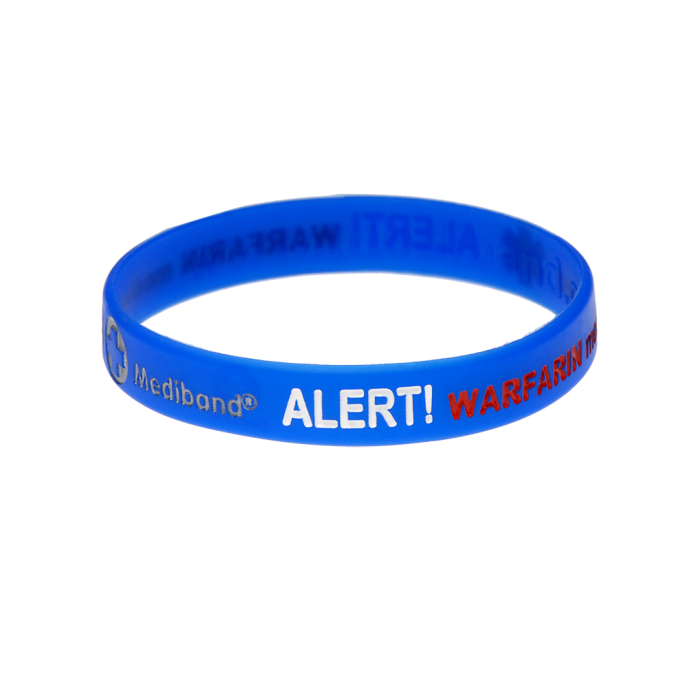
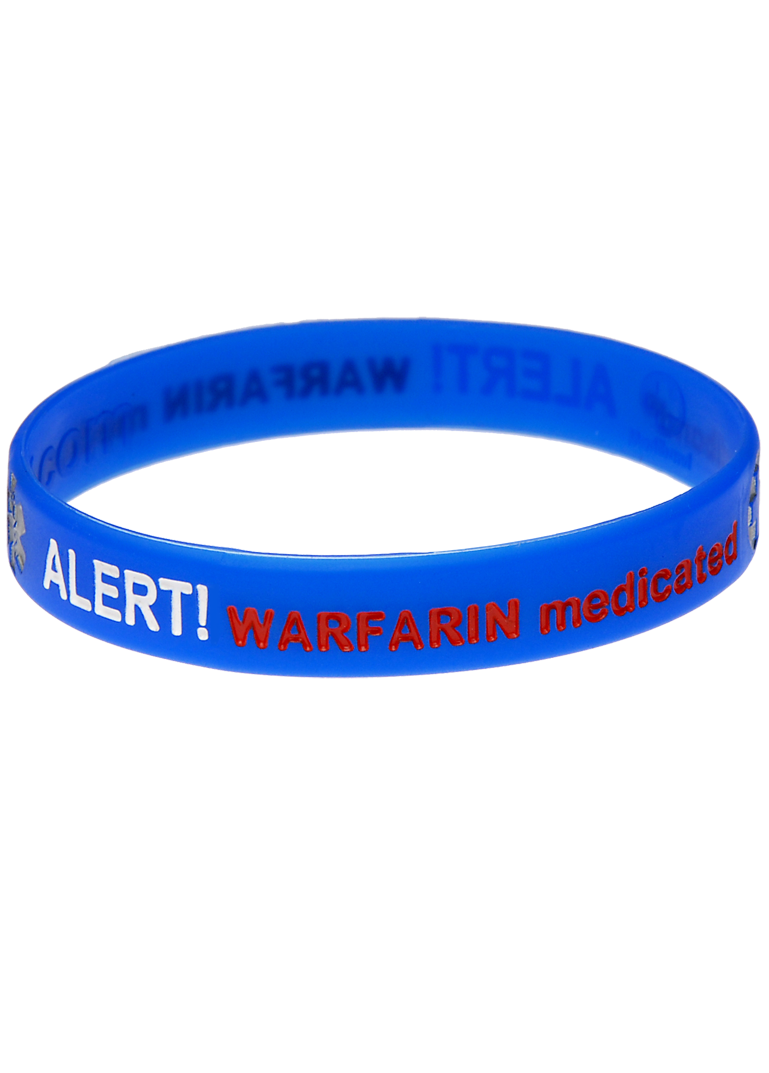
Warfarin Medicated Medical Bracelet
EUR 4.82
SKU
B0326
Secure checkout
VISA
Mastercard
Apple Pay
Google Pay
+5 more
Also accepted
AMEX
Afterpay
Zip
Klarna
PayPal
Enjoy life more knowing that you - or your loved one - can get immediate and appropriate treatment should something happen.
4.9 · 79 reviews
Since 2004
Warfarin Medical Alert Bracelet — Anticoagulant ID
The Warfarin Medical ID Bracelet is essential safety wear for anyone on warfarin (Coumadin, Marevan), the most widely prescribed oral anticoagulant in Australia. In an accident, trauma or unconscious admission, paramedics need to know in seconds that you're warfarinised — it determines whether to administer vitamin K reversal, how to manage any bleeding, and which medications can be co-administered.
Around 100,000 Australians take warfarin daily for atrial fibrillation, mechanical heart valves, deep vein thrombosis prevention, or post-stroke care. For every one of them, this bracelet bridges the critical gap between the scene and your medication record.
Why a Visible Warfarin Bracelet Matters
Warfarin's bleeding risk changes every emergency decision:
- Trauma + head injury — immediate vitamin K + prothrombin complex concentrate if INR elevated
- Surgical intervention — reversal protocols + delayed procedure if elective
- GI bleed / haemorrhagic stroke — fast-track reversal vs slower workup
- Drug interactions — avoid NSAIDs, certain antibiotics, certain antifungals
- INR monitoring — ED will check INR on arrival, every 6 hours after reversal
Without the bracelet, ED staff may delay reversal until past medications can be confirmed — minutes that matter in active bleeding.
What This Bracelet Shows
This is a ready-to-wear, pre-printed alert band. The alert wording and the Star of Life symbol are permanently printed and fixed, so paramedics can identify it at a glance. This band has no engraving and no write-on panel, so you do not add your own text to it.
If you need personal details on your ID — your name, an exact medication and dose, or an emergency contact — choose a Mediband Custom ID. The Custom ID range is made to order with your own details (engraved stainless steel and gold, or custom-printed silicone), and our write-on bands let you add details by hand.
Who Should Wear One
- Anyone on long-term warfarin (3+ months)
- Patients with mechanical heart valves (lifelong warfarin)
- Atrial fibrillation patients on warfarin
- Post-DVT / pulmonary embolism patients
- Stroke prevention patients (especially with antiphospholipid syndrome)
- Patients on bridging warfarin therapy
Warfarin vs DOACs — Why Bracelets Still Matter
Even with newer direct oral anticoagulants (DOACs — apixaban, rivaroxaban, dabigatran, edoxaban) gaining popularity, around 1 in 3 Australian anticoagulant users still take warfarin — especially for mechanical valves and certain renal patients where DOACs aren't suitable. The Warfarin bracelet specifically helps ED choose the right reversal agent (vitamin K + PCC) rather than the DOAC-specific reversals (andexanet, idarucizumab).
How Paramedics Read the Bracelet
Bright blue silicone + Star of Life makes "Warfarin" visible in seconds. Australian paramedic protocol on every trauma or unconscious patient call includes a medical ID check; the bracelet immediately upgrades bleeding management to high-priority and starts the reversal workflow.
Care & Sizing
Medical-grade silicone, fully waterproof, dishwasher-safe, 4-5 year lifespan. Available S/M/L/XL. Soft, smooth band suits thin wrists and elderly skin.
Related Mediband Medical Alert Bracelets
Why a band that names the medication
A band reading "blood thinners" tells a clinician the category. One reading warfarin tells them which drug, and the anticoagulants are not managed identically. That specificity is the whole reason this band exists rather than a generic one.
| Band | States | Choose when |
|---|---|---|
| Warfarin (this band) | The medication by name | You are on warfarin long term |
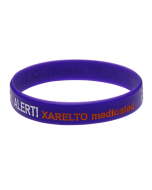
| Xarelto | That medication by name | You are on rivaroxaban |
| Reversible anticoagulant | The drug class, discreetly | Appearance is why an ID gets left off |
| Custom engraved | Whatever you specify | Your combination is not a standard band |
Choose the band that matches your current prescription. If you change medication, replace the band — an out-of-date name is read as current, which is worse than a generic alert.
What to add in the engraving
Your name and a contact
The medication is already on the band front, so the engraving carries identification and a number for someone who knows your history and prescriber.
Keep your monitoring record with you
People on warfarin usually have regular monitoring, and the results live in a book or app rather than on a wrist. Carry that record, keep it in a wallet card or on My Health Record, and let the band point to it.
Mention other conditions where relevant
Many people on anticoagulants have a cardiac history too — see the stents alert band. If several facts matter equally, a custom engraved band lets you set the wording rather than choosing between standard alerts.
For information about anticoagulant medicines, Healthdirect Australia is the reference to use. Anything about your own dose, monitoring or diet is a question for your prescriber, pharmacist or anticoagulation clinic — we make identification products, not clinical recommendations.
Wearing it
No routine reason to remove it
Silicone is waterproof, light and breakaway-safe, so it stays on through showering, swimming and sport. The commonest failure of a medical ID is being taken off for one of those and not put back.
Before procedures and dental work
Anticoagulant use is relevant to dentists, surgeons and anyone taking blood. The band is a prompt in those settings as much as in emergencies — it means the conversation happens without you having to remember to start it. That matters most with clinicians you see rarely, or in a practice where your regular records are not in front of whoever is treating you that day.
Keeping it legible
The text is colour-filled into the silicone below the wear surface, so it does not rub off. What reduces legibility is grime in the recess; an occasional wash with soap and water keeps it clear.
Ordering
Order a spare at the same time. A lost or damaged band leaves you unidentified until a replacement arrives, and for an anticoagulant that is exactly the gap the band exists to close. Browse the full medical alert range or the write-on styles if your details change often.
Anticoagulation clinics, aged-care homes and NDIS providers ordering in quantity with per-wearer engraving can do so as a single order — request a bulk quote.
Warfarin bracelet FAQs
Why name warfarin rather than just blood thinners?
Because the anticoagulants are not managed identically. Naming the specific medication gives a clinician more to work with than the drug class alone.
What should I engrave?
Your name and an emergency contact number. The medication is already stated on the band, so the engraving is for identification and a route to someone who knows your history.
What if my medication changes?
Replace the band with one naming the new medication, or move to a generic anticoagulant band. Outdated information on a wrist is read as current.
Will the text wear off?
No. It is colour-filled into the silicone below the wear surface, so daily wear, showering and sport do not remove it. Occasional cleaning keeps it legible.
Should I wear it for dental appointments and procedures?
Keeping it on is sensible. Anticoagulant use is relevant to dentists, surgeons and anyone taking blood, and the band prompts the conversation without relying on memory.
Can I wear it all the time?
Yes, and that is how it works. It is waterproof and breakaway-safe, so there is no routine reason to take it off.
SKU B0326Manufacturer Mediband
| SKU | B0326 |
|---|---|
| Manufacturer | Mediband |
Shipping
In-stock orders are dispatched the same business day when placed before 12pm AEST, Monday to Friday (excluding public holidays). Orders placed after 12pm AEST, or on weekends and public holidays, are dispatched the next business day.
Express, Regular and Courier delivery estimates are shown at checkout and apply from the dispatch date.
More information about shipment and delivery times can be found on our shipping page.
Returns & guarantee
100% Quality Guarantee. Your satisfaction is our priority. If there is a confirmed quality issue, return the item to us in its original condition and packaging within 14 days of receipt and we will issue a full refund (excluding the original delivery charge) or replace the item.
In-stock items may be exchanged for a different size or colour, provided they are returned as new, unworn and in their original packaging within 14 days of receipt.
Custom and made-to-order items are produced to your specification, so we do not accept returns or exchanges for change of mind, size or colour. Please check your size, colour, spelling and details carefully before ordering. First Aid Kits and Defibrillator Supplies also cannot be returned or exchanged except for a confirmed quality issue.
Please view terms and conditions for further information.
Loading reviews…
Frequently Asked Questions
Quick answers from the Mediband team
What is a warfarin bracelet?
A medical alert bracelet engraved with 'Warfarin' (Coumadin/Marevan) that tells paramedics and ED clinicians the wearer is on long-term anticoagulation. It triggers immediate vitamin K reversal protocols in active bleeding or trauma.
Why does Warfarin need its own bracelet vs a generic anticoagulant one?
The reversal agents differ: warfarin reverses with vitamin K + prothrombin complex concentrate (PCC), while DOACs (apixaban, rivaroxaban, dabigatran) need their own specific reversal agents (andexanet alfa, idarucizumab). Specifying 'Warfarin' speeds up the right treatment.
Can I add my name or medication to this band?
This band is pre-printed with its alert wording fixed, so it cannot be engraved or written on. If you need a name, a specific medication and dose, or an emergency contact on your ID, choose a Mediband Custom ID, made to order with your own text, or a write-on band you fill in by hand.
Should I wear it during pregnancy?
Warfarin is contraindicated in pregnancy and replaced with LMWH (enoxaparin/Clexane) — so update the bracelet to 'Enoxaparin / Clexane' for the duration. Discuss the change with your obstetrician and haematologist.
What if I switch from warfarin to a DOAC?
Get a new bracelet immediately. Old engraved warfarin info on the bracelet during a DOAC emergency could lead to vitamin K reversal that doesn't work, delaying correct treatment. The Mediband Anticoagulant Alert bracelet covers all DOAC variants.
Should I wear my warfarin bracelet all the time?
Yes - wear it around the clock, including while you sleep. Emergencies are unpredictable, and paramedics check the wrist first when you cannot speak for yourself.
Can I wear the warfarin bracelet swimming or in the shower?
Yes. The silicone band is waterproof and sweat-resistant, so you can keep it on in the pool, the shower and the gym without removing your alert.
Should I engrave "Warfarin" or the brand name (Coumadin / Marevan)?
Engrave the generic name "Warfarin" - it is recognised by clinicians everywhere. Add "blood thinner" so lay responders understand, and include the brand (Coumadin or Marevan) if space allows.
Complete your order