

Medical ID bracelets for seniors — for older adults living at home and in aged care
A medical ID for an older adult does two jobs: it identifies the wearer and surfaces the conditions, medications and contacts that matter in an emergency. For someone managing multiple conditions, on a blood thinner, or living with the early stages of dementia, the band is the most reliable place to put what a paramedic or stranger needs to know first.
Shop medical ID bracelets for older adults →
Designed in Australia
Since 2004
Seniors Card 15% off*
Code SENIORS, all year. *Terms
NDIS-registered
For younger-onset eligibility
22+ years
Designing medical IDs
When a medical ID matters for an older adult
Roughly one in six Australians — about 4.4 million people — are aged 65 and over, and the population aged 85 and over is projected to roughly double over the next 25 years. The reasons families and older adults reach for a medical ID converge on four patterns.
Multiple conditions stacked. Around 80% of Australians aged 65 and over have at least one chronic health condition, and 28% live with three or more. The band is the most reliable place to surface the combination at a glance — "ATRIAL FIB — WARFARIN — TYPE 2 DIABETES" tells a paramedic the three things that change their treatment immediately.
On a blood thinner. The majority of Australians on oral anticoagulant therapy (warfarin, apixaban, dabigatran, rivaroxaban) are aged 65 and over. A fall, a road accident, or surgery on an anticoagulated wearer is a different clinical event — the band's anticoagulant flag prevents a paramedic from missing the bleeding risk.
Falls and emergency presentations. Approximately one in three Australians aged 65 and over experiences at least one fall each year, and falls account for around 77% of injury hospitalisations in this age group. When the wearer arrives at hospital without a family member, the band carries the medication list and the GP contact that the ED needs in the first 60 seconds.
Cognitive change and wandering. Around 8.4% of Australians aged 65 and over — rising to 29.2% of those aged 85 and over — live with dementia. For someone in the early stages, the band carries the diagnosis, the wearer's name, and the primary carer's mobile. For someone further along, it shortens the time between a stranger noticing and the carer's phone ringing.
"100 percent of the medical personnel I've come in contact with have noticed this bracelet. I wear it 24/7 to speak for me when I can't speak for myself." — Michael S., Pacemaker Recipient Bracelet, 10+ year Mediband customer.
Which situation fits
There is no single older-adult audience. The right engraving depends on the wearer's living situation, current conditions, and who would be called first in an emergency. The five groups below describe the most common Mediband customers in this audience.
Living independently
Active, generally well, possibly on one or two long-term medications. Engraving priority: any high-stakes conditions (anticoagulant, severe allergy, cardiac device), GP or family contact in international format, NOK as backup.
Living with a partner
The partner may not always be the right call — they may be elsewhere, sleeping deeply, or themselves managing memory loss. Engraving priority: condition flags + a backup contact (adult child or close friend) beyond the partner.
On a Support at Home package
Receiving in-home aged care under the Support at Home program (the scheme that replaced Home Care Packages from 1 November 2025). Engraving priority: condition flags, provider after-hours line, family contact.
Early-stage cognitive change
Mild cognitive impairment or early-stage dementia, still living at home with carer support. Engraving priority: dementia flag + the wearer's name + carer's mobile. The name on the band is critical — first-responders use it to settle the wearer.
In supported residential aged care
Residential aged care, RACF or memory-support unit. The band travels with the wearer to medical appointments, hospital transfers, and family outings — situations where the facility file isn't in reach. Engraving priority: condition flags, RACF after-hours, family contact.
Recommended Mediband IDs for older adults
The six formats below cover the most common purchases for older adults — from a discreet stainless band for a still-active wearer through to a pre-printed write-on band for someone living with dementia. The right product depends on the wearer's situation, not their age.
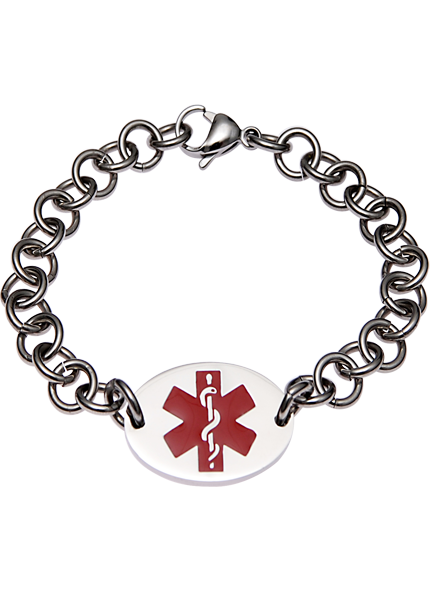
Custom stainless steel
Engraved stainless plate, subtle for daily and dress wear, sturdy for long-term life. Carries the core engraving — conditions, carer contact, and the wearer's name. Many older adults prefer stainless because it reads as a watch or fashion piece, not as "medical".
Best for: living independently, dress and professional contexts, long-term daily wear.
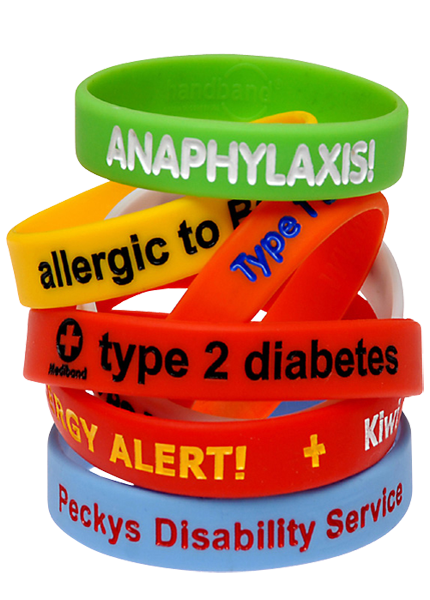
Custom-engraved silicone
Soft silicone strap engraved with conditions, medications, and carer contact. Holds more characters across multiple lines than pre-printed bands — useful when atrial fibrillation, anticoagulant, diabetes and a carer phone all need to fit. Hypoallergenic, water-resistant, low sensory load.
Best for: complex multi-condition profiles, sensory-sensitive wearers, all-day wear including sleep.
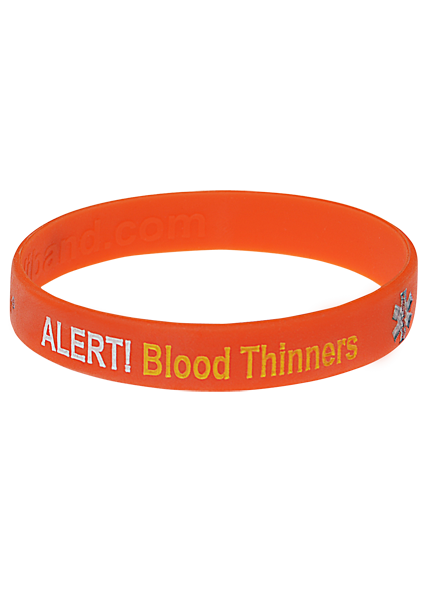
Blood Thinners write-on (B1792)
Pre-printed "BLOOD THINNERS — HIGH RISK OF BLEEDING" outer with a write-on strip on the inside for member ID, medication name (warfarin, apixaban, dabigatran, rivaroxaban) and emergency contact. Orange silicone, ships from Australian stock. The fastest, cheapest band to get the anticoagulant flag on a wrist this week.
Best for: any older adult on an oral anticoagulant, first-band purchases, fast turnaround.
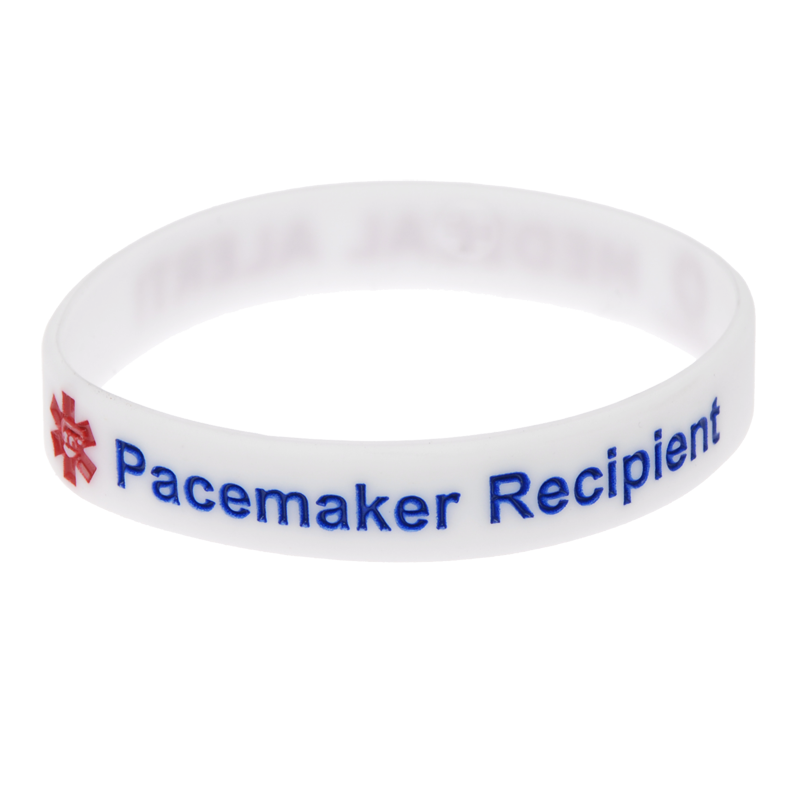
Pacemaker write-on (B2099)
Pre-printed "PACEMAKER RECIPIENT" outer with a write-on inside strip for device type, MRI-conditional status, and emergency contact. White silicone, ships from Australian stock. Visible to a paramedic and to MRI screening staff in the same band.
Best for: wearers with a pacemaker, ICD, or CRT-D — about 8% of Australians 65+ have a cardiac device or are on long-term cardiac medication.
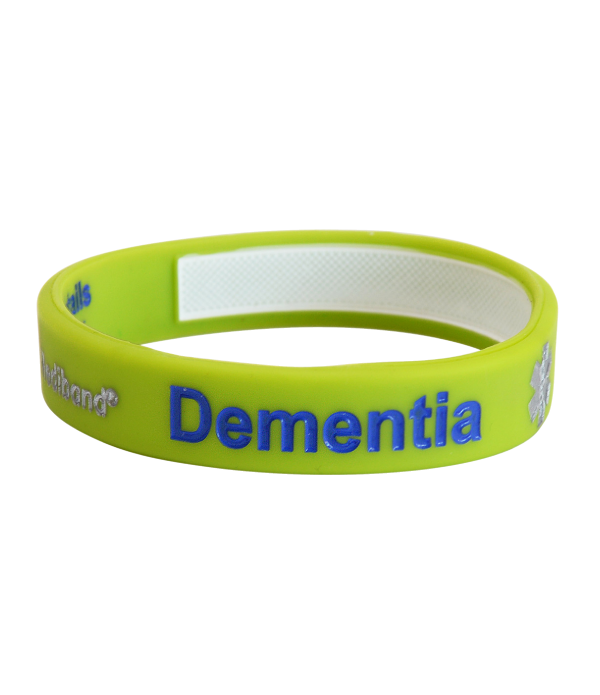
Dementia Alert write-on (W2677)
Pre-printed "DEMENTIA ALERT" outer in high-visibility neon green with an inside write-on strip for the wearer's name and primary carer mobile. Set the inside writing with hot water and it stays put. The fastest band to get the dementia flag on a wrist for someone newly diagnosed.
Best for: early-stage dementia, wandering and elopement risk, supported residential transitions.
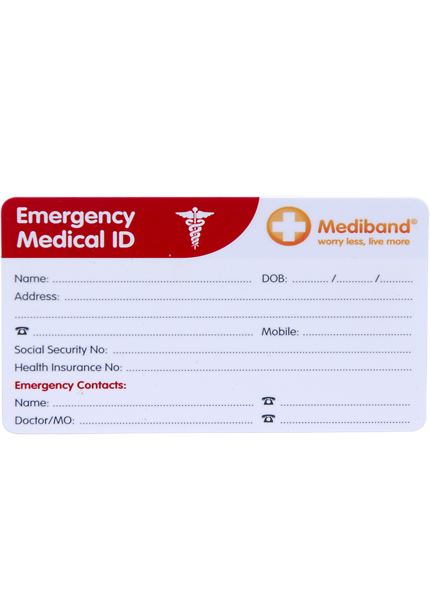
Wallet card — full profile
Carries the detail that doesn't fit on a wristband: full medication list, GP, geriatrician, cardiologist, allergies, Advance Care Directive location, NOK and backup contact. Pair with any band.
Best for: any older adult on three or more medications, transitions between home and hospital, dementia profiles, residential aged care.
For most older adults, the practical combination is a custom stainless steel or custom silicone band (carrying the two or three highest-stakes condition flags) plus a wallet card (carrying the full medication list and GP contact). For wearers in early-stage dementia, swap the band for the W2677 pre-printed Dementia Alert and keep the wallet card.
Prefer to talk it through first? Call 1300 796 401 during business hours AEST — or just shop the full range online →
What to engrave
Every medical ID for an older adult should carry five pieces of information: the highest-stakes condition (or up to three if more than one applies), any anticoagulant or device flag, the wearer's name, a primary carer or GP contact in international format (+61 4XX XXX XXX), and an NOK backup. Three engraving examples below cover the most common Mediband customer profiles in this audience.
Example — older adult on warfarin with atrial fibrillation and type 2 diabetes
| Front | ATRIAL FIB | WARFARIN | TYPE 2 DIABETES |
| Back | JEAN HARRIS | ICE Daughter +61 412 345 678 |
Example — older adult living alone with severe penicillin allergy and a heart valve replacement
| Front | PENICILLIN ALLERGY | MECHANICAL HEART VALVE |
| Back | BRIAN LEE | GP Dr Patel 02 9XXX XXXX | Son +61 412 345 678 |
Example — older adult with early-stage dementia, living at home with carer support
| Front | DEMENTIA | NAME: MARGARET S |
| Back | ICE Husband +61 412 345 678 | Daughter +61 412 987 654 |
What NOT to engrave
- Don't engrave a full address. The band is read in public; it shouldn't tell a finder where the wearer lives.
- Don't engrave a Medicare or Aged Care client number. Identity details don't help in the first 60 seconds of a response.
- Don't engrave every medication. Only the highest-stakes one (anticoagulant, insulin, opioid patch). The wallet card carries the full list.
- Don't engrave "DNR" without an Advance Care Directive cross-reference. "DNR" on a band alone is not a legally enforceable instruction in Australia; engrave "ACD ON FILE — GP" so a clinician knows where the directive lives.
- Don't list every clinician on the band. Only the primary carer or emergency contact goes on the band. GP, geriatrician, cardiologist and the Support at Home provider belong on the wallet card.
Multiple conditions and medication lists
Multimorbidity is the defining feature of medical IDs for older adults. AIHW data show 79% of Australians aged 85 and over live with two or more chronic conditions; 28% of those 65 and over manage three or more concurrently. The clinical implication is consistent: an emergency response that treats one condition without knowing about the others can do real harm. Anticoagulant + a fall + an assumed bleed-stop intervention is the textbook example.
The medical ID can't hold a full polypharmacy list. What it can hold is the two or three highest-stakes conditions on the front of the band, and a clear pointer to where the full list lives — usually a wallet card kept with the wearer, with the GP and the Support at Home provider listed on it. For older adults on five or more medications (around 40% of the 65+ population), the wallet card is not optional.
Australian Prescriber and the Australian Commission on Safety and Quality in Health Care both highlight medication-related harm at transitions of care — home to hospital, hospital to home, hospital to residential aged care. The band's job is to make sure the receiving clinician sees the most important medication-relevant facts before they prescribe.
Living alone — what the band changes
For an older adult who lives alone, the band carries the medical history the wearer would normally relay verbally to a paramedic. If a fall leaves the wearer disoriented, semi-conscious, or unable to answer questions, the band fills the gap.
For an older adult living with a partner, the same logic applies in a different scenario: the partner may not be at home, may be sleeping, may themselves be living with memory loss, or may be the one who has been hurt. The band's contact field should list someone beyond the partner — typically an adult child, a close friend, or the Support at Home provider's after-hours line — so a response doesn't stall on a single uncontactable number.
For a wearer in supported residential aged care, the band travels — to the hospital appointment, to the family Christmas, to the GP. The facility file stays at the facility. The wearer's most critical medical facts need to ride with them.
Practical combinations for older adults
The band rarely sits alone for an older wearer. The combinations below cover the three most common living situations in this audience.
For an older adult living independently, the practical combination is:
- A custom stainless steel band carrying conditions, anticoagulant flag (if applicable), and primary contact.
- A wallet card carrying the full medication list, GP, specialists, and Advance Care Directive location.
- An ICE entry in the wearer's mobile phone matching the band's contact.
- A printed one-page profile on the fridge for paramedics arriving at the home.
For an older adult on a Support at Home package or receiving CHSP services:
- A custom silicone band carrying the condition stack and the Support at Home provider's after-hours number as the primary contact.
- A wallet card with GP, geriatrician, allied health team, and family backup contact.
- A laminated provider-issued profile in the home's main living area.
For an older adult in residential aged care or memory-support unit:
- A pre-printed band matching the wearer's primary condition (W2677 Dementia Alert, B1792 Blood Thinners, or B2099 Pacemaker as appropriate).
- The facility's primary contact on the band; family contact second.
- A wallet card travelling with the wearer to every external appointment and hospital transfer.
Funding — Aged Care, NDIS, Seniors Card and out-of-pocket
Older Australians fund medical IDs through several pathways. The right one depends on the wearer's age, the funding programme they're already on, and whether the band is being bought for everyday wear or to meet a specific care plan goal.
Support at Home. From 1 November 2025, in-home aged care funding moved from Home Care Packages to the Support at Home program. Support at Home has eight ongoing classifications plus restorative and end-of-life pathways. Medical IDs are generally an out-of-pocket purchase rather than a listed item under the Assistive Technology and Home Modifications (AT-HM) scheme that sits inside Support at Home. Speak to your Support at Home provider or care partner before assuming coverage — some plans allocate flexibility for items that support safety and emergency response.
NDIS. Younger-onset wearers under 65 (or under 50 for First Nations Australians) on the NDIS can typically claim a Mediband under Assistive Technology or Consumables in their plan. Mediband is an NDIS-registered supplier (provider 4050021192).
Seniors Card 15% off*. Mediband offers a 15% discount on all products to Seniors Card holders — enter SENIORS at checkout. The discount applies year-round to custom-engraved bands, pre-printed bands, stainless steel, gold, and accessories. It stacks with the out-of-pocket pathway but does not stack with NDIS-funded orders or with the pharmacy or affiliate program discounts. Full terms →
Out-of-pocket. For older adults not on Support at Home or the NDIS, out-of-pocket purchase is the standard route. Custom-engraved bands are made to order in Australia within 10–14 business days; pre-printed bands (B1792, B2099, W2677) ship from Australian stock same business day when ordered before midday AEST.
On Support at Home or CHSP?
See how Mediband fits with the Support at Home program (the scheme that replaced Home Care Packages from 1 November 2025), including what Support at Home covers, how to ask your provider about medical IDs, and the out-of-pocket fallback when the plan doesn't.
Questions about ordering, the Seniors Card discount, or Support at Home eligibility? Call 1300 796 401 (AEST).
Customer reviews
★★★★★ Three verified reviews from Mediband customers managing the situations this hub covers — emergency identification, partner-as-buyer, and a long-term wearer of a pacemaker recipient band.
★★★★★
Saved my life.
"Saved my life. I passed out one night and woke up in hospital — the medical staff saw the band and didn't give me anything Penicillin based."
Anonymous — Penicillin Allergy Medical Bracelet — New Zealand
★★★★★
Emergency Services know.
"My husband had an anaphylactic reaction to Penicillin — he collapsed and almost died. The Mediband lets Emergency Services know, if he's unconscious, what the problem is."
Cazza — Anaphylaxis Alert Camouflage Medical ID
★★★★★
Speak for me when I can't.
"100 percent of the medical personnel I've come in contact with have noticed this bracelet. I wear it 24/7 to speak for me when I can't speak for myself."
Michael S. — Pacemaker Recipient Bracelet — USA — 10+ year customer
Reviews verified via the Mediband reviews programme on live product pages. We publish first names and a band reference only; reviewer details beyond this are not retained on the public site.
Why Mediband
Mediband has been designing medical IDs in Australia since 2004. We supply NDIS participants, plan managers, support coordinators, Support at Home providers, residential aged care facilities, hospitals, peak bodies, and families across Australia, New Zealand, Ireland, the United Kingdom, and worldwide. Every band is engraved to order, drawing on more than 22 years of working alongside wearers, their carers, and the clinicians around them. Mediband products are used by hospital systems including Boston Children's Hospital and LA County Hospital.
Related condition hubs
Older adults often manage more than one condition, and the engraving rules differ by condition. The hubs below cover each in depth.
Pacemaker, ICD & CRT-D
MRI-conditional flags, AED placement, anticoagulation pairing →
Diabetes
Type 1, Type 2 and pump users →
Anaphylaxis
Food, insect, drug and latex allergy →
Frequently asked questions
My parent is on warfarin and apixaban — what should the band say?
The band should carry the anticoagulant flag, the specific medication name (warfarin, apixaban, dabigatran or rivaroxaban), and an emergency contact. A pre-printed "BLOOD THINNERS — HIGH RISK OF BLEEDING" band (Mediband SKU B1792) covers the flag; the inside write-on strip carries the specific drug and the carer's mobile in international format (+61 4XX XXX XXX). For wearers managing multiple medications, a custom-engraved silicone or stainless band lets you fit the full picture on the band itself.
Is the medical ID covered by Support at Home or by CHSP?
Medical IDs are generally an out-of-pocket purchase rather than a listed item under the Assistive Technology and Home Modifications (AT-HM) scheme that sits inside Support at Home. Speak to your Support at Home provider or care partner before assuming coverage — some plans allocate flexibility for items that support safety and emergency response. CHSP (Commonwealth Home Support Programme) similarly does not list medical IDs as a funded item, though many CHSP providers will help with the purchase administratively. The Seniors Card 15% discount applies year-round regardless of funding pathway.
My mum has early-stage dementia — should she still have a medical ID?
Yes, and early is the right time. The Dementia Alert write-on band (Mediband SKU W2677, neon green) carries the diagnosis on the outside and her name + your mobile on a write-on strip on the inside. The band reads instantly to a passer-by, shopkeeper or police officer who notices she's on her own and not sure where she is. As dementia progresses, the band remains as it was — the value of the wearer's name and your phone number doesn't change.
Should "DNR" or "Do Not Resuscitate" go on the band?
"DNR" engraved on a band alone is not a legally enforceable instruction in Australia — paramedics generally require a documented Advance Care Directive (ACD) or a Resuscitation Plan signed by a medical practitioner. The right engraving is "ACD ON FILE — GP" or "VOLUNTARY ASSISTED DYING PLAN — SEE NOK", which tells a clinician where to find the documented instruction without pretending the band substitutes for it. Discuss the wording with the wearer's GP before engraving.
My father lives alone — who should the band's emergency contact be?
For an older adult living alone, the band's primary contact is usually an adult child, a close family member, or a long-term close friend who has a working knowledge of the wearer's medical situation. If your father is on a Support at Home package or receiving CHSP, the provider's after-hours line can be a useful second contact — they can respond when family can't be reached. Two contacts on the band beats one whenever the band has room.
How does the Seniors Card discount work at Mediband?
Mediband offers Seniors Card holders an unlimited 15% discount* on all products, year-round. At checkout, enter the code SENIORS in the discount field. The discount applies to custom-engraved bands, pre-printed bands, stainless steel, gold, accessories, and wallet cards. State-equivalent cards (Queensland Seniors Card, Victorian Seniors Card and others) qualify on the same basis — the code SENIORS works regardless of issuing state. The 15% discount stacks with the out-of-pocket pathway. It does not stack with NDIS-funded orders (where the NDIA pays the full price and the discount does not apply). For Support at Home wearers paying out-of-pocket because the band isn't covered by the AT-HM scheme, the Seniors Card discount applies normally. It does not stack with the pharmacy discount or the affiliate program discount.
How quickly can I get the band?
Pre-printed bands (B1792 Blood Thinners, B2099 Pacemaker Recipient, W2677 Dementia Alert) ship from Australian stock same business day when ordered before midday AEST. Custom-engraved bands — stainless steel, custom silicone, Active hybrid, gold — are made to order in Australia and ship within 10–14 business days. Need it faster for an upcoming hospital admission or holiday? Call 1300 796 401 during business hours AEST and we'll work the quickest path.
Ready to order?
Browse Mediband's full range for older adults — custom stainless steel, custom silicone, the B1792 Blood Thinners write-on, the B2099 Pacemaker write-on, the W2677 Dementia Alert write-on, and wallet cards. Seniors Card 15% off* year-round with code SENIORS.
Prefer to talk? Call 1300 796 401 — business hours AEST.
Seniors Card 15% discount — terms
The 15% Seniors Card discount applies year-round to all products and stacks with the out-of-pocket pathway. It does not stack with NDIS-funded orders (where the NDIA pays the full price and the discount does not apply). For Support at Home wearers paying out-of-pocket because the band isn't covered by the AT-HM scheme, the Seniors Card discount applies normally. It does not stack with the pharmacy discount or the affiliate program discount. Enter code SENIORS at checkout.
About this page: Mediband has been designing medical IDs in Australia since 2004. We are an NDIS-registered supplier (provider 4050021192). Statistics on this page are sourced from the Australian Institute of Health and Welfare, the Australian Bureau of Statistics, Dementia Australia, the Heart Foundation, and the NSW Government — full citations available on request. The engraving examples reflect common practice; they are not medical advice and should not replace guidance from the wearer's GP, geriatrician, or treating clinician. Advance Care Directive wording in particular should be discussed with a medical practitioner before engraving.