
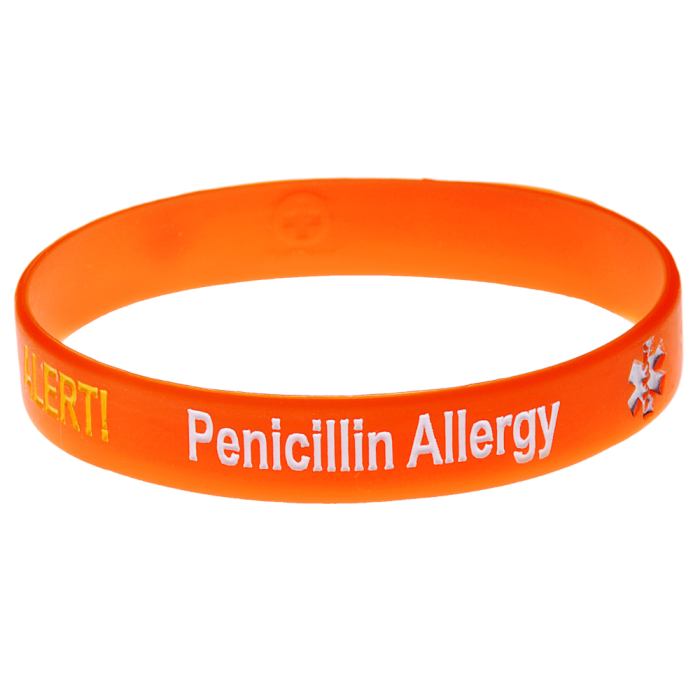
Penicillin Allergy Medical Bracelet
EUR 4.82
SKU
B0776
Secure checkout
VISA
Mastercard
Apple Pay
Google Pay
+5 more
Also accepted
AMEX
Afterpay
Zip
Klarna
PayPal
4.9 · 84 reviews
Since 2004
Penicillin Allergy Medical Alert Bracelet
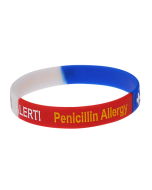
The Penicillin Allergy Medical ID Bracelet is a pre-printed orange silicone band for anyone with a confirmed allergy to penicillin or a related beta-lactam antibiotic. The wording ALERT! Penicillin Allergy is moulded into the band and colour-filled in yellow and white alongside the medical symbol, so it reads from a distance without being handled.
What it tells a treating team is short and actionable: do not reach for penicillin, amoxicillin, Augmentin or a related beta-lactam — choose another class. That is a decision made in the first minutes of emergency care, often before anyone has opened a chart.

Why a visible penicillin alert earns its place
A penicillin allergy sits in your file. The problem is the window before anyone reads the file.
The situations where it matters most
- Emergency surgery — routine surgical prophylaxis commonly uses a cephalosporin; a visible alert prompts the question before the drug is drawn up.
- Suspected sepsis — empirical therapy is started fast and often includes a beta-lactam.
- An unconscious or confused patient — nobody can be asked, so the band answers on their behalf.
- Admission and handover — the allergy gets onto the chart at minute one rather than minute forty.
- Away from home — interstate, overseas, or at any service that cannot see your usual records.
ASCIA, the peak professional body for clinical immunology and allergy in Australia and New Zealand, states on its penicillin allergy information page that where a true penicillin allergy is confirmed, the allergy should be recorded in hospital, doctor and pharmacy records and uploaded to My Health Record — and that you may also be advised to carry medical identification of your allergy. This band is that identification in its simplest form.
What this band shows — and what it cannot
This is a ready-to-wear, pre-printed alert band. The wording and symbol are fixed at manufacture. There is no engraving plate and no write-on panel, so you cannot add a name, a contact number or a second condition to it.
If you need your own details on the ID
Choose a Mediband Custom ID, made to order with your own text — engraved stainless steel and gold, or custom-printed silicone. If you would rather write the details yourself and change them when they change, our write-on bands have a panel for exactly that. Many people wear both: the fixed band for instant recognition, the custom one for the specifics.
If you are deciding how to word a custom ID, our guide to medical ID abbreviations covers which shorthand clinicians read reliably and which is better spelled out.
Choosing between the penicillin options
| Option | Wording | Pick it when |
|---|---|---|
| This band — orange alert | Fixed: ALERT! Penicillin Allergy | You want maximum readability at the lowest cost |
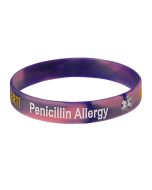
| Penicillin allergy swirl design | Fixed | You want it to look less clinical and still say the same thing |
| Write-on band | You add it | You need the specific drug, a reaction type or a contact number |
| Custom engraved ID | Made to order | You want a permanent, personalised ID in steel or gold |
Who should wear one
- Anyone with a confirmed penicillin allergy diagnosed or reviewed by a doctor
- People who have reacted to amoxicillin, Augmentin or another beta-lactam
- Anyone with a history of anaphylaxis to an antibiotic
- Children with a diagnosed penicillin allergy, particularly for school, camp and sport
- Anyone whose allergy is not yet reflected in the records of the service most likely to treat them
The de-labelling question — worth asking your GP
A penicillin allergy label is often applied on the basis of symptoms during a course of antibiotics — a rash, itching or an upset stomach — which ASCIA notes can lead to someone being labelled incorrectly. Where that label is wrong, it is not harmless: ASCIA states that an incorrect penicillin allergy label can result in longer treatment times, increased risk of side effects, and higher healthcare costs, because clinicians are pushed onto second-choice antibiotics.
What testing involves
Testing can include blood tests, skin tests and supervised antibiotic challenge. If the testing clears you, penicillins go back on the table for future infections. If it confirms the allergy, a specialist can advise whether other penicillins are still safe for you, and your doctor may provide an ASCIA Action Plan for Drug (Medication) Allergy.
The practical advice: if your label is decades old and has never been tested, ask your GP about a referral. Until that conversation has happened and a result is in hand, keep wearing the band — an untested label is still a label every treating clinician must work around.
How it gets used in practice
Checking wrists and neck for medical identification is part of a standard primary survey; we cover what that looks like in do paramedics check medical ID. On arrival the allergy is added to the chart, the treating team is briefed at handover, and an alternative antibiotic class is selected according to what is being treated.
The band is a prompt, not a prescription. It does not say which alternative to use — that is a clinical decision — and it does not replace telling every new doctor, dentist and pharmacist about the allergy. What it does is make sure the question gets asked when you are not in a position to raise it.
Sizing, materials and care
Medical-grade silicone with no metal parts and no clasp, in small, medium, large and extra large. Measure around the wrist and compare against our wrist measurement guide; you want it snug enough not to slide over the hand and loose enough to turn freely.
Keeping it readable
It is waterproof, so it stays on in the shower, the pool and the surf. Wash with warm water and mild soap, rinse after chlorine, salt water or sunscreen, and let it air dry. Replace it when the colour-fill has worn back far enough that the wording no longer reads at a glance — a faded band is a band that will be missed.
Ordering for a clinic, school or group
Single bands can be ordered from this page. For a clinic display, a school sick bay, an aged-care service or a community programme, tell us quantities and sizes and we will come back with pricing and a date.
Frequently asked questions
Can I put my name or phone number on this band?
No — the wording is moulded in and fixed. For personal details, use a write-on band or a custom engraved ID. Plenty of people wear the fixed band on one wrist and a custom ID on the other.
Does it cover cephalosporins and other related antibiotics?
The band names penicillin, which is the flag clinicians act on. Whether related classes are also unsafe for you is a question for your doctor or an immunologist, and the answer varies by person and by reaction history. If a specialist has told you to avoid a broader group, record that on a custom or write-on ID as well.
Should I keep wearing it if I have been told my allergy might not be real?
Yes, until testing has actually been done and you have the result. An untested label still governs what you can safely be given, so the band remains accurate right up to the day it is formally removed from your record.
Is it safe to wear in an MRI or during surgery?
It is silicone with no metal, so it has none of the problems a metal ID has around imaging. Theatre staff will still tell you what they want removed and when — follow their instruction, and make sure the allergy is on the chart before anything comes off.
How long does one last?
With everyday wear the silicone outlasts the colour-fill, so judge it on legibility rather than on age. Sun, chlorine and sunscreen are what dull it fastest. Check every few months and ask whether the words still read from a metre away.
Which other allergy bands do you make?
The full range is under allergy bracelets, with drug-specific bands grouped under drug allergy bracelets. Everything we make sits in medical alert bracelets.
SKU B0776Manufacturer Mediband
| SKU | B0776 |
|---|---|
| Manufacturer | Mediband |
Shipping
In-stock orders are dispatched the same business day when placed before 12pm AEST, Monday to Friday (excluding public holidays). Orders placed after 12pm AEST, or on weekends and public holidays, are dispatched the next business day.
Express, Regular and Courier delivery estimates are shown at checkout and apply from the dispatch date.
More information about shipment and delivery times can be found on our shipping page.
Returns & guarantee
100% Quality Guarantee. Your satisfaction is our priority. If there is a confirmed quality issue, return the item to us in its original condition and packaging within 14 days of receipt and we will issue a full refund (excluding the original delivery charge) or replace the item.
In-stock items may be exchanged for a different size or colour, provided they are returned as new, unworn and in their original packaging within 14 days of receipt.
Custom and made-to-order items are produced to your specification, so we do not accept returns or exchanges for change of mind, size or colour. Please check your size, colour, spelling and details carefully before ordering. First Aid Kits and Defibrillator Supplies also cannot be returned or exchanged except for a confirmed quality issue.
Please view terms and conditions for further information.
Loading reviews…
Frequently Asked Questions
Quick answers from the Mediband team
What is a penicillin allergy bracelet?
A medical alert bracelet engraved with 'Penicillin Allergy' that tells paramedics, anaesthetists, ED staff and surgeons to avoid penicillin, amoxicillin, augmentin and (in severe cases) all beta-lactam antibiotics.
Is penicillin allergy really that dangerous?
Yes for true IgE-mediated allergy — reactions range from severe rash to anaphylaxis and fatal cardiovascular collapse. Around 10% of Australians report a penicillin allergy; the bracelet ensures that warning reaches every clinician within seconds.
What if my 'allergy' was from childhood and I'm not sure?
Recent research suggests 90% of self-reported penicillin allergies are not true allergies — often a viral rash misattributed. Ask your GP for an immunologist referral to formally test and potentially de-label. Until then, keep wearing the bracelet.
Do I need to avoid cephalosporins too?
True penicillin allergy carries less than 1% cross-reactivity to modern cephalosporins (cefazolin, cefuroxime). However if you had anaphylaxis, the safer policy is 'avoid all beta-lactams' until allergist-cleared — engrave that on the bracelet.
Can children wear a penicillin allergy bracelet?
Yes — soft silicone is safe from age 3. Many Australian parents put one on their child with documented penicillin allergy for school, sport, sleepovers and any travel. Include 'See parent' or an emergency contact mobile.
Need multiple sizes — should I buy the 3-Pack?
If you need bracelets for a growing child, multiple family members, or a back-up spare, the Penicillin Allergy Medical Alert Bracelet 3 Pack bundles all three sizes (small, medium and large) at a discount — useful for families, caregivers, schools and clinics that need spares on hand.
Complete your order
Related products
Based on this product