
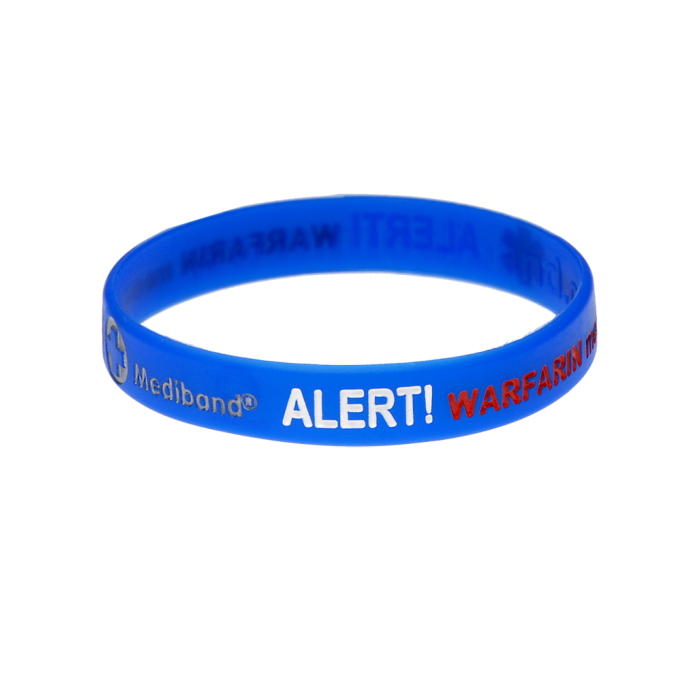
Warfarin Medicated Medical Bracelet
US$ 5.66
SKU
B0326


Enjoy life more knowing that you - or your loved one - can get immediate and appropriate treatment should something happen.
| SKU | B0326 |
|---|---|
| Manufacturer | Mediband |
Warfarin Medical Alert Bracelet — Anticoagulant ID
The Warfarin Medical ID Bracelet is essential safety wear for anyone on warfarin (Coumadin, Marevan), the most widely prescribed oral anticoagulant in Australia. In an accident, trauma or unconscious admission, paramedics need to know in seconds that you're warfarinised — it determines whether to administer vitamin K reversal, how to manage any bleeding, and which medications can be co-administered.
Around 100,000 Australians take warfarin daily for atrial fibrillation, mechanical heart valves, deep vein thrombosis prevention, or post-stroke care. For every one of them, this bracelet bridges the critical gap between the scene and your medication record.
Why a Visible Warfarin Bracelet Matters
Warfarin's bleeding risk changes every emergency decision:
- Trauma + head injury — immediate vitamin K + prothrombin complex concentrate if INR elevated
- Surgical intervention — reversal protocols + delayed procedure if elective
- GI bleed / haemorrhagic stroke — fast-track reversal vs slower workup
- Drug interactions — avoid NSAIDs, certain antibiotics, certain antifungals
- INR monitoring — ED will check INR on arrival, every 6 hours after reversal
Without the bracelet, ED staff may delay reversal until past medications can be confirmed — minutes that matter in active bleeding.
What to Engrave on a Warfarin Bracelet
- "Warfarin" (or "Coumadin" / "Marevan")
- Dose — e.g. "5mg daily" (optional but helpful)
- Indication — e.g. "AF" (atrial fibrillation), "Mech valve", "Post-DVT"
- Your name + emergency contact mobile
- (Optional) target INR range
Who Should Wear One
- Anyone on long-term warfarin (3+ months)
- Patients with mechanical heart valves (lifelong warfarin)
- Atrial fibrillation patients on warfarin
- Post-DVT / pulmonary embolism patients
- Stroke prevention patients (especially with antiphospholipid syndrome)
- Patients on bridging warfarin therapy
Warfarin vs DOACs — Why Bracelets Still Matter
Even with newer direct oral anticoagulants (DOACs — apixaban, rivaroxaban, dabigatran, edoxaban) gaining popularity, around 1 in 3 Australian anticoagulant users still take warfarin — especially for mechanical valves and certain renal patients where DOACs aren't suitable. The Warfarin bracelet specifically helps ED choose the right reversal agent (vitamin K + PCC) rather than the DOAC-specific reversals (andexanet, idarucizumab).
How Paramedics Read the Bracelet
Bright blue silicone + Star of Life makes "Warfarin" visible in seconds. Australian paramedic protocol on every trauma or unconscious patient call includes a medical ID check; the bracelet immediately upgrades bleeding management to high-priority and starts the reversal workflow.
Care & Sizing
Medical-grade silicone, fully waterproof, dishwasher-safe, 4-5 year lifespan. Available S/M/L/XL. Soft, smooth band suits thin wrists and elderly skin.
Related Mediband Medical Alert Bracelets
Frequently Asked Questions
Quick answers from the Mediband team
What is a warfarin bracelet?
A medical alert bracelet engraved with 'Warfarin' (Coumadin/Marevan) that tells paramedics and ED clinicians the wearer is on long-term anticoagulation. It triggers immediate vitamin K reversal protocols in active bleeding or trauma.
Why does Warfarin need its own bracelet vs a generic anticoagulant one?
The reversal agents differ: warfarin reverses with vitamin K + prothrombin complex concentrate (PCC), while DOACs (apixaban, rivaroxaban, dabigatran) need their own specific reversal agents (andexanet alfa, idarucizumab). Specifying 'Warfarin' speeds up the right treatment.
What should I engrave on a warfarin bracelet?
'Warfarin' (or brand name Coumadin/Marevan), dose if known, indication (AF, mechanical valve, post-DVT), your name, and one emergency contact mobile. Optional: target INR range.
Should I wear it during pregnancy?
Warfarin is contraindicated in pregnancy and replaced with LMWH (enoxaparin/Clexane) — so update the bracelet to 'Enoxaparin / Clexane' for the duration. Discuss the change with your obstetrician and haematologist.
What if I switch from warfarin to a DOAC?
Get a new bracelet immediately. Old engraved warfarin info on the bracelet during a DOAC emergency could lead to vitamin K reversal that doesn't work, delaying correct treatment. The Mediband Anticoagulant Alert bracelet covers all DOAC variants.
Related Products
Xarelto Medicated Medical Bracelet
US$ 5.66

Pacemaker Recipient Medical Bracelet
US$ 5.66