
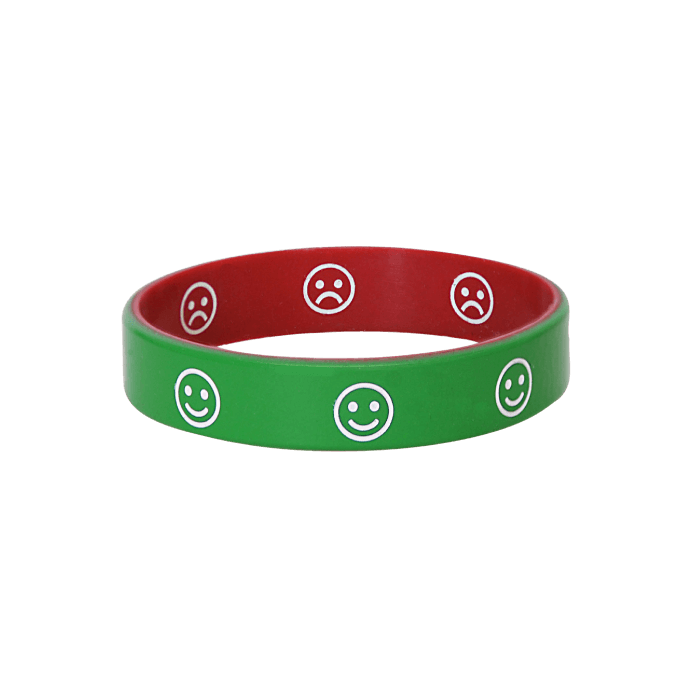
Emotion Bracelet
US$ 4.83
SKU
Emotion-Bracelet
Secure checkout
VISA
Mastercard
Apple Pay
Google Pay
+5 more
Also accepted
AMEX
Afterpay
Zip
Klarna
PayPal
4.9 · 1 reviews
Since 2004
Emotion Bands Help Kids Communicate Their Emotional State
Kids and parents of kids who struggle to communicate their emotions may find Emotion Bands helpful. Emotion Bands can be a simple way for them to communicate their general mood to those around them. Our silicone Emotion Band bracelets have two sides. One side has a red background and a frowning face, while the other side has a green background and a smiling face. These universal signals let kids show that they're comfortable with someone approaching them, or that they're overwhelmed and need help to calm down.
Who Can Use Emotion Bands?
Emotion Bands can be helpful for anyone. Some groups of people may find them particularly useful. These include:
- Kids who struggle with verbal skills when they are upset or stressed. They can simply flip their bracelet from green to red. This shows that they need time to calm down without needing to speak. It can signal to caregivers that they need access to accommodations in the moment.
- Kids who are non-verbal don't use spoken language but are still able to communicate. Emotion Bands give them a way to show those around them that they’re having a good day or a bad one. This helps them create independence and feel more in control.
When Are Emotion Bands Useful?
Emotion Bands can be useful in a variety of situations.
- Emotion Bands can help kids share their emotions in school settings, without disrupting the classroom. Flipping their bracelet can signal that they are becoming overwhelmed. This can alert an aide who can help them get to a space where they can regulate.
- Occupational and physical therapy can be hard for kids. They may get tired, upset, or frustrated. All these emotions can make it harder to communicate with words. Flipping the Emotion Band can signal the therapist that the kid needs a break, and also let them know when the child is ready to resume work.
- Emotion Bands could also find use in more customised ways if needed. When students need to show if they’re happy with a proposed solution or not, they could use the band to indicate that, for example.
How Do Kids Benefit From Emotion Bands?
Emotion bands are great for kids who struggle with communication. Even kids who have high verbal skills while they’re calm may find it hard to use verbal speech when they’re upset, physically uncomfortable, or out of their routine. Staff or caregivers may not realise that these kids need communication boards or other AAC tools at these times.
Emotion Bands can be an easy signal to those around a child to switch into a different mode of communication. They can better support the child to get what they need and access appropriate tools. When kids can communicate on their own, they have fewer inappropriate behaviours in school or therapeutic sessions and can connect more easily to the other kids and staff members around them.
Emotion Bands can also be useful at home. Some kids put in a lot of work during the day to get through and perform as well as possible. When they get home, they can feel exhausted, which can make it difficult to keep up with rules at home. Kids can use their bracelet on the way home to show how the day went. When parents know how their kids are feeling, they can make the right decisions about how to support their child throughout the evening.
These bracelets are not suitable for chewing; for kids who tend to chew on rubbery or silicone items, use these bracelets with caution. Emotion Bands are sold per piece.
The emotion bracelet is a silicone bracelet which allows the wearer to indicate how you feel so that people in the environment can take this into account. For example, if you are over-stimulated and do not want others to talk to you, you wear your bracelet with the red side (sad faces) displayed. If you are happy and you are open to be addressed, then flip the bracelet around and wear the green side (happy faces) upwards.
Sizing: Child size (The circumference is 180mm and the diameter is 60mm)
A Communication Bracelet for Kids
The Emotion silicone bracelet gives a child a simple, wearable way to share how they are feeling. They can flip the band or point to the printed emotion faces to signal happy, sad, worried, angry, tired or another need when words are hard to find. It can support non-verbal children, children building communication skills, or kids who need a quick visual prompt. It is an aid for everyday communication and routines, not a medical device or a substitute for professional advice.
Where It Helps
This communication wristband can be useful at school, in therapy settings, during transitions, and at home. Teachers, parents and carers can use it as a shared visual cue to start a conversation, check in gently, or help a child ask for support without needing to speak immediately.
Explore more kids bracelets or contact Mediband if you need help choosing a size or product option.
How does the emotion communication bracelet work?
The child wears the silicone band and points to, shows, or flips to the emotion face that best matches how they feel or what they need. It provides a quick visual prompt when speaking is difficult or when a child needs help explaining feelings.
What ages is it suitable for?
It is designed in kids sizes and may suit children who can safely wear a wristband and understand basic emotion pictures. Adult supervision is recommended, especially for younger children or any child who may chew, pull, or misuse wearable items.
Is the silicone bracelet washable?
Yes. The silicone band can be wiped clean with mild soap and water, then dried before wearing again. Avoid harsh chemicals, high heat, or abrasive scrubbing, as these may affect the printed design over time.
Can it be used for classroom sets?
Yes, it can be used as part of a classroom communication toolkit where appropriate. If you need multiple bracelets for a school, support unit, therapy practice, or program, please contact us to discuss availability and ordering options.
Can it support autistic children?
Some autistic children and other children with communication differences may find a visual wrist prompt helpful for showing feelings or needs. Every child is different, so it should be introduced in a way that suits the child, family, educators, and any supporting professionals.
How do I choose the right size?
Check the product size information and choose a kids size that sits comfortably on the wrist without being too tight or too loose. If you are unsure, measure the wrist and contact us before ordering.
Trusted since 2004: Mediband is an Australian medical-ID and support bracelet brand helping families, schools and organisations choose practical wristband solutions.
SKU Emotion-BraceletManufacturer Mediband
| SKU | Emotion-Bracelet |
|---|---|
| Manufacturer | Mediband |
Shipping
In-stock orders are dispatched the same business day when placed before 12pm AEST, Monday to Friday (excluding public holidays). Orders placed after 12pm AEST, or on weekends and public holidays, are dispatched the next business day.
Express, Regular and Courier delivery estimates are shown at checkout and apply from the dispatch date.
More information about shipment and delivery times can be found on our shipping page.
Returns & guarantee
100% Quality Guarantee. Your satisfaction is our priority. If there is a confirmed quality issue, return the item to us in its original condition and packaging within 14 days of receipt and we will issue a full refund (excluding the original delivery charge) or replace the item.
In-stock items may be exchanged for a different size or colour, provided they are returned as new, unworn and in their original packaging within 14 days of receipt.
Custom and made-to-order items are produced to your specification, so we do not accept returns or exchanges for change of mind, size or colour. Please check your size, colour, spelling and details carefully before ordering. First Aid Kits and Defibrillator Supplies also cannot be returned or exchanged except for a confirmed quality issue.
Please view terms and conditions for further information.
Loading reviews…