
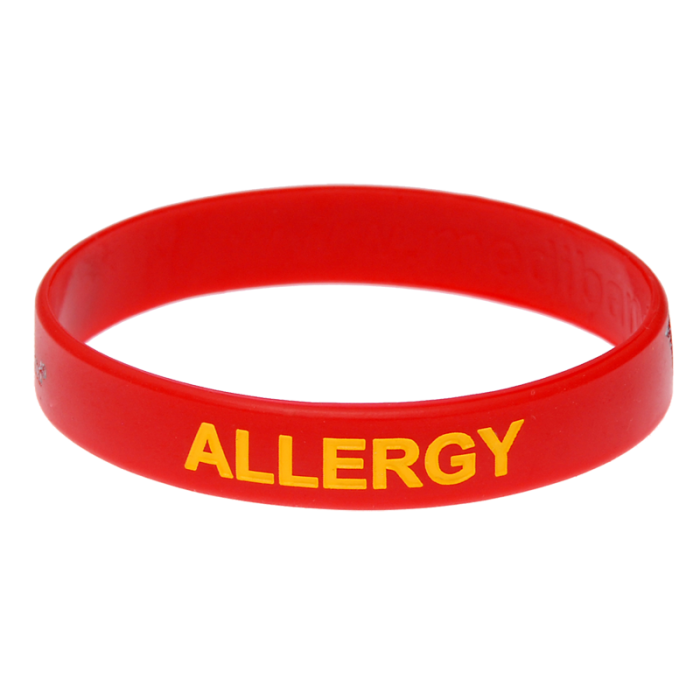
Allergy Alert Medical Bracelet
US$ 5.67
SKU
B0306
Secure checkout
VISA
Mastercard
Apple Pay
Google Pay
+5 more
Also accepted
AMEX
Afterpay
Zip
Klarna
PayPal
Enjoy life more knowing that you - or your loved one - can get immediate and appropriate treatment should something happen.
4.9 · 13 reviews
Since 2004
Looking for the full anaphylaxis & severe allergy guide?
The Anaphylaxis hub covers EpiPen/Anapen guidance, ASCIA Action Plans, school and travel scenarios, NDIS funding, and the full Mediband allergy product range — pre-printed to custom-engraved.
Allergy bracelet — the general alert band
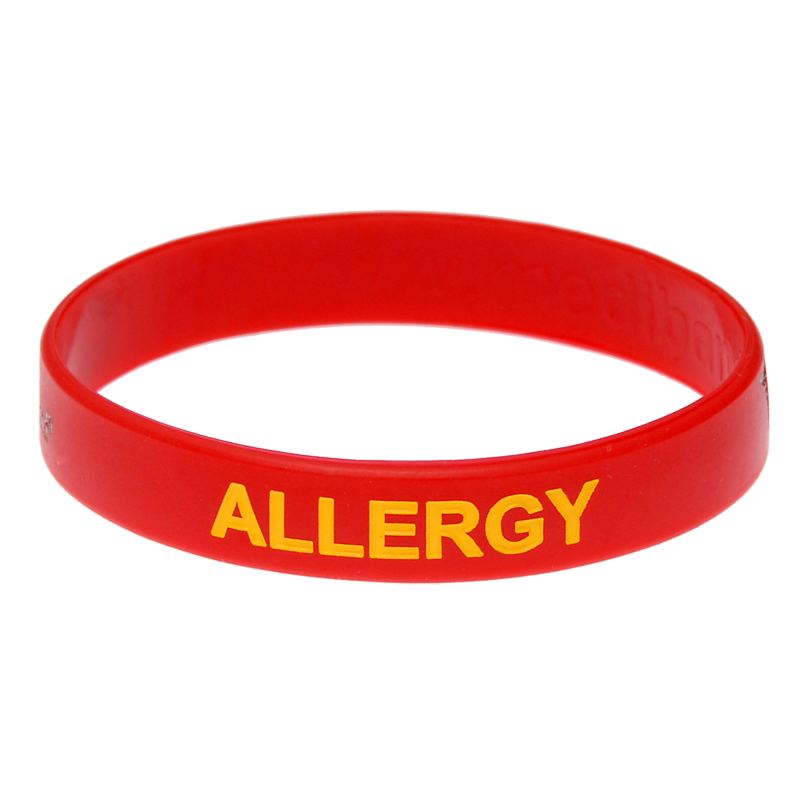
A red silicone band reading ALLERGY in yellow, with the Mediband and Star of Life marks moulded in. One piece, no clasp, no metal, waterproof, and readable from across a room.
It is the broadest band we make, and that is both its strength and the thing to understand before you buy it.
What it tells a responder — and what it does not
It tells them there is an allergy. It does not tell them to what.
For some situations that is exactly right. A child at school, a wearer with several unrelated allergies, someone newly diagnosed and still being worked up, or anyone whose main need is simply that nobody assumes they can be given anything — a general band covers all of that in one word.
For others it leaves the most useful fact unsaid. If one specific allergen is the one that will put you in an ambulance, a band naming it removes a question the treating team would otherwise have to answer first.
When a named band is the better buy
| Band | What it states | Choose it when |
|---|---|---|
| This band — ALLERGY | An allergy exists | Several allergies, or a diagnosis still being worked up |
| Nut allergy | The allergen | Food allergy where the trigger is known and fixed |
| Bee sting allergy | The allergen | Insect venom allergy, especially for outdoor work |
| Penicillin allergy | The drug | Drug allergy — changes prescribing immediately |
| Latex allergy | The allergen | Matters in every clinical setting, from gloves to catheters |
| Write-on allergy band | You add it | You want the specific trigger and a contact number |
The honest recommendation: if you have one allergen that matters most, name it. If you have several, wear this one and put the detail on a write-on band or a made-to-order Custom ID. The whole range is under allergy bracelets.
What a severe reaction looks like from outside
ASCIA, the peak professional body for clinical immunology and allergy in Australia and New Zealand, describes anaphylaxis as the most severe type of allergic reaction, states it should always be treated as a medical emergency, and that it requires immediate treatment with adrenaline — delayed treatment can result in fatal anaphylaxis.
The signs ASCIA lists as potentially life-threatening
- Difficult or noisy breathing
- Swelling of the tongue, or swelling and tightness in the throat
- Wheeze or persistent cough
- Difficulty talking, or a hoarse voice
- Persistent dizziness or collapse
- Pale and floppy, in young children
Any one of those is enough. Several of them — collapse, difficulty talking, an altered voice — are precisely the circumstances in which the wearer can no longer explain their own allergy. That is the moment the band is doing its job.
Milder reactions still matter
ASCIA also lists signs of a mild to moderate reaction, which in some cases happen before anaphylaxis: swelling of the lips, face or eyes, a tingling mouth, hives or welts. Those are the reactions where somebody noticing a band early can stop a situation escalating.
Why a visible band and not just a note in the file
An allergy recorded in a GP system, a hospital chart and a pharmacy record is three records that are all correct and all unreachable at a school fete, a restaurant or a roadside. The record answers the question once somebody knows to ask it; the band is what prompts the asking.
It also works on people who are not clinicians at all — a teacher, a coach, a colleague, the stranger who gets there first. None of them can open your file, and all of them can read one word on a wrist.
Who wears one
- Children at school, daycare and on excursions, where supervising adults rotate
- Adults with multiple allergies that do not fit on one named band
- People recently diagnosed and still identifying triggers
- Anyone carrying an adrenaline autoinjector
- Older adults, where a reaction may be mistaken for something cardiac
ASCIA notes on its drug allergy page that where an allergy is confirmed it should be recorded in hospital, doctor and pharmacy records — and that you may also be advised to carry medical identification of it. Checking wrists and neck for that identification is part of a standard primary survey, as we cover in do paramedics check medical ID.
What the band does not replace
It is an alert, not a plan. It does not replace an ASCIA Action Plan, a prescribed adrenaline autoinjector, or telling the adults around a child where that autoinjector is kept. ASCIA's instruction where anaphylaxis is suspected is to use the autoinjector immediately and then call triple zero (000) for an ambulance.
The band buys recognition in the seconds before any of that starts. Our anaphylaxis ID guide covers how the band, the plan and the autoinjector fit together.
Fit, wear and care
Sizing
Small, medium, large and extra large. Measure around the wrist and compare against our wrist measurement guide. Snug enough not to slide over the hand, loose enough to rotate and take a fingertip underneath. Re-measure a child's wrist each school year — an outgrown band is a common reason an ID stops being worn.
Care
Medical-grade silicone with no metal and no clasp, so it stays on in the shower, the pool and the surf, and causes no problems around imaging. Wash with warm water and mild soap, rinse after chlorine, salt water or sunscreen, and air dry. Replace it once the yellow infill has worn back far enough that the word no longer reads at a glance.
For schools, clinics and camps
Single bands can be ordered here. For a school sick bay, a general practice, a pharmacy counter, a camp or a childcare service, tell us quantities and sizes and we will come back with pricing and a date.
Frequently asked questions
Can I have my specific allergy added to this band?
Not to this one — the wording is moulded in and fixed. Use a write-on allergy band for a trigger you can add by hand, or a custom engraved ID for something permanent.
Is a general band good enough?
For multiple or still-unconfirmed allergies, yes — it stops anyone assuming you can be given anything. If one allergen is the dangerous one, a band naming it is better, because it answers the question rather than raising it.
Does it replace an action plan or an autoinjector?
No. ASCIA's advice where anaphylaxis is suspected is to use the adrenaline autoinjector immediately, then call triple zero (000). The band is what gets someone to that point faster.
Is it suitable for a young child?
Yes, in the small size, and it is one of the most common school bands for exactly that reason — a relief teacher or a parent helper who has not read the file can still read a wrist.
Can it be worn for sport and swimming?
Yes — waterproof silicone with nothing to catch or corrode. That matters for allergy specifically, because exertion is a recognised co-factor that can make a reaction more severe.
Can I wear two bands?
Plenty of people do — this one plus a named band, or one on each wrist. Two bands each saying one true thing are read faster than one crowded band.
SKU B0306Manufacturer Mediband
| SKU | B0306 |
|---|---|
| Manufacturer | Mediband |
Shipping
In-stock orders are dispatched the same business day when placed before 12pm AEST, Monday to Friday (excluding public holidays). Orders placed after 12pm AEST, or on weekends and public holidays, are dispatched the next business day.
Express, Regular and Courier delivery estimates are shown at checkout and apply from the dispatch date.
More information about shipment and delivery times can be found on our shipping page.
Returns & guarantee
100% Quality Guarantee. Your satisfaction is our priority. If there is a confirmed quality issue, return the item to us in its original condition and packaging within 14 days of receipt and we will issue a full refund (excluding the original delivery charge) or replace the item.
In-stock items may be exchanged for a different size or colour, provided they are returned as new, unworn and in their original packaging within 14 days of receipt.
Custom and made-to-order items are produced to your specification, so we do not accept returns or exchanges for change of mind, size or colour. Please check your size, colour, spelling and details carefully before ordering. First Aid Kits and Defibrillator Supplies also cannot be returned or exchanged except for a confirmed quality issue.
Please view terms and conditions for further information.
Loading reviews…
Frequently Asked Questions
Quick answers from the Mediband team
What allergies can I put on an allergy bracelet?
Food, nut, drug, penicillin, latex and bee or insect sting allergies — anything responders need to know fast.
Does an allergy bracelet help in anaphylaxis?
Yes — it alerts first responders to anaphylaxis risk immediately, even if you cannot speak.
Is engraving included on the allergy bracelet?
Yes — deep, permanent engraving of your allergies and emergency details is included.
Is the allergy bracelet waterproof and kid-friendly?
Yes — water-resistant and available in child sizes, ideal for school and daily wear.