Reversible Signature Medical ID – Classic Style by Mediband
£14.35
SKU
CRD01
Buy more, save more
QuantityPrice eachSave
1–3
£8.38
—
4–6
£6.41
−24%
7–9
£3.76
−55%
10–19
£3.05
−64%
20–39
£2.92
−65%
40–49
£2.67
−68%
50–99
£2.51
−70%
100–499
£2.29
−73%
500–999
£2.11
−75%
1000+
£1.79
−79%
Secure checkout
VISA
Mastercard
Apple Pay
Google Pay
+5 more
Also accepted
AMEX
Afterpay
Zip
Klarna
PayPal
Sleek, discreet, and always ready, the Reversible Signature Medical ID – Classic Style by Mediband offers personalised safety in a subtle design. With custom medical info hidden on the inside, it’s the ideal choice for dependable, understated protection.
4.9 · 45 reviews
Since 2004
Reversible Signature Medical ID — Classic Style designer medical alert bracelet
In short
A reversible medical ID in a single restrained colour. The outer face carries an In Case of Emergency line and the medical mark; your engraved details sit on the inner face. Breakaway-safe silicone, designed in Australia, NDIS-registered. Minimum order of 4.
Designed in Australia since 2004 | NDIS-registered | Seniors Card 15% off*
A medical ID that does not announce a diagnosis
There is a difference between an ID that can be found and an ID that is on display. The Classic Style is built for the first. In a single restrained colour, with an In Case of Emergency line and the medical mark on the outer face, it reads as a plain band across a meeting room — while a responder who looks at a wrist knows exactly what they have found.
Your own details go on the inner face, against the skin, where they are read by someone who has turned the band over and not by the person sitting opposite you at lunch.
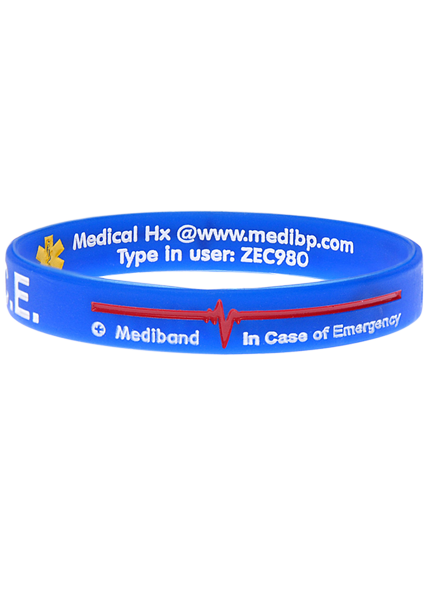
What the photograph is showing
That is a real customer's band, turned so both faces are visible. The outer carries the emergency line; the inner carries what they chose to engrave — in this case a pointer to their own online medical record and the username to open it. It is one approach among several. Plenty of people use the same space for a condition and a phone number instead, and both work.
Deciding what to engrave
This is the part that matters, and it is worth thinking about before you order, because engraving is permanent.
Lead with what changes the first decision
A responder is not reading a medical history. They are deciding what to do in the next two minutes. The facts that change that decision are a short list: the condition or allergy, a critical medication, an implanted device. Everything else is detail that belongs on a card, in a record, or in a conversation later.
The advice to carry identification is not just ours. ASCIA, the peak professional body for clinical immunology and allergy in Australia and New Zealand, states that where a drug allergy is confirmed you may be advised to carry medical identification of that allergy. The same logic applies to anticoagulation, insulin dependence and implanted cardiac devices.
Wording that gets read correctly
Spell out anything a non-specialist has to act on. Abbreviations save space but cost time if the person reading them has to decode first, and some are ambiguous between specialties. Our guide to medical ID abbreviations goes through which shorthand is safe and which is better written in full.
Contacts and languages
If you include an emergency contact, include the country code — a number that only works domestically is no help on a trip. Engraving is available in other languages, which is worth considering for a wearer whose first language is not English, or for travel; a second band in English covers local responders.
Classic or Vivid — picking between the two
The two finishes are identical in function. The difference is what the outer face is doing and who that suits.
| Classic Style (this one) | Vivid Style | |
|---|---|---|
| Outer face | Single restrained colour with an emergency line and medical mark | Bold saturated colour with a stripe and the Mediband mark |
| Reads as | A plain band; unobtrusive in professional settings | A sports or charity band |
| Usually chosen by | Adults in client-facing work, anyone who wants it to disappear | Children, teenagers, active adults |
| Engraving | Identical — your text, inner face | Identical — your text, inner face |
| Minimum order | 4 bands | 4 bands |
If you would rather the condition itself were visible from the outside, this is the wrong format — the Bold Alert Signature puts custom text on the outer face, and our pre-printed alert bands state a single named condition permanently at a lower price. Discretion is a real trade, and it is worth making deliberately rather than by default.
How a responder uses it
Checking wrists and neck for medical identification is part of a standard primary survey — we go through what that looks like in do paramedics check medical ID. The emergency line and the medical mark on the outer face are what classify the band as an ID rather than as jewellery, which is the step that prompts anyone to turn it over.
That is the one dependency a reversible format has, and it is worth being honest about it: the information is only read if the band is recognised first. That is precisely why the outer face is not blank.
Why four bands
The most common way a medical ID fails is not that it was the wrong design. It is that it came off for a shower, a swim or a shift, and never went back on.
Where the four tend to go
One worn, one in the bag, one in the car or the bedside drawer, one spare. A replacement within reach turns a lost band into a one-minute problem instead of a two-week gap. You can mix colours across the order, and each band can carry different engraving — useful when you are buying for more than one person in a household.
Material, fit and care
Breakaway-safe silicone
A single piece of soft silicone with no clasp and no metal. It stretches over the hand to go on and gives rather than holds if it snags — which matters around machinery, in care settings and for children. No metal also means nothing to corrode in a pool and no question to answer in an imaging suite.
Getting the size right
Measure around the wrist and compare against our wrist measurement guide. Snug enough that it will not slide over the hand, loose enough to rotate freely and take a fingertip underneath — and on a reversible band, free rotation is not cosmetic, because turning it is how it gets read.
Care
Wash with warm water and mild soap, rinse after chlorine, salt water or sunscreen, and air dry away from direct heat. The engraving is cut into the silicone rather than printed onto it, so it does not scuff off — but check the inner face occasionally, since that is the one that has to stay legible.
Funding, discounts and ordering
Mediband is NDIS-registered and medical ID can be funded under a participant's plan — our NDIS page explains how. There is aged care funding information if you are buying for an older person, and a Seniors Card discount that applies year-round.
There is no subscription and no membership on any Mediband product. What is engraved on the band is what the band says, with nothing to renew and nothing to lapse — we set out why on medical ID without a subscription.
Buying for a clinic, a disability service, an aged-care provider or a workplace? Tell us quantities and what the engraving needs to carry, and we will come back with pricing and a date.
Frequently asked questions
Will a responder know to turn it over?
The emergency line and the medical mark on the outer face are what signal that it is an ID. If you would rather not depend on that step at all, choose a band that carries the information on the outside — the Bold Alert Signature or a pre-printed alert band.
Can each band say something different?
Yes, and colours can be mixed within the order of four. Households buying for more than one person do this routinely — just tell us what each band needs to say.
Can I link to an online record instead of listing conditions?
Some people do, as the photograph above shows. It fits more information into less space, but it depends on whoever finds you having a phone, signal and the patience to type an address. A hybrid works well: the critical fact engraved plainly, plus a pointer for the detail.
What if my medication or contact changes?
Engraving is permanent, so a changed detail means a new band — one reason the minimum order is four. If your prescriptions change often, a write-on band you update by hand may suit you better for now, with an engraved band ordered once things settle.
Is it suitable for someone in aged care or a disability service?
Yes, and the breakaway-safe construction is usually the deciding factor — no clasp, no metal, and it gives if it catches. See our aged care funding and NDIS pages for how it can be paid for.
Is there an ongoing fee?
No. No subscription, no membership, no database to keep paying for. The band is the whole purchase.
Related: Bold Alert Signature | Reversible Signature — Vivid | Design your own | All medical alert bracelets
*The 15% Seniors Card discount applies year-round to all products and stacks with the out-of-pocket pathway. It does not stack with NDIS-funded orders, the pharmacy discount or the affiliate program discount.
SKU CRD01Manufacturer Mediband
| SKU | CRD01 |
|---|---|
| Manufacturer | Mediband |
Shipping
Production time: 7-14 business days
Express, Regular & Courier shipping estimated times are displayed at check-out. These time estimates must be added to the above production time estimates.
Contact Mediband today if you require expedited production for your custom order. This must be confirmed in advance of your order being received. More information about shipment and delivery times can be found please visit shipping page.
Returns & guarantee
100% Quality Guarantee. Your satisfaction is our priority. If there is a confirmed quality issue, return the item to us in its original condition and packaging within 14 days of receipt and we will issue a full refund (excluding the original delivery charge) or replace the item.
In-stock items may be exchanged for a different size or colour, provided they are returned as new, unworn and in their original packaging within 14 days of receipt.
Custom and made-to-order items are produced to your specification, so we do not accept returns or exchanges for change of mind, size or colour. Please check your size, colour, spelling and details carefully before ordering. First Aid Kits and Defibrillator Supplies also cannot be returned or exchanged except for a confirmed quality issue.
Please view terms and conditions for further information.
Loading reviews…
Frequently Asked Questions
Quick answers from the Mediband team
How does a reversible medical ID bracelet work?
Your chosen colour faces out. Flip the band and your custom-engraved emergency details and the Star of Life face up for a responder.
What can I have engraved on it?
Your condition, medication, allergy and emergency contact, plus the Star of Life, engraved on the alert side.
Will people know it is a medical ID?
Only when needed. The fashion side looks like a normal band; the medical alert stays on the reverse until a responder flips it.
Is it waterproof and comfortable for everyday wear?
Yes. It is skin-friendly, water-resistant silicone with a breakaway-safe fit, made for everyday wear, sport and sleep.
What is the minimum order?
Four per design. It is a low minimum, so it is easy to keep a spare or order for the whole family.
How long does a custom order take?
Lead time depends on quantity. A typical order is around 10-14 business days; larger runs take longer, and quicker turnarounds are available on application.
Complete your order
Related products
Based on this product
You might also like
Type 1 Diabetes For Dummies
£23.33